

An ecommerce UX audit can cost $2,250 for a fixed conversion report, €2,500 to €15,000 for a specialist studio engagement, or $30,000 and up for a research-heavy enterprise program. Those are published provider examples from Oddit and BTNG, not universal market averages or DesignX rates.
The useful number depends on the buying decision the audit must support. A checkout review, a full-store diagnosis, and an implementation-ready roadmap require different evidence, people, and time.
- Pay for a focused review when one flow is underperforming and your team can design the fix.
- Add analytics and session evidence when you need to separate visible friction from revenue risk.
- Add user research when behavioral data cannot explain why shoppers hesitate.
- Buy implementation-ready design when your team needs validated Figma work, priorities, and engineering constraints.
DesignX approaches an ecommerce UX audit as a scope decision before it becomes a design project. The goal is to find the smallest investigation that gives your team enough confidence to act. That boundary matters because an audit can expose a broken mobile product page without including the production design or code needed to repair it.
What does an ecommerce UX audit cost?
Published ecommerce UX audit prices span a wide range because sellers package different work under the same label. Oddit publishes Conversion Reports starting at $2,250 and describes broader single-product audit programs from $5,000 to $25,000. BTNG publishes a €2,500 to €15,000 specialist-studio range, with lower-cost heuristic work and higher-cost agency programs outside that band.
Use these figures as proposal examples. They do not prove a market average, and currency, geography, store complexity, research depth, and deliverable format change the quote. A useful proposal names the flows, evidence, outputs, timeline, and implementation boundary.
| Published example | Provider-stated price | What the provider says is included | Buyer check |
|---|---|---|---|
| Oddit Conversion Report | Starts at $2,250 | Analytics review, prioritized issues, dev-ready designs, and a sequenced roadmap | Confirm the number of pages, concepts, and revision rounds |
| BTNG audit-only engagement | €2,500 to €5,000 | Core store-page heuristics, funnel review, tracking review, and competitor benchmarks | Confirm access needs and whether research participants are included |
| BTNG audit plus implementation-ready redesign | €5,000 to €15,000 | Audit findings plus redesigned components and implementation support | Confirm which findings receive design work |
| Oddit enterprise program example | $30,000 to $75,000+ | Broader research, stakeholder work, compliance review, and a multi-quarter roadmap | Confirm why enterprise process is necessary for this store |
A general audit-cost guide can help you compare methods. Our guide to how much a UX audit costs covers wider product and SaaS engagements. Ecommerce needs a tighter lens because catalog structure, merchandising, search, checkout ownership, returns, and platform limits all affect the work.
Six factors that change ecommerce UX audit cost
Two stores with similar revenue can receive different quotes for sound reasons. The auditor needs to know how many journeys require review and how much evidence your team can provide.
1. Catalog and template complexity
A 20-product direct-to-consumer store may use a homepage, collection page, product page, cart, and checkout. A distributor can have tens of thousands of SKUs, layered taxonomy, account pricing, quote requests, substitutes, and technical product data. DesignX saw this complexity firsthand in its work with Klein Tools and a catalog of more than 40,000 SKUs. Large catalogs turn navigation and product discovery into system problems.
2. Number of markets and buyer types
International stores add currencies, languages, tax expectations, delivery rules, and payment methods. B2B commerce adds account catalogs, approval chains, bulk ordering, and repeat-order behavior. Each buyer path adds states that an auditor must inspect.
3. Platform and checkout ownership
Shopify, Shopify Plus, Adobe Commerce, BigCommerce, and custom storefronts expose different control points. A recommendation has little value if the team cannot implement it inside the platform, theme, app stack, or checkout plan. Atwix describes platform feasibility as part of its ecommerce audit process, including Shopify, Adobe Commerce, Magento, Shopware, and BigCommerce.
4. Evidence depth
A heuristic review asks an expert to inspect the experience against established patterns. A data-backed audit adds funnel analytics, site search terms, session recordings, support tickets, returns, reviews, and experiment history. Research-backed work can add interviews or usability sessions. Each layer answers a different question and raises the cost.
5. Device and journey coverage
Mobile commerce deserves its own testing pass. Search, filters, product media, variants, sticky controls, cart changes, address entry, and payment methods behave differently on a small screen. The quote should state which devices and journeys the team will test.
6. Deliverable depth
A report can stop at findings, or it can include redesigned components, prototypes, experiment plans, technical notes, and implementation sequencing. Ask which recommendations become design work. A lower audit fee can create a second procurement cycle if your internal team cannot turn observations into shipped changes.
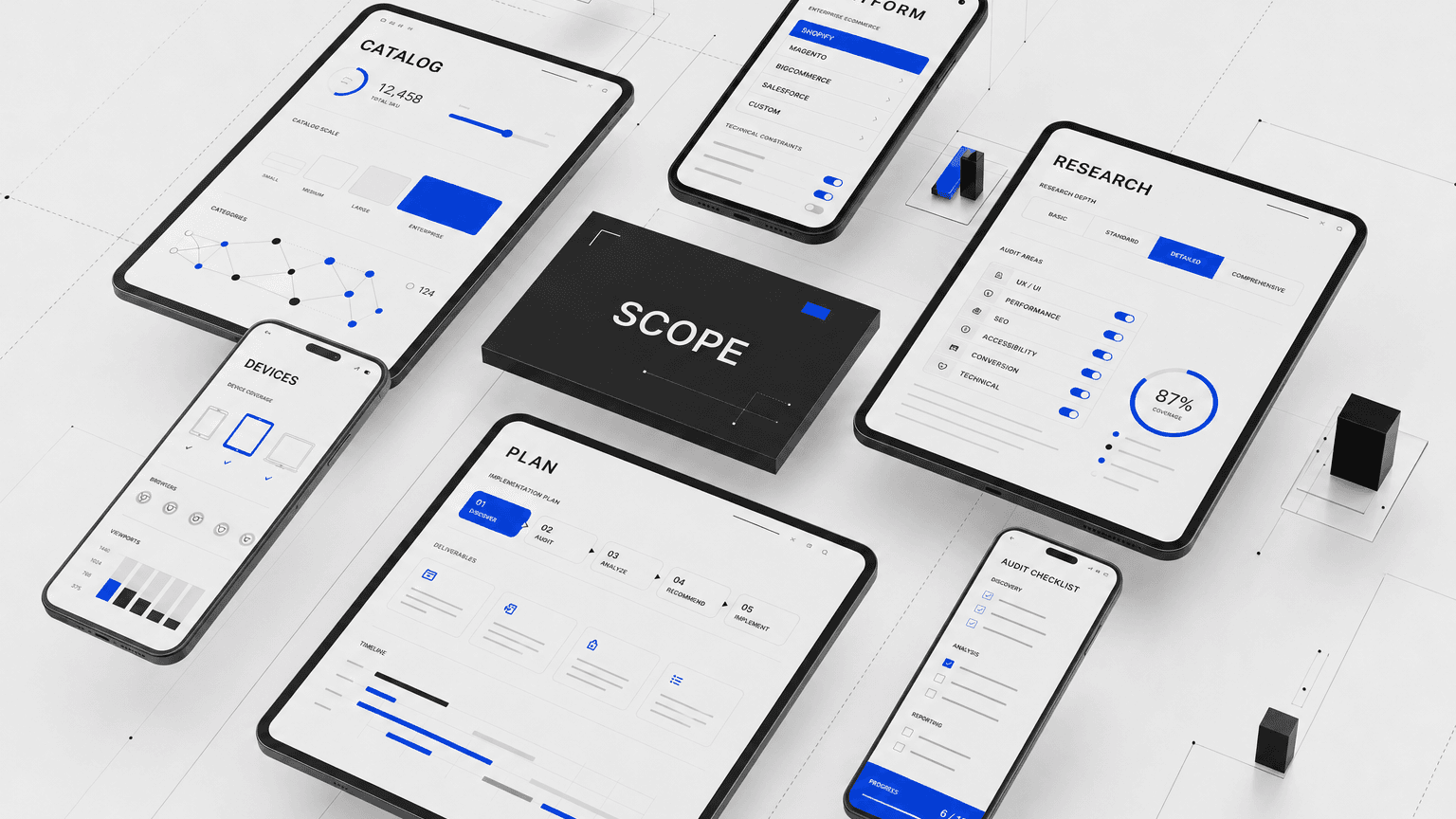
Choose the smallest ecommerce UX audit tier that can answer the decision
Budget follows uncertainty. Start with the decision your team cannot make today, then buy enough evidence to make it.
Focused heuristic review
Choose a focused review when one journey has an obvious problem, such as mobile PDP comprehension or checkout form friction. Your team should already have clean analytics and the capacity to design and build the fixes. The output needs issue severity, screenshots, rationale, and clear ownership.
Analytics-led store audit
Choose an analytics-led audit when you know revenue leaks somewhere between landing, product discovery, cart, and payment. The auditor should review funnels by device and traffic source, then connect observed friction to drop-off evidence. This tier fits teams that need a ranked backlog before they spend on design.
Research-backed audit
Choose research when analytics show where shoppers leave but cannot explain why. Five carefully recruited sessions can reveal language, trust, product-selection, and checkout problems that event data cannot name. Recruitment, facilitation, synthesis, and recordings should appear in the proposal.
Implementation-ready audit
Choose implementation-ready work when the audit must move into sprints without another design engagement. Expect annotated Figma concepts, component states, copy direction, platform notes, acceptance criteria, and a sequence based on impact and effort. This tier often costs more because the team is solving and specifying the fix, not only diagnosing the problem.
If your team is comparing partners rather than audit tiers, use our ecommerce UX design agency guide to evaluate commerce experience, implementation ownership, and proof.
Evidence to prepare before requesting an ecommerce UX audit quote
A prepared evidence pack reduces discovery time and exposes tracking gaps before the engagement clock starts. Bring the following:
- GA4 or another analytics source with product-view, add-to-cart, checkout-start, payment, purchase, and error events
- Site-search terms, zero-result queries, filter usage, and collection exits
- Support tickets, returns reasons, reviews, chat logs, and sales-team notes
- Session recordings or heatmaps with consent and privacy controls in place
- Experiment history, past redesigns, campaign landing pages, and known tracking changes
- Platform, theme, apps, checkout plan, international markets, and engineering constraints
Weak tracking does not make an audit impossible. It changes the first deliverable. The auditor may need to define measurement and collect evidence before making high-confidence recommendations.
What an ecommerce UX audit should deliver
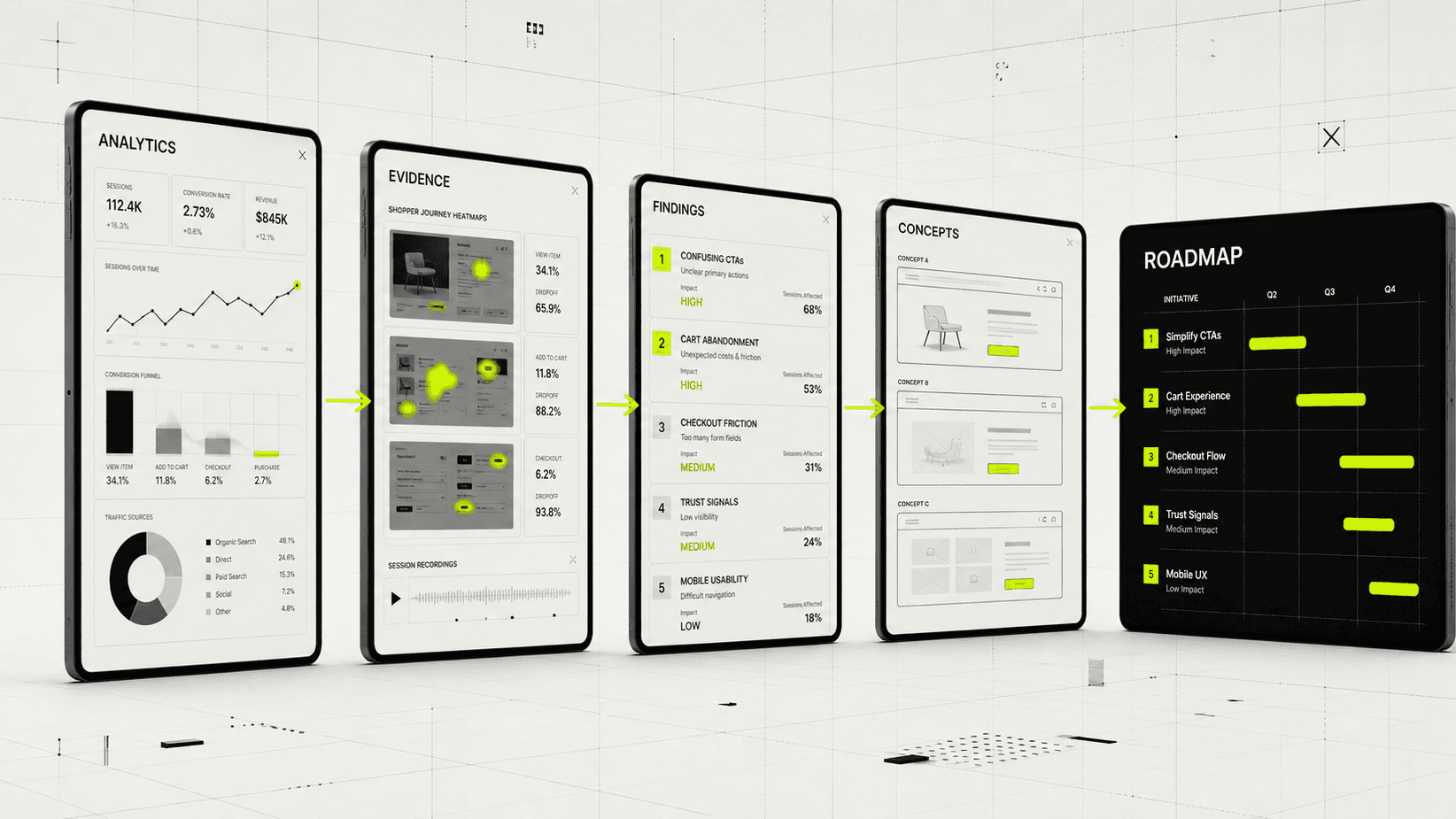
Atwix says its ecommerce audit output ranks friction by revenue impact and implementation effort. Baymard describes a research-backed audit with prioritized improvements, a presentation, and implementation advisory calls. These examples share a useful idea: the buyer needs a decision system, not a gallery of screenshots.
A strong deliverable set includes:
- Scope map: pages, journeys, segments, devices, markets, and exclusions.
- Evidence record: the data, sessions, research, and heuristics behind each finding.
- Prioritized issue inventory: severity, affected users, business risk, confidence, and effort.
- Recommendation detail: the change, rationale, dependencies, and success measure.
- Implementation roadmap: quick fixes, design work, engineering work, experiments, and owners.
- Readout: a working session where stakeholders can challenge findings and agree on the next sprint.
For product-page-specific work, our ecommerce product page design guide shows the evidence shoppers need around product fit, trust, delivery, and selection.
How to judge whether the audit can pay back
Use a scenario, not a promised uplift. Start with monthly sessions, purchase conversion, average order value, and gross margin. Model a small change in one target step, then subtract implementation cost and the audit fee.
Baymard reports a 70.22% average cart abandonment rate across 50 studies. Its research also reports that 17% of surveyed US shoppers abandoned an order because checkout felt too long or complicated. Those figures establish that checkout friction exists across the category. They do not predict the lift your store will receive.
Ask the auditor to mark confidence for each recommendation. A finding backed by your funnel data and repeated session evidence deserves different treatment from a heuristic concern with no behavioral signal. That distinction keeps the roadmap honest.
When to skip the audit and move into redesign
Skip a broad audit when the problem and solution boundary are already clear. A broken mobile navigation, obsolete theme, inaccessible checkout customization, or unsupported platform can make another report wasteful. Run a short validation pass, define the risk controls, and scope the redesign.
Move into targeted redesign when:
- prior research already identifies the failed journey
- the platform change forces new templates or checkout behavior
- the brand and product story have changed enough to invalidate the current experience
- your team lacks the design capacity to act on audit findings
Our Shopify redesign cost guide can help when the work has moved beyond diagnosis. For a narrower product/service audit model, see the DesignX UX audit service guide.
How DesignX scopes ecommerce UX audit work
DesignX starts with the decision, the evidence already available, and the team that must implement the result. We inspect product discovery, PDPs, cart and checkout, mobile behavior, content, accessibility, analytics, and platform constraints only where they affect the agreed scope.
The best fit is a commerce team with traffic, a measurable buying problem, and the capacity to ship. DesignX can connect brand, UX, web design, and implementation thinking, so the roadmap does not end at a generic recommendation.
Need a defensible scope before committing to a redesign? Review the DesignX engagement options and bring your funnel data, store constraints, and the decision your team needs to make.
Frequently asked questions about ecommerce UX audit cost
How much should a small ecommerce store spend on a UX audit?
A small store should buy the narrowest review that can change a decision. A focused heuristic review can make sense when one flow is failing and the team can implement recommendations. Published provider examples start around $2,250 at Oddit, while BTNG lists lower-cost freelancer and specialist options in euros. Confirm scope rather than treating either figure as a market average.
Does an ecommerce UX audit include redesign work?
Some audits stop at findings and priorities. Others include wireframes, Figma concepts, prototypes, copy direction, and platform notes. The proposal should state which findings receive design work, how many concepts are included, and whether the output is ready for engineering.
How long does an ecommerce UX audit take?
Provider timelines vary by scope. Atwix says most of its UX/UI audits run two to three weeks, BTNG describes 10 to 15 business days for a scoped audit, and Baymard lists about 15 to 25 business days for a full-site audit. Access delays, missing analytics, research recruitment, and multi-market coverage can extend delivery.
What data does an ecommerce UX auditor need?
Useful inputs include funnel events, device and traffic segments, site-search terms, support tickets, return reasons, session recordings, reviews, experiment history, and platform constraints. The auditor should explain how each source changes the confidence or priority of a finding.
Should I audit the whole store or only checkout?
Audit checkout when the evidence points to payment, shipping, account creation, form errors, or checkout trust. Audit the wider store when shoppers fail earlier during discovery, product comparison, variant selection, or cart building. The scope should follow the first meaningful break in the buying journey.
Can a UX audit guarantee a conversion lift?
No credible audit can guarantee a lift. Traffic quality, pricing, inventory, product demand, engineering quality, and implementation choices affect the result. Ask for evidence confidence, a measurement plan, and testable recommendations instead of a promised percentage.