
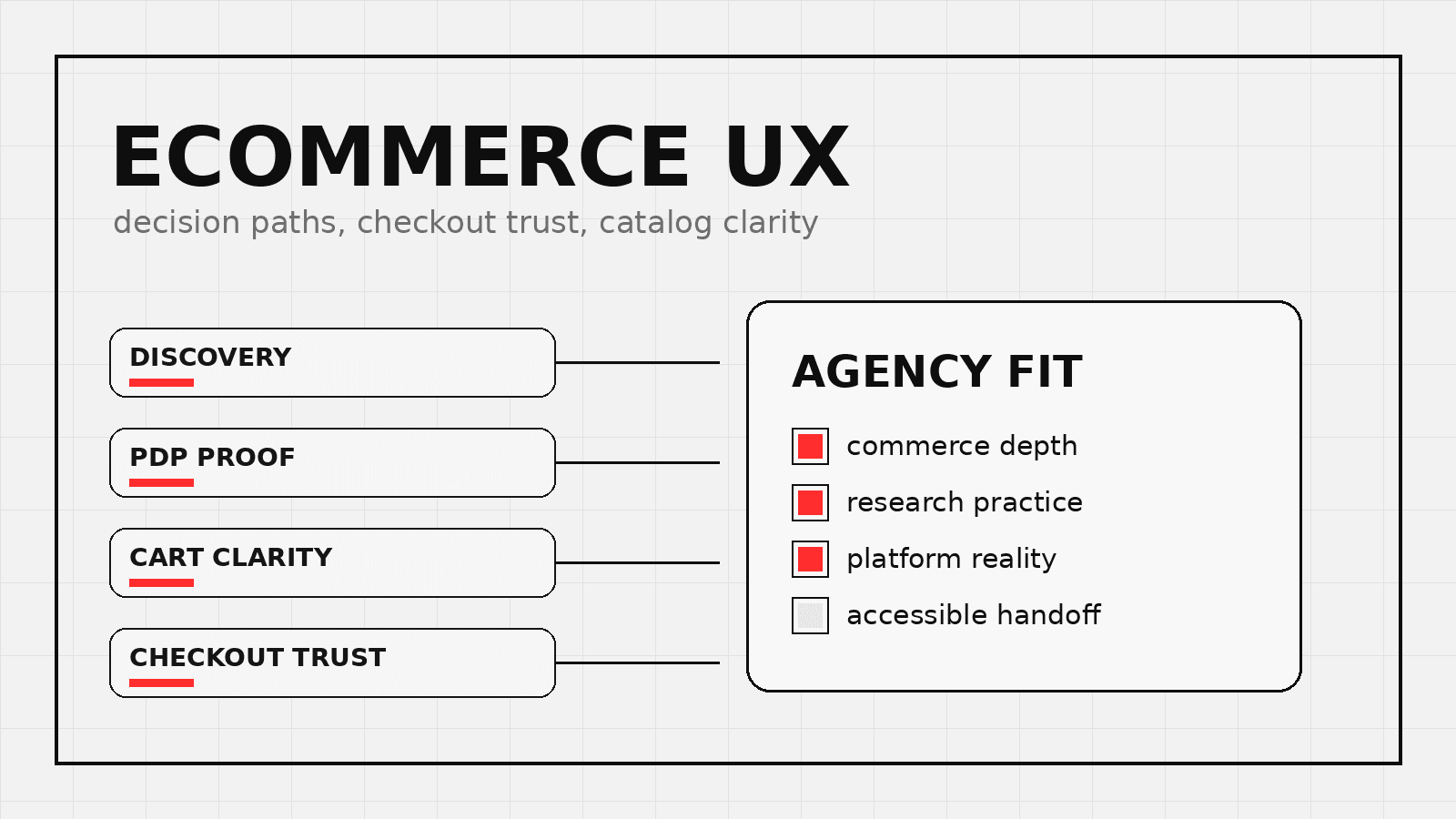
An ecommerce UX design agency should help your team find and fix the product discovery, product detail, cart, checkout, and post-purchase friction that blocks revenue. The right partner brings senior UX judgment, commerce pattern fluency, analytics thinking, accessibility discipline, and enough engineering empathy to design work your platform team can ship.
DesignX approaches ecommerce UX through the same lens we use on complex catalog and product-system work: make large product experiences easier to understand, easier to compare, and easier to buy from. The goal is not a prettier store. The goal is fewer buyer doubts at the exact moments where shoppers decide to keep moving or leave.
- Hire for commerce judgment, not generic portfolio polish.
- Ask how the agency handles PDPs, filtering, carts, checkout, accessibility, and design handoff.
- Look for a testable roadmap tied to analytics and user behavior.
- Avoid teams that jump into visual redesign before studying where revenue leaks.
- Expect a senior ecommerce UX design agency to challenge your brief when the data points somewhere else.
What an ecommerce UX design agency should actually fix
A good ecommerce UX design agency does more than restyle your homepage. Most revenue friction lives deeper in the buying path: category pages that hide the right product, filters that do not match how people shop, PDPs that leave size or compatibility questions open, carts that surprise buyers, and checkout steps that create anxiety.
Baymard reports that the average documented online shopping cart abandonment rate currently sits at 70.19%. That does not mean design alone fixes every abandoned cart. It does mean cart and checkout UX should be treated as a revenue system, not a cosmetic screen set.
The agency should be able to work across five parts of the commerce experience:
- Product discovery: navigation, search, filters, merchandising, and comparison paths.
- Product decision support: PDP hierarchy, images, specs, reviews, compatibility, sizing, policies, and variant states.
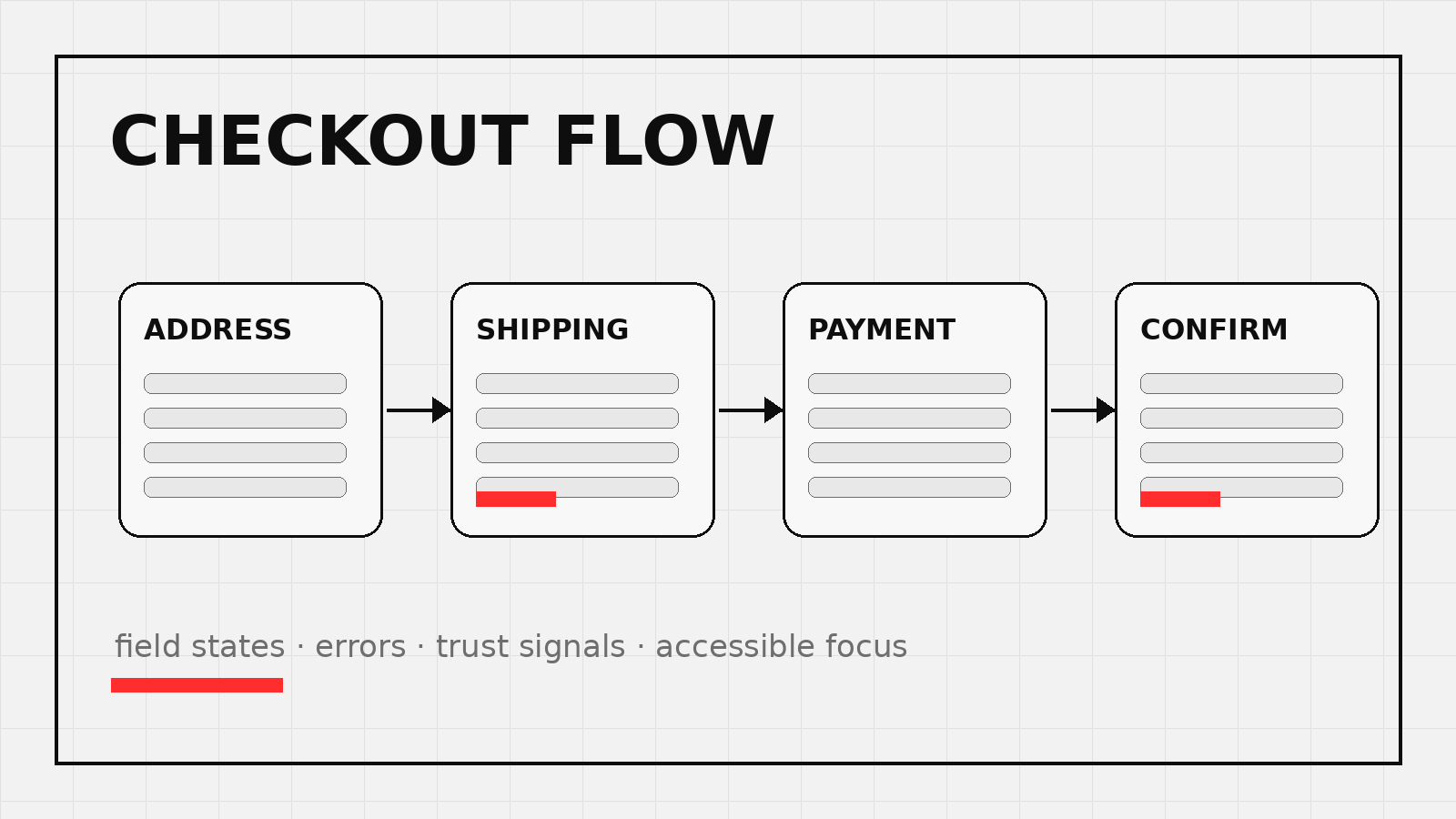
- Cart and checkout: address flows, payment trust, delivery clarity, field design, error recovery, and account options.
- Accessibility and performance: WCAG-aligned interaction states, keyboard paths, content contrast, speed, and stability.
- Design handoff: Figma systems, component logic, annotation, QA support, and practical constraints for Shopify, Magento, WooCommerce, headless commerce, or custom builds.
If an agency only talks about moodboards and homepage concepts, keep looking. Commerce UX is where brand, inventory, trust, merchandising, and platform constraints collide.
When an ecommerce UX design agency is the right hire
You do not need an agency every time a button needs work. You need one when the problem crosses functions and your internal team keeps circling the same debates.
An ecommerce UX design agency is usually the right hire when one or more of these are true:
- Your traffic is strong, but PDP-to-cart or cart-to-order rates are flat.
- Your catalog has grown past the navigation model you launched with.
- Your team has analytics data, but no shared view of what to fix first.
- Your Shopify, Magento, or headless stack limits what design ideas can become real.
- Your buyers need more proof, comparison help, or technical detail before purchase.
- Your brand has improved, but the shopping flow still feels like an old template.
For more focused product page problems, DesignX already covers tactical PDP issues in our guide to ecommerce product page design. This article is broader. It is for teams choosing a partner who can shape the whole commerce experience, from the first category click to the order confirmation state.
How to evaluate ecommerce UX design agency candidates
Start with the work, but do not stop there. Ecommerce portfolios can be misleading because the final screenshots hide the hard parts: analytics tradeoffs, technical constraints, stakeholder conflict, and post-launch learning.
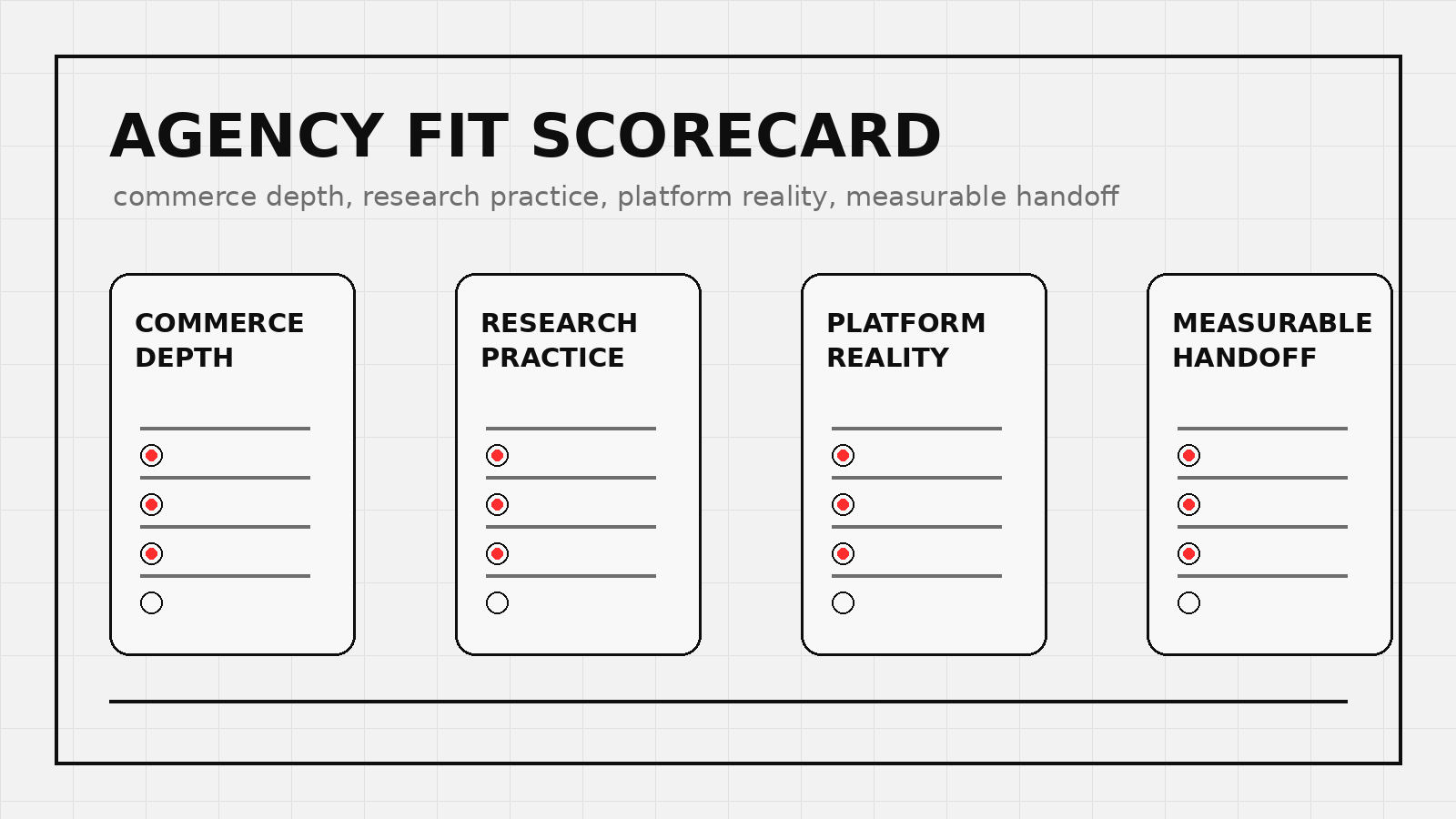
Use this scorecard before you book calls:
| Evaluation area | What to look for | Warning sign |
|---|---|---|
| Commerce depth | Examples of PDPs, PLPs, cart, checkout, account flows, B2B buying, or large catalogs | Only homepage redesigns and campaign pages |
| Research practice | Analytics review, session review, usability testing, support tickets, search logs, and customer interviews | They start with style exploration only |
| Platform reality | They ask about Shopify, Magento, WooCommerce, headless architecture, apps, checkout limits, and release process | They promise anything before seeing the stack |
| Accessibility | They reference WCAG 2.2, focus states, contrast, keyboard paths, form errors, and accessible component behavior | They treat accessibility as a final QA pass |
| Measurement | They define leading metrics by funnel stage before design starts | They talk only about launch date and deliverables |
| Handoff | They show component states, specs, responsive rules, and design QA process | They hand over flat mockups and disappear |
The point is not to create the longest possible shortlist. The point is to remove teams with no evidence of commerce-specific thinking.
The agency questions that reveal the real partner
Discovery calls should feel practical. A senior team will ask about margins, product categories, mobile share, return reasons, support volume, top search terms, abandoned checkout patterns, shipping rules, platform limits, and what your team has already tried.
Ask these questions and listen for specificity:
- Where do ecommerce redesigns usually fail? Good answers mention scope creep, weak measurement, checkout limits, merchandising politics, content gaps, and slow engineering handoff.
- How do you decide what to fix first? Look for a mix of analytics, behavior evidence, customer language, heuristic review, and business impact.
- What do you need before designing? They should ask for analytics access, platform constraints, product data, prior experiments, audience segments, and team roles.
- How do you handle checkout if the platform restricts changes? A serious partner can separate native checkout limits from areas still under your control.
- How will design become shippable? Listen for component systems, responsive states, QA rituals, and developer collaboration.
- What will you refuse to do? The best agencies have boundaries. They will not redesign a revenue path from taste alone.
NN/g maps UX research methods across attitudinal versus behavioral, qualitative versus quantitative, and context of use dimensions. That matters in ecommerce because surveys alone can tell you what shoppers say, while product analytics and usability sessions show where they hesitate, misread, or abandon.
What should be in the scope
A strong ecommerce UX scope usually includes more than wireframes. The work should produce a prioritized path from diagnosis to shipped change.
For a commercial ecommerce project, we would expect a scope to include:
- A conversion and journey audit across product discovery, PDP, cart, checkout, account, and support touchpoints.
- Analytics review by device, channel, category, and funnel stage.
- Voice-of-customer review from support tickets, reviews, on-site search, and returns data.
- Competitive pattern review, with notes on what to copy, what to avoid, and what your category requires.
- UX recommendations ranked by buyer impact, technical effort, and business risk.
- Prototype work for the highest-value flows.
- UI system updates for reusable commerce components.
- Developer-ready handoff, responsive specs, and design QA support.
This is where a product design sprint process can help if the team needs fast alignment before a bigger build. For ongoing experimentation, pair the sprint with the principles in our conversion rate optimization UX guide.
Performance and accessibility are part of ecommerce UX
Do not separate UX from speed and access. Google’s Core Web Vitals documentation says a good user experience should have LCP within 2.5 seconds, INP below 200 milliseconds, and CLS below 0.1.
Those are not just SEO talking points. Slow image galleries, jumpy PDP content, delayed cart drawers, and heavy scripts make shoppers doubt the store before they doubt the product.
WCAG 2.2 became a W3C Recommendation on October 5, 2023. Ecommerce teams should expect an agency to design keyboard-visible focus states, form labels, error messages, contrast-safe components, predictable navigation, and checkout paths that work for assistive technology.
If accessibility enters the project only at the end, the team will either ship barriers or pay to redo design decisions that should have been right from the start.
Where DesignX fits
DesignX is a good fit when the ecommerce problem is complex enough to need senior judgment. That usually means large catalogs, technical buyers, premium positioning, conversion friction, design systems, or brand trust issues that affect the buying path.
Our team brings ex-Apple, Shopify, eBay, and Bodybuilding.com experience, plus client work for brands including Klein Tools, Oura Ring, HP, Panasonic, and Bodybuilding.com. The Klein Tools catalog work is a useful reference point: commerce UX is often about helping real buyers compare, trust, and act inside a messy product system.
If your main need is broad vendor selection, start with our guide on how to hire a UI/UX design agency. If your issue is scaling repeatable commerce patterns, our design system component library guide will help your team think beyond one-off screens.
Red flags before you sign
Some red flags show up early. They are worth taking seriously.
- The agency cannot explain its commerce UX process without buzzwords.
- They do not ask for analytics, search data, cart data, or support data.
- They present accessibility as an optional add-on.
- They promise conversion gains before diagnosis.
- They ignore platform constraints until handoff.
- They show beautiful concepts with no component states.
- They recommend a full redesign when an audit and staged fixes would be safer.
A partner does not need to know your business better than you on day one. But they should know how to learn it, where ecommerce friction hides, and how to turn findings into design decisions your team can defend.
Frequently Asked Questions
What does an ecommerce UX design agency do?
An ecommerce UX design agency studies and redesigns the shopping experience across discovery, product pages, cart, checkout, account flows, and post-purchase touchpoints. The work can include audits, analytics review, usability testing, information architecture, wireframes, UI design, design systems, and developer handoff. The strongest agencies tie the work to buyer behavior and business metrics instead of treating the project as a visual refresh.
How is ecommerce UX different from normal website design?
Ecommerce UX has to support a buyer making a transaction, not just a visitor reading a marketing page. That means the agency must understand product comparison, inventory states, shipping rules, return policies, payment trust, accessibility, and platform limits. A homepage may shape first impressions, but ecommerce revenue often depends on product detail, cart, and checkout decisions that happen later in the journey.
How much does an ecommerce UX design agency cost?
Costs vary by catalog size, platform, research depth, number of flows, and whether the project includes design system work or implementation support. For DesignX, many strategy and UX/UI projects sit in the $15k to $25k range, while fractional design retainers start around $9.7k per month. A focused audit can be less than a full redesign, while a complex headless commerce redesign can require a larger phased scope.
Should we hire an ecommerce UX agency or a Shopify developer?
Hire a Shopify developer when the main problem is technical implementation inside a known direction. Hire an ecommerce UX agency when the team is unsure what to change, how to prioritize, or how the buying experience should work across product discovery, PDPs, cart, and checkout. Many strong projects need both roles, with UX defining the path and development making it real within the platform.
What should we prepare before talking to agencies?
Bring analytics access or screenshots, top landing pages, device split, funnel drop-off data, customer support themes, return reasons, on-site search terms, product categories, platform details, and examples of internal debates. Share what you have already tried and what did not work. A good agency can work with imperfect inputs, but better evidence leads to a sharper first roadmap.
Choosing the right ecommerce UX design agency
The right ecommerce UX design agency will make the buying path easier to trust, easier to understand, and easier to act on. It will not treat your store like a gallery. It will treat it like a system where shoppers, product data, brand trust, platform constraints, and revenue goals all meet.
If your ecommerce team is trying to turn traffic into clearer product decisions, stronger checkout confidence, and a design system your developers can ship, DesignX can help. Ready to find the friction in your ecommerce experience? Let’s talk →