
Design system agency pricing in 2026 can run from $5,000 for a starter library to $120,000 or more for a full program, with enterprise engagements reaching $500,000+. Those figures come from one provider’s published benchmarks, not DesignX rates or universal market averages. Your proposal price depends on product count, component depth, code coverage, migration work, governance, and the amount of training your teams need.
This guide combines a public agency pricing source with primary guidance from Figma, GOV.UK, and the W3C Design Tokens Community Group. That mix lets you compare dollar ranges against the work a functioning system requires in design files, production code, documentation, and team operations.
- Published price bands for five common scope tiers
- The deliverables and acceptance criteria each proposal should name
- The scope decisions that push cost up or down
- A vendor comparison method and agency-versus-in-house test
Published design system agency pricing benchmarks
DigDesigns publishes the following cost ranges for its view of custom design system work. Treat these figures as a single-provider benchmark. They are not DesignX quotes, a rate card for other agencies, or proof that your project should land at the midpoint.
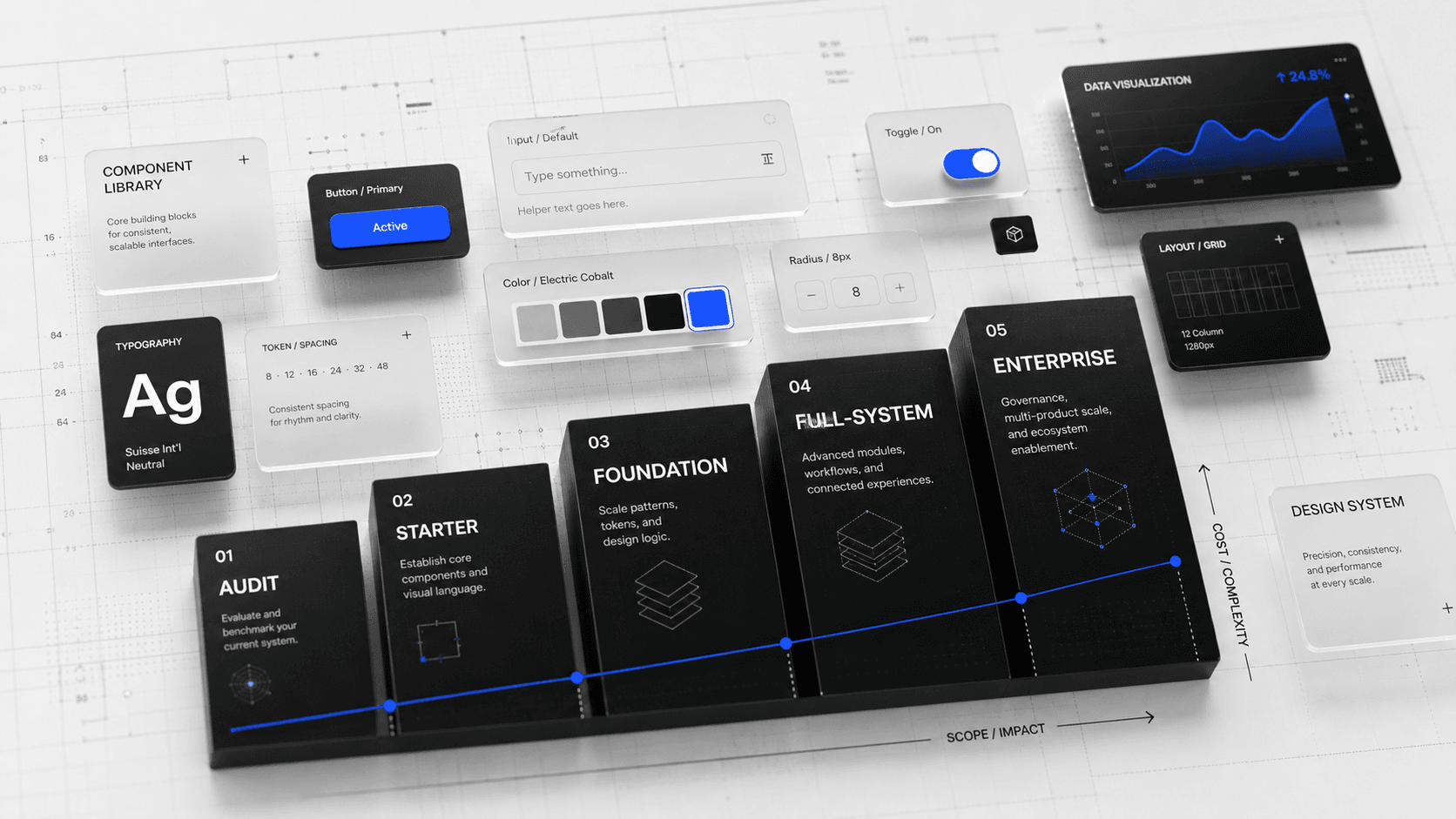
| Scope tier | Published benchmark | What a buyer may expect to discuss |
|---|---|---|
| Audit and roadmap | $500 to $12,000 | Inventory, duplication findings, priorities, pilot recommendation, and a phased plan |
| Starter system | $5,000 to $20,000 | Core tokens, a small component set, basic usage notes, and one target product or platform |
| Foundation system | $20,000 to $45,000 | A broader library, design-to-code alignment, documentation, and contribution rules |
| Full system | $45,000 to $120,000 | Production components, token architecture, migration support, governance, training, and release practices |
| Enterprise program | $120,000 to $500,000+ | Multiple products or brands, platform variants, accessibility requirements, adoption work, and ongoing ownership |
The table helps you size the conversation, not select a budget by label. Two proposals called “foundation” can cover different component counts, code frameworks, product teams, and migration obligations. Compare the defined outputs and exclusions before comparing totals.
What a design system agency proposal should buy
A useful proposal connects system assets to product delivery. Donux describes agency design system work through audit, tokens, Figma libraries, code alignment, training, and maintenance. That sequence gives buyers a sound baseline because it covers discovery, construction, adoption, and care after launch.
Discovery that produces a scoped pilot
Discovery should end with decisions. Autentika says discovery defines the pilot scope, roadmap, technology, team, and cost. Ask the agency to name the products it will inspect, the stakeholders it needs, the code repositories in scope, and the evidence it will use to recommend a pilot.
An audit alone can make sense when your organization has scattered libraries and no shared view of the problem. It gives leaders a bounded way to test an agency before funding a build. The deliverable should identify duplicate patterns, accessibility gaps, token debt, code divergence, and the teams affected by each problem.
Tokens, components, and a design-to-code contract
Figma frames implementation as the connection between components, tokens, guidelines, and what teams ship in design and code. Figma also reports that organizations using design systems saw 34% faster task completion for designers and 96% brand consistency. Those figures describe reported outcomes, not a guaranteed return for any buyer.
Tokens now have a firmer interoperability base. The W3C Design Tokens Community Group announced its first stable specification in October 2025, supporting vendor-neutral token exchange and theming across tools. Ask whether the agency will use a portable token model, how it will handle aliases and modes, and which transformations connect source tokens to each code platform.
A polished Figma file without production parity leaves engineering teams to recreate decisions. Your scope should say which components exist in design, which exist in code, which states each includes, and how both sides stay synchronized. A buyer who needs more context on library structure can review DesignX’s guide to a design system component library.
Documentation, contribution, and ownership
Documentation should cover usage, content rules, accessibility behavior, variants, and known limits. A component page needs enough detail for a designer and engineer to make the same decision without a meeting. DesignX’s overview of design system documentation explains the practical role of those shared instructions.
The GOV.UK Design System contribution criteria provide a strong governance test: components should be useful or unique, have named ownership, include documentation and support, and stay consistent across design and development resources. A proposal should explain who reviews contributions, who approves releases, and who handles support once the agency leaves.
Governance can add cost because it asks the agency to design roles and decision paths alongside assets. That expense has value when several product teams share the system. For a deeper operating model, see DesignX’s guide to enterprise design system governance.
How design system agency pricing changes with scope
Component count attracts attention, but raw quantity gives you a weak estimate. A table, date picker, or data visualization can require far more state logic and accessibility work than several simple controls. Ask vendors to estimate by component complexity, variant count, behavior, and platform coverage.
- Product and brand coverage. One web application with one theme costs less to systematize than a portfolio spanning mobile, web, white-label products, and regional brands.
- Code responsibility. A Figma-only library carries less build work than tested React, Vue, native iOS, or Android packages. Production code also brings release, dependency, and quality obligations.
- Migration depth. A greenfield pilot differs from replacing patterns across mature products. Inventory, deprecation, compatibility work, and rollout support can consume more effort than the first component build.
- Accessibility standard. Keyboard behavior, focus management, contrast, screen-reader semantics, reduced motion, and validation states need explicit design and test coverage.
- Documentation and training. Usage guidance, contribution instructions, office hours, workshops, and onboarding materials turn files into a system teams can use.
- Governance and maintenance. Release ownership, intake rules, versioning, support channels, and adoption reporting extend the engagement beyond initial delivery.
Ask each bidder to mark these six variables as included, optional, or excluded. That exercise exposes a low proposal that depends on your team to supply code, documentation, or migration labor. It also reveals a higher proposal that covers work another vendor left outside the total.
How to compare agency proposals without losing the scope
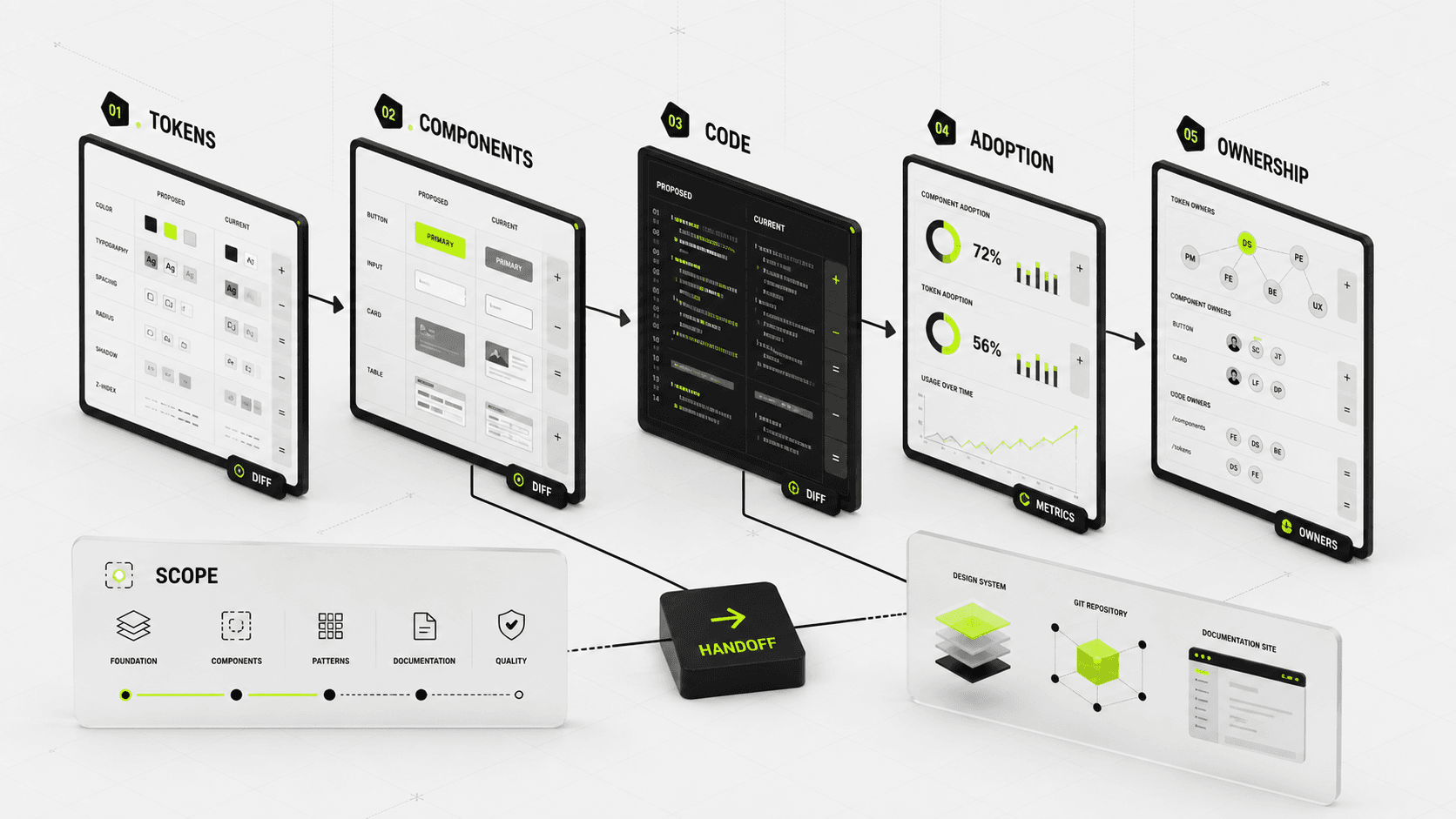
Normalize proposals into the same worksheet. General hourly rates and engagement models can help you understand the commercial frame; DesignX’s design agency pricing guide covers that wider context. For the design system decision, compare the contract at the asset, workflow, and ownership level.
| Comparison area | Question to ask | Evidence to request |
|---|---|---|
| Baseline | Which products, files, repositories, and teams will you audit? | Inventory method and sample audit output |
| System scope | Which tokens, components, states, themes, and platforms are included? | Named backlog with acceptance criteria |
| Code quality | Who writes, reviews, tests, packages, and releases the components? | Repository examples, test plan, and release workflow |
| Adoption | Which product team will pilot the system, and how will migration work? | Pilot plan, rollout checkpoints, and deprecation policy |
| Ownership | Who runs the system after handoff? | Role map, contribution path, support period, and maintenance options |
Review the assumptions page with the same care as the deliverables. Confirm how many revision cycles the fee includes, what client-side roles the agency expects, how change requests affect cost, and which travel or software expenses sit outside the fee. A precise proposal protects both sides from silent scope growth.
Relevant work samples should show shipped code and operating documentation, not screenshots alone. Ask to speak with the design-system owner or engineering lead from a past engagement. If you need a broader vendor screen before the proposal stage, use DesignX’s guide on how to hire a UI/UX design agency.
Fixed project, phased build, or ongoing retainer?
A fixed project fits a known pilot with bounded products, platforms, and components. It gives procurement a firm number, but the agency needs enough discovery to price uncertainty. If the brief contains unresolved technology or ownership questions, the vendor will add contingency or write broad exclusions.
A phased build separates audit, pilot, expansion, and adoption into funded decisions. This model works well when leaders need evidence before committing to a large program. Define a decision gate after each phase, along with the assets and findings required to approve the next one.
A retainer suits teams that expect recurring component work, migration support, release management, and office hours. Compare the monthly capacity, response rules, backlog ownership, and rollover terms. A retainer with no named service level can turn into expensive availability.
When an agency beats an in-house build
An agency fits when you need a neutral audit, specialist skill across design and code, or concentrated delivery that your product roadmap cannot spare. The model can also help several teams settle token, component, and governance decisions without assigning the work to one product squad.
An in-house team fits when the system requires continuous daily decisions, deep product context, and permanent support. The internal owner still needs authority, engineering capacity, and time for adoption. Hiring one designer and expecting that person to cover architecture, code, documentation, and governance creates a fragile program.
A hybrid often works best: an agency establishes the architecture and pilot while an internal core team joins the work and assumes ownership. DesignX compares these staffing tradeoffs in enterprise design partner versus in-house team. Teams serving complex business software should also account for permissions, dense workflows, and role-based interfaces; the B2B UX design guide shows why those product conditions raise the bar for reusable patterns.
Build a budget your team can defend
Start with the business surface, not a desired component total. Name the pilot product, the delivery teams involved, the frameworks in production, the accessibility target, and the release deadline. Then identify which existing patterns cause rework or inconsistency and connect the first system scope to those costs.
Request a priced discovery phase when your inventory or technical path remains uncertain. Ask for a base scope, optional work packages, payment milestones, and change-control terms. The best budget document lets finance see the commitment while design and engineering can trace each fee to a usable output.
If you are scoping a design system build and want a concrete engagement conversation, review DesignX pricing and start a project discussion. Bring your product list, current libraries, code frameworks, and the team that will own the system after launch.
Frequently asked questions
How much does a design system agency cost in 2026?
One provider publishes benchmarks from $5,000 to $20,000 for a starter system, $20,000 to $45,000 for a foundation, $45,000 to $120,000 for a full system, and $120,000 to $500,000+ for enterprise work. These are third-party figures, not DesignX quotes or universal rates. Your scope, platforms, migration burden, and ownership model determine the proposal.
What should a design system agency quote include?
A sound quote should define discovery, inventory, tokens, component coverage, design and code outputs, documentation, accessibility testing, pilot support, governance, training, and maintenance terms. It should also name exclusions, client responsibilities, revision limits, acceptance criteria, and the people assigned to each workstream. Without those details, buyers cannot compare two totals on equal terms.
How long does a design system build take?
Timeline depends on product count, decision speed, code frameworks, component complexity, and migration scope. A scoped audit or pilot can move faster than a multi-brand program with several engineering platforms. Ask vendors for milestones tied to accepted outputs, then confirm how stakeholder review, security checks, and client-side engineering availability affect each date.
Is a fixed fee or retainer better for design system work?
A fixed fee suits a bounded audit or pilot with named deliverables and stable assumptions. A retainer suits recurring component delivery, migration support, release work, and team enablement. Many buyers use a phased fixed project for discovery and foundation work, then choose maintenance support once the internal owner understands the ongoing workload.
Can an agency build on our existing component library?
Yes, if the agency audits the library before estimating the reuse plan. It should inspect component quality, variants, accessibility, token usage, code parity, documentation, adoption, and dependency risk. Some assets may need repair, consolidation, or retirement. Require the proposal to separate reusable work from replacement work so the budget does not assume clean foundations.
When should we keep the design system in-house?
Keep core ownership in-house when the system needs constant product context, frequent releases, and daily support across teams. An agency can still help with the audit, architecture, pilot, or a difficult migration. Assign an internal product owner and engineering counterpart during the engagement so knowledge, release authority, and contribution decisions stay with your organization.