
An AI design company should help you make better product decisions with AI-assisted research and production while a senior human remains accountable for the work. The best partner can show where AI enters the process, which inputs it used, how the team tested the output, and who approved the final decision.
That standard matters more than a long tool list. NIST organizes AI risk work around four functions: Govern, Map, Measure, and Manage. Google’s People + AI Guidebook draws on input from more than 100 Googlers, industry experts, and academic research. Both sources point buyers toward process evidence and human responsibility.
What makes an AI design company credible?
A credible AI design company can explain its method without hiding behind model names. It shows the path from evidence to decision, marks machine-generated material, and assigns a human owner to each important choice.
DesignX has a separate guide on how design agencies use AI across delivery. This buyer-guide asks a different question: can a prospective partner prove that its AI-assisted process produces work your team can inspect, test, govern, and build?
| Evaluation area | Evidence to request | Warning sign |
|---|---|---|
| Research | Source list, interview notes, synthesis trail, and assumptions marked for validation | A polished summary with no path back to source material |
| Prototyping | Test plan, participant criteria, observed failures, and revision history | Many generated screens with no user or stakeholder test |
| Design system | Token rules, component states, accessibility notes, and governance owner | One-off visual output that does not map to reusable components |
| Handoff | Reviewed specs, assets, acceptance criteria, and implementation notes | Generated code presented as production-ready without engineering review |
| Risk and ownership | Data handling, model-use policy, IP terms, and named approvers | Vague answers about where client data goes or who owns generated assets |
Ask for workflow evidence
Tool access says little about design quality. Your review should focus on the artifacts that survive after a model produces an answer.
Research needs a source trail
AI can group interview notes, find repeated themes, and draft research summaries. The team still needs to preserve the raw source, separate observation from inference, and flag weak evidence. Ask to see one anonymized research chain from input through synthesis to a product decision.
A mature partner will tell you which inputs came from users, product data, support tickets, market research, or stakeholder opinion. Our guide to AI-assisted UX research explains where machine support helps and where the research lead must check the work.
Prototypes need a test record
AI can produce more interface directions before the team invests in high-fidelity design. More options create value only when the team has a reason to reject most of them. Ask which assumption each prototype tested, who reviewed it, what failed, and what changed in the next version.
For an AI-powered product, the prototype should cover uncertainty, error states, confidence, user control, and recovery. A polished happy path does not prove that the experience will hold up when a model gives a weak answer. The AI product design patterns guide covers these interaction risks in more depth.
Design systems need governance
AI can draft component variants, content states, token mappings, and documentation. A senior designer must decide which patterns belong in the system, how states behave, and how the team handles exceptions. Ask for a component decision log and the name of the person who can approve or reject a new pattern.
The handoff should map screens to real components and tokens. If the partner delivers a set of attractive screens with no reusable logic, your product team inherits the cleanup. Our design system documentation guide shows the level of structure a build team needs.
Code handoff needs engineering review
AI can draft front-end code, acceptance criteria, and implementation notes. Engineers still need to review behavior, architecture, performance, security, and maintainability. Ask the agency to show how a design decision becomes a ticket, component spec, code review, and accepted build.
Generated code should count as a starting artifact. Your contract should state who checks it and who fixes defects found during implementation. A vendor that sends generated code across the wall has shifted risk to your team.
Senior human judgment must stay accountable
The agency should name one senior owner for each decision that can change customer trust, product direction, or implementation cost. “Human in the loop” is too vague for a contract or a weekly review.
- Research framing: A research lead chooses the questions, checks the sample, and separates evidence from assumption.
- Product tradeoffs: A product or design lead decides which user problem deserves attention and which scope the team cuts.
- Brand and interaction judgment: A senior designer approves hierarchy, tone, states, and the behavior of the experience.
- Accessibility and risk: Named reviewers check the work against agreed standards, data rules, and failure scenarios.
- Final sign-off: One accountable lead confirms that the deliverable meets the brief before it reaches your team.
The NIST AI RMF Playbook gives teams suggested actions across Govern, Map, Measure, and Manage. The Google People + AI Guidebook adds product guidance grounded in human-centered AI work. For web products, WCAG 2.2 provides testable, technology-neutral accessibility criteria across devices.
These references give the agency and buyer a shared basis for review. Your partner should state which standards apply, which checks it will run, and who owns remediation.
How an AI design company should change the workflow
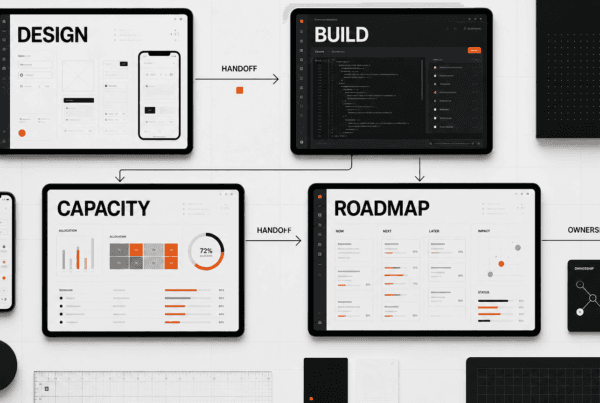
AI should change the shape of the work, not erase the controls around it. Each phase should produce a faster feedback loop and a stronger audit trail.
| Phase | AI contribution | Human decision | Buyer-visible deliverable |
|---|---|---|---|
| Research | Cluster notes, tag themes, draft summaries | Choose questions, check sources, judge evidence | Source map and decision-ready findings |
| Prototyping | Produce interface options and state variations | Select assumptions, run tests, reject weak paths | Prototype set, test notes, and revision log |
| Design system | Draft tokens, components, states, and documentation | Set rules, approve patterns, manage exceptions | Governed library tied to product screens |
| Code handoff | Draft code, specs, tickets, and acceptance criteria | Review architecture, behavior, quality, and risk | Build package with owners and review status |
Buyers should also ask how the agency handles generated UI. The team must explain why a generated screen belongs in the product and how it survived review. Our guide on when to use AI-generated UI and when to hire a human offers a practical boundary.
How to evaluate the proposal and the first two weeks
The proposal should connect each promised AI use to an artifact, owner, and review point. If it promises research synthesis, it should name the source format and approval step. If it promises code support, it should name the engineer or reviewer who accepts the output.
Use these questions in the sales call:
- Show us one AI-assisted deliverable and the source material, edits, tests, and approvals behind it.
- Which project decisions can a model influence, and which decisions require senior approval?
- How do you protect confidential data, client IP, and material entered into third-party tools?
- How will your components and handoff fit our current design and engineering environment?
During the first two weeks, look for access to the work in progress, direct contact with senior owners, and written decisions. A weekly presentation full of finished screens gives you too little time to correct a bad assumption. The broader UI/UX agency hiring guide covers team access, scope, and commercial fit.
Where DesignX is the right AI-first design partner
DesignX fits teams that need one senior partner to connect brand, UX/UI, product-system decisions, and implementation handoff. That condition often appears when a product has outgrown disconnected freelancers, generated screens lack a coherent system, or the internal team needs outside judgment for a high-stakes launch or redesign.
Our role is strongest when your team wants AI-assisted exploration with a human owner for research framing, design direction, system rules, and delivery quality. We can work with your existing product and engineering team, or carry a defined engagement from strategy through handoff.
DesignX is a poor fit when you need model training, data engineering, AI infrastructure, or a large staff-augmentation bench. Those needs call for an AI engineering firm or recruiting partner. A buyer should prefer the specialist whose core delivery matches the work.
Frequently asked questions
What is an AI design company?
An AI design company uses AI inside research, concept development, design-system work, and delivery while human designers remain responsible for decisions and quality. Some firms also design AI-powered products, so buyers should confirm whether the agency’s experience matches the product and the workflow support they need.
How can I verify an agency’s AI process?
Ask for an anonymized example that connects source material to synthesis, prototype tests, design decisions, component rules, and handoff. The agency should identify machine-generated material, human edits, rejected options, review owners, and the final approval step.
Should AI replace user research?
No. AI can help a research lead organize notes, find patterns, and draft summaries. A human still needs to choose the questions, recruit the right participants, check the source trail, interpret context, and decide which evidence should influence the product.
Can an AI design company deliver production code?
Some agencies can deliver reviewed front-end code, while others stop at design files and specifications. Treat generated code as unreviewed until an engineer checks architecture, behavior, accessibility, security, performance, and maintainability against your team’s standards.
Who owns AI-generated design work?
Ownership depends on the contract, the tools used, and the source material. Ask the agency to state its IP terms, third-party model terms, client-data policy, and process for checking generated assets before the engagement starts.
When is DesignX the right fit?
DesignX fits product teams that need senior judgment across brand, UX/UI, product systems, and implementation handoff in one accountable engagement. Teams seeking model development, AI infrastructure, or large-scale staff augmentation should choose a specialist in those services.
Bring a real workflow to the first conversation
If you need an AI design company for a product decision, design-system gap, or handoff problem, bring the real workflow. DesignX will help you define the evidence, senior ownership, and delivery path the engagement requires.
Review DesignX engagement options and start the conversation.