
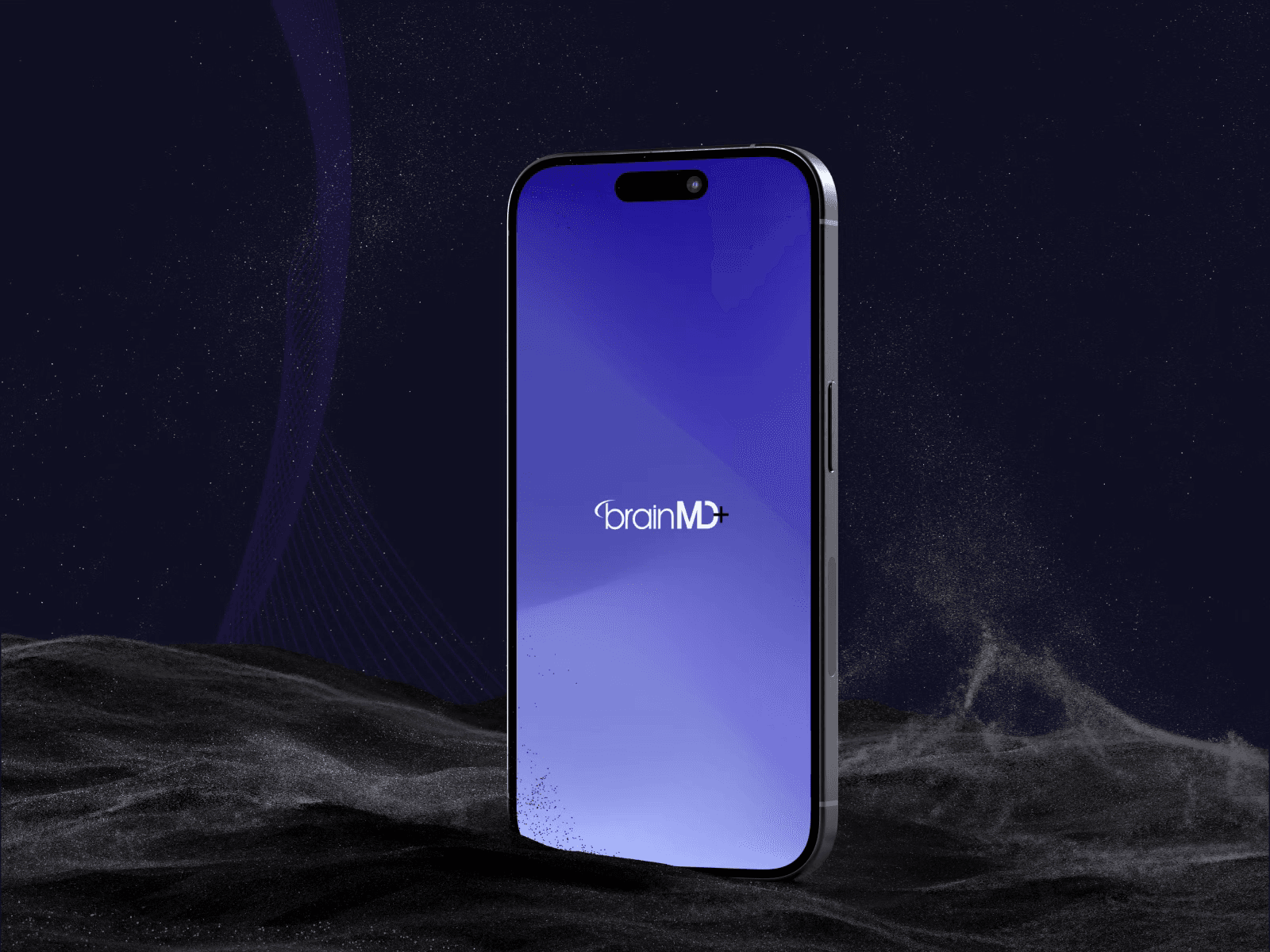
Brain Md faced the challenge of translating complex neurological concepts into an accessible mobile experience. DesignX aimed to empower users with science-backed insights into brain health.
Brain Md, a pioneering neuroscience startup, faced a significant hurdle: how to translate complex neurological concepts into an accessible, engaging, and actionable mobile experience for the everyday user. Their ambition to empower individuals with science-backed insights into brain health was hampered by the inherent difficulty in making dense academic material digestible. DesignX was brought in to bridge this gap, designing an application that would not only educate but also foster lasting behavioral change.
Project Overview
| Attribute | Detail |
|---|---|
| Client Type | Health-Tech Startup |
| Industry | Neuroscience, Health & Wellness, EdTech |
| Project Type | Mobile App UX/UI Design, Brand Extension, Content Strategy Integration |
| Timeline | 7 months |
| Deliverables | User Research Report, Information Architecture, Wireframes, Interactive Prototypes, Comprehensive UI Design, Design System, Usability Testing Report, Handoff Documentation |
| Tools Used | Figma, Maze, Miro, Adobe Illustrator, Notion |
The Challenge
Brain Md’s vision was to democratize neuroscience, offering personalized insights into brain function, mental well-being, and cognitive enhancement. However, their initial conceptualization struggled with several critical issues. The primary challenge was the sheer complexity of neuroscience itself. Presenting topics like neuroplasticity, neurotransmitter functions, or cognitive biases in a way that was both scientifically accurate and engaging for a non-expert audience proved daunting. Early user feedback indicated that proposed content structures felt overwhelming, leading to high abandonment rates and low perceived value. Users expressed confusion over jargon, a lack of clear pathways for learning, and an inability to connect abstract concepts to practical, everyday applications. Furthermore, the absence of a distinct visual identity failed to convey the authority and approachability necessary for a health-focused application. The client recognized that without a thoughtfully designed user experience, their valuable scientific content would remain inaccessible, hindering their mission to impact brain health globally. They needed an interface that simplified, guided, and motivated.
Our Approach
Our engagement began with an intensive discovery phase, anchoring our work in a deep understanding of Brain Md’s mission and their target audience. We initiated comprehensive stakeholder interviews with Brain Md’s team of neuroscientists, researchers, and business leaders to distill the core scientific principles and business objectives. This was complemented by extensive competitive analysis, examining existing health, education, and mindfulness applications to identify market gaps and best practices. To gain direct user insights, we conducted targeted surveys and one-on-one interviews with potential users, ranging from health-conscious individuals to students and professionals interested in cognitive improvement. This research allowed us to develop detailed user personas, mapping their motivations, pain points, and desired outcomes.
Following research, we facilitated several collaborative workshops with Brain Md, focusing on information architecture and content strategy. We organized complex neuroscience topics into logical hierarchies, developing a modular content framework that prioritized digestible learning units. Wireframing and prototyping began early, allowing for rapid iteration and feedback loops. We employed low-fidelity prototypes for initial concept validation, progressing to high-fidelity interactive models for rigorous usability testing. This iterative, user-centered approach ensured that every design decision was grounded in empirical data and aligned with Brain Md’s scientific accuracy requirements, translating intricate knowledge into an intuitive and empowering user journey.
Key Design Decisions
Modular, Progressive Learning Pathways
The fundamental challenge of making complex neuroscience accessible hinged on how information was delivered. Our primary design decision was to break down expansive topics into a series of short, interconnected, and progressively challenging modules. Instead of presenting users with lengthy articles or abstract diagrams, we designed a system where each module focused on a single, digestible concept, building foundational knowledge before introducing more intricate ideas. This decision was driven by cognitive load theory, which suggests that learners absorb new information more effectively when presented in smaller, manageable chunks. We implemented clear progress indicators within each module and across entire learning paths, providing users with a sense of accomplishment and motivation. This modularity allowed users to learn at their own pace, revisit specific topics, and seamlessly integrate new knowledge without feeling overwhelmed, directly addressing the initial problem of information overload and disengagement.
Adaptive Personalization and Goal Setting
Generic content, no matter how well-structured, often fails to resonate with individual user needs and preferences. Our second key decision was to embed a sophisticated personalization engine from the outset. Upon onboarding, users complete a concise assessment to identify their primary interests, current knowledge level, and specific goals, such as improving focus, managing stress, or understanding memory. This data then dynamically tailors the app’s content recommendations, learning pathways, and even the difficulty of interactive challenges. For example, a user interested in sleep optimization would receive a curated path focusing on circadian rhythms and sleep hygiene, while another seeking improved memory might explore modules on neurogenesis and mnemonic techniques. The “My Journey” dashboard was designed to prominently display personal goals and track progress against them, reinforcing relevance and fostering a deeper sense of ownership over their learning experience. This adaptive personalization ensured that every interaction felt relevant and purposeful, significantly enhancing user engagement and retention.
Interactive Visualizations and Gamified Engagement
Neuroscience is inherently visual, but often presented through static, intimidating diagrams. Our third crucial decision was to integrate highly interactive, dynamic visualizations and subtle gamification elements throughout the app. Instead of just reading about brain structures, users can interact with 3D brain models, tracing neural pathways and understanding functions through direct manipulation. Complex processes, like neurotransmitter release or synaptic pruning, are animated and explained step-by-step, making abstract concepts tangible. We introduced micro-interactions, such as swipe-to-reveal content, drag-and-drop exercises, and short quizzes with immediate feedback, transforming passive learning into an active discovery process. Furthermore, gamified elements like “Brain Points” for module completion, “Knowledge Streaks,” and unlockable “Insight Badges” provided intrinsic motivation without detracting from the scientific seriousness. These interactive and gamified components were designed to leverage principles of operant conditioning and intrinsic motivation, making the learning journey enjoyable, memorable, and ultimately more effective than traditional text-based approaches.
Design Highlights
Our visual and interaction design choices for Brain Md+ were meticulously crafted to balance scientific authority with user-centric warmth.
The color palette was strategically selected to evoke a sense of calm, clarity, and intellectual depth. We established a primary palette anchored by deep, authoritative blues, such as `#1D3557` (a rich navy), complemented by serene greens like `#457B9D` (a soft teal). These colors, reminiscent of both scientific precision and natural tranquility, form the backbone of the app’s interface, fostering trust and reducing visual fatigue. Accent colors, including a warm coral `#E63946` and a subtle lavender `#A8DADC`, were sparingly used for calls to action, highlights, and micro-interactions, providing visual interest and guiding user attention without overwhelming the user. Critical contrast ratios were maintained across all elements to ensure superior accessibility and readability for diverse user groups.
For typography, we prioritized legibility and a sophisticated, modern aesthetic. The primary typeface for body copy was “Inter,” chosen for its excellent readability on digital screens, clean lines, and extensive character set which supports clear presentation of scientific terminology. For headings and key interface elements, we selected “Montserrat,” which offers a strong, confident presence while maintaining approachability. The combination provides a clear visual hierarchy, allowing users to quickly scan and comprehend information. Font sizes and line heights were optimized to prevent eye strain, particularly during extended reading sessions within learning modules.
The layout logic was designed for clarity, efficiency, and focus. We adopted a clean, card-based system for content modules, allowing for clear separation of information and easy scanning. Ample white space was a deliberate choice, reducing visual clutter and directing the user’s attention to the core content. Grids were meticulously applied to ensure consistency across all screens, creating a predictable and harmonious user experience. Progressive disclosure was a core principle, revealing complex details only when users actively sought them, preventing initial overwhelm. This minimalist yet structured approach ensured that the app felt professional, intuitive, and easy to navigate, regardless of content complexity.
Interaction patterns were engineered to be intuitive and rewarding. Swiping gestures were implemented for navigating between content pages within modules, creating a fluid and natural progression. Pinch-to-zoom functionality was incorporated for detailed diagrams and interactive brain models, allowing for precise exploration. Micro-interactions played a crucial role, providing immediate visual and haptic feedback for
Frequently Asked Questions
What problem did the brain Md Neuroscience Mobile App Casestudy work need to solve?
Brain Md’s vision was to democratize neuroscience, offering personalized insights into brain function, mental well-being, and cognitive enhancement. However, their initial conceptualization struggled with several critical issues. The primary challenge was the sheer complexity of neuroscience itself. Presenting topics like neuroplasticity, neurotransmitter functions, or cognitive biases in a way that was both scientifically accurate and engaging for a non-expert audience proved daunting.
How did DesignX approach the brain Md Neuroscience Mobile App Casestudy work?
Our engagement began with an intensive discovery phase, anchoring our work in a deep understanding of Brain Md’s mission and their target audience. We initiated comprehensive stakeholder interviews with Brain Md’s team of neuroscientists, researchers, and business leaders to distill the core scientific principles and business objectives. This was complemented by extensive competitive analysis, examining existing health, education, and mindfulness applications to identify market gaps and best practices. To gain direct user insights, we conducted targeted surveys and one-on-one interviews with potential users, ranging from health-conscious individuals to students and professionals interested in cognitive improvement.
Which design decisions mattered most in the brain Md Neuroscience Mobile App Casestudy project?
Modular, Progressive Learning Pathways The fundamental challenge of making complex neuroscience accessible hinged on how information was delivered. Our primary design decision was to break down expansive topics into a series of short, interconnected, and progressively challenging modules. Instead of presenting users with lengthy articles or abstract diagrams, we designed a system where each module focused on a single, digestible concept, building foundational knowledge before introducing more intricate ideas. This decision was driven by cognitive load theory, which suggests that learners absorb new information more effectively when presented in smaller, manageable chunks.
What stands out in the final Brain Md Neuroscience Mobile App Casestudy design?
Our visual and interaction design choices for Brain Md+ were meticulously crafted to balance scientific authority with user-centric warmth. The color palette was strategically selected to evoke a sense of calm, clarity, and intellectual depth. We established a primary palette anchored by deep, authoritative blues, such as `#1D3557` (a rich navy), complemented by serene greens like `#457B9D` (a soft teal). These colors, reminiscent of both scientific precision and natural tranquility, form the backbone of the app’s interface, fostering trust and reducing visual fatigue.
Related Reading from DesignX
Related DesignX reading: For more context on the design decisions behind this work, see healthcare app design, healthcare UX design, medical device UX.