
TL;DR: The product design sprint process is a five-day way to answer one high-stakes product question before your team funds a full build. The strongest sprints do less than most teams expect: they frame one risk, pick one target user, build one believable prototype, and test it with real customers.
- Use a sprint when the cost of guessing is higher than the cost of a focused week.
- Put a real decision-maker in the room, or the sprint turns into theater.
- Test the riskiest assumption, not the prettiest screen.
- Expect a decision at the end: build, revise, pause, or gather missing evidence.
A product design sprint process gives founders and product leaders a structured way to move from uncertainty to evidence in one working week. It is useful when a team has a product idea, feature bet, or market question that feels too expensive to answer through a full build.
At DesignX, we see sprints work best when they are treated as a decision tool, not a creativity workshop. Our senior design team has worked across product, brand, and UX programs for companies including Oura Ring, HP, Bodybuilding.com, and Klein Tools, where clearer digital product choices helped drive a 23% dealer adoption lift after a catalog redesign.
The catch is that most sprint articles make the process sound cleaner than it feels. Real teams have politics, half-formed data, nervous stakeholders, and a calendar full of conflicts. A good sprint does not remove that mess. It contains it long enough to make a sharper call.
The product design sprint process in plain English
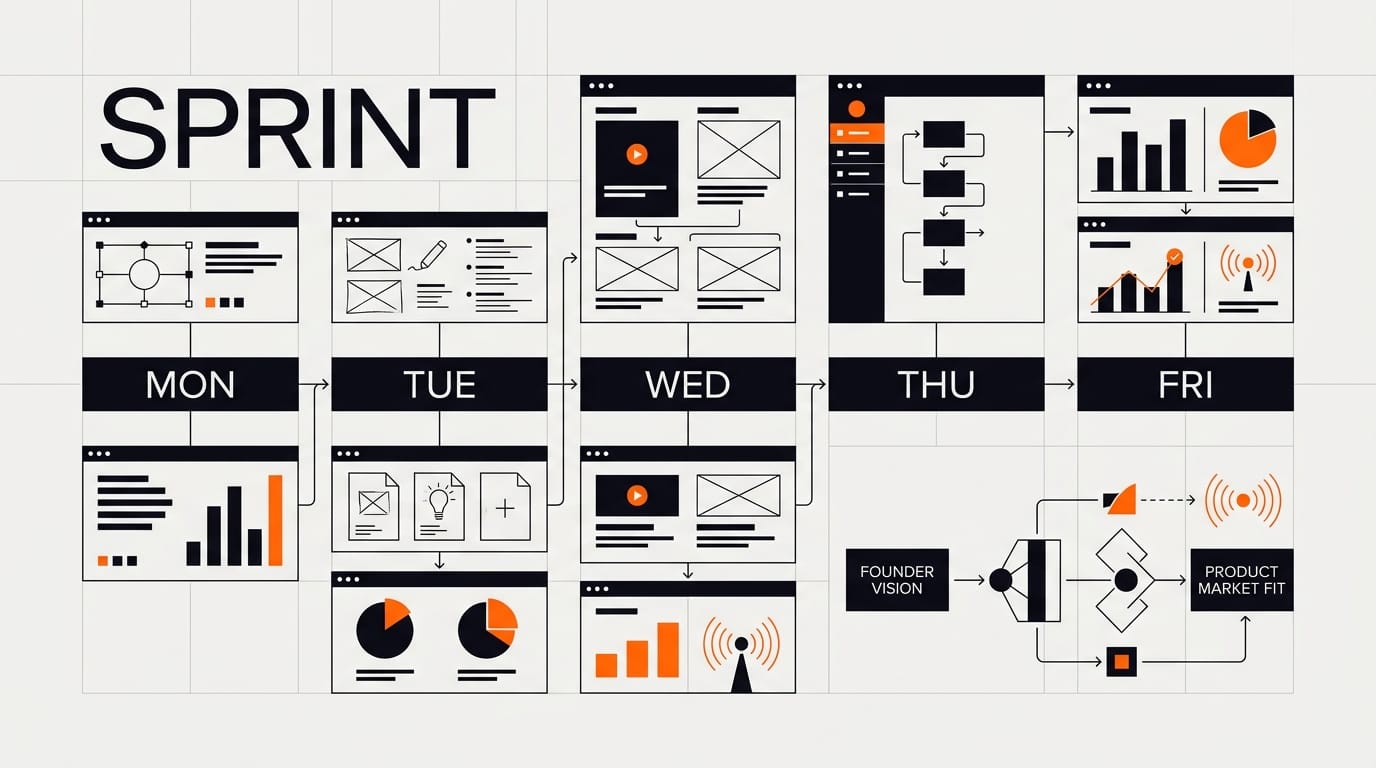
The product design sprint process is a time-boxed path for answering one business or product question through mapping, sketching, choosing, prototyping, and customer testing. The classic GV model frames it as five days: map on Monday, sketch on Tuesday, decide on Wednesday, prototype on Thursday, and test on Friday.
That sequence matters because it stops a common founder mistake: jumping from an idea straight to pixels. The sprint forces the team to agree on the user, the moment of pain, the business risk, and the test before anyone starts designing a polished interface.
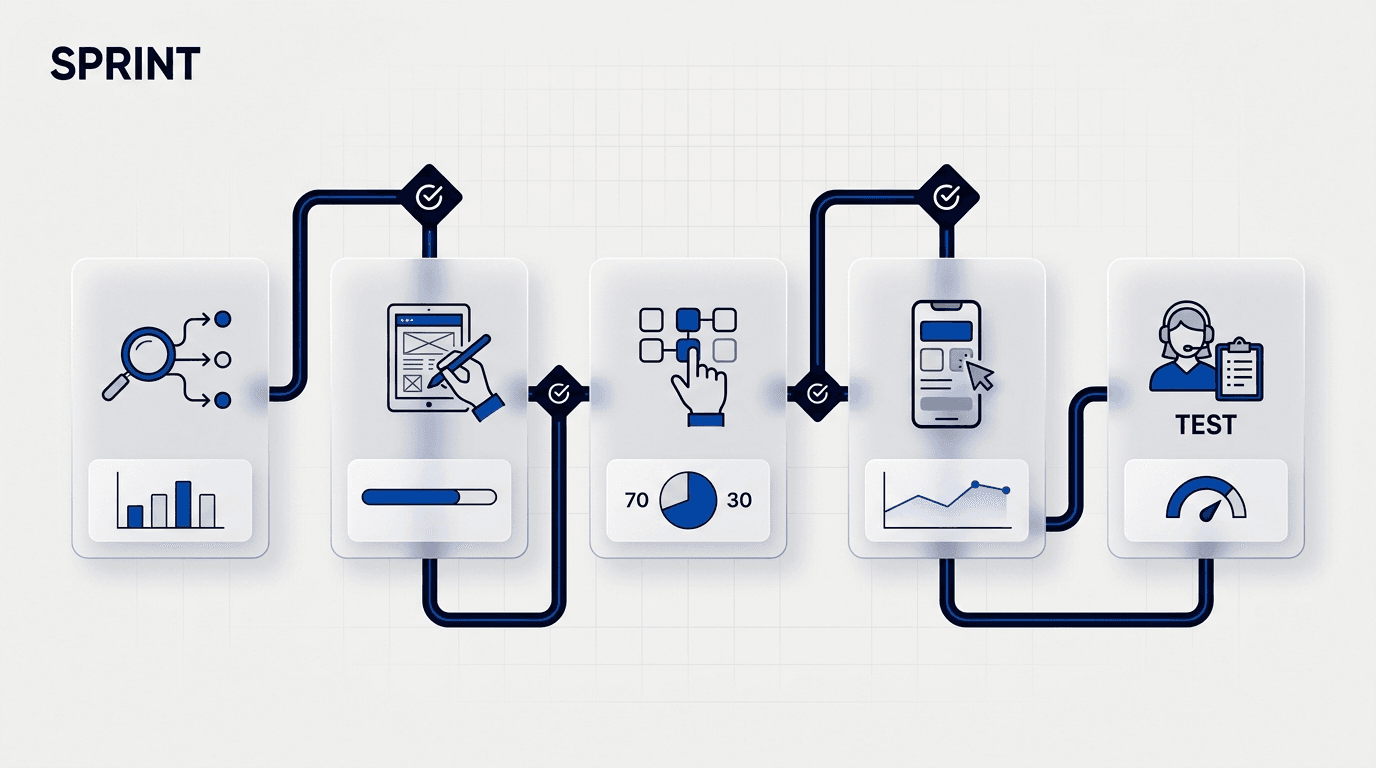
GV describes the sprint as a shortcut to learning without building and launching. That framing is still the best reason to run one. If your team already knows what to build, a sprint is probably a delay. If your team is arguing because nobody can prove which path is safer, a sprint can buy clarity fast.
When a sprint is worth the week
A sprint is worth the week when the decision has real cost behind it. That cost might be engineering time, investor confidence, sales momentum, onboarding friction, or the risk of teaching the market the wrong story.
Use the product design sprint process when one of these conditions is true:
- The team is split between two product directions and debate is not helping.
- A founder has a strong idea, but the target user has not validated the need.
- A feature is expensive enough that a wrong build would set the roadmap back.
- A sales or onboarding problem keeps showing up, but the cause is unclear.
- The company needs a prototype for investor, buyer, or internal alignment.
Do not run a sprint because the calendar looks empty. Do not run one to decorate an idea that leadership has already approved. If the outcome cannot change the plan, call it a workshop and save everyone the pretense.
This is also where a sprint differs from a longer product engagement. A sprint can answer, “Is this the right path to test next?” It cannot replace product discovery, design systems work, accessibility review, content design, analytics, or the patient detail work behind a production-ready product.
What to prepare before day one
The sprint is won or lost before Monday morning. The strongest teams arrive with a sharp challenge, a known decision owner, enough context to brief the room, and access to target users for Friday.
Before you start, gather these inputs:
- A sprint question: One plain-language question the week must answer.
- A decision owner: The person who can choose the direction when tradeoffs appear.
- Customer evidence: Sales calls, support tickets, analytics notes, user interviews, or churn reasons.
- Known constraints: Technical limits, brand rules, pricing boundaries, legal requirements, and launch timing.
- Test participants: Five target users or buyers who match the decision you need to make.
- A prototype lane: A clear agreement on what fidelity is enough for the test.
Most teams underprepare the participants. Friday testing is not a generic usability session with whoever is available. It should match the risk. If the sprint is about enterprise admin setup, do not test with junior employees who will never own that workflow.
Day 1: map the risk before you map the screen
Monday is for making the invisible problem visible. The team should draw the customer journey, name the business goal, list known risks, and choose the moment where a better product experience could change the outcome.
A good map is plain. It shows the user, the trigger, the job they are trying to finish, the decisions they make, and the point where the current experience breaks down. You are not drawing the whole product. You are finding the point of highest learning.
For a SaaS team, that target might be the first setup action after signup. For a hardware brand, it might be the dealer search and product comparison flow. For a founder raising capital, it might be the moment a buyer understands why the product matters.
Day 2: sketch options without turning it into design by committee
Tuesday is for generating competing answers. The best sprint teams avoid open-ended group ideation because it favors the loudest person in the room. Silent sketching gives every expert a way to contribute without turning the day into a status meeting.
Sketches do not need art skill. They need logic. Each concept should show how the user gets from problem to action and what proof, interface, or message helps them move forward.
DesignX often looks for two kinds of ideas at this stage: the expected answer and the uncomfortable answer. The expected answer follows the current product story. The uncomfortable answer asks whether the team has framed the problem too narrowly. That second path is where useful tension shows up.
Day 3: decide what you are actually testing
Wednesday is where the sprint earns its keep. The team reviews sketches, compares them against the sprint question, and chooses a testable direction. This is not a popularity vote. It is a decision about which assumption deserves evidence first.
A strong decision has four parts:
- The target user segment.
- The scenario the prototype must show.
- The behavior you need to observe.
- The signal that would change the roadmap.
If the team cannot name the signal, the test will produce opinions instead of evidence. “They liked it” is not enough. Look for behavior: confusion, hesitation, false confidence, skipped steps, wrong interpretation, or a clear pull toward the next action.
Day 4: build a prototype that tells the truth
Thursday is for a believable prototype, not a finished product. The prototype only needs enough realism to let a customer react as if the thing exists. For a software product, that might mean a Figma flow with real copy, pricing hints, empty-state logic, and a few believable edge cases.
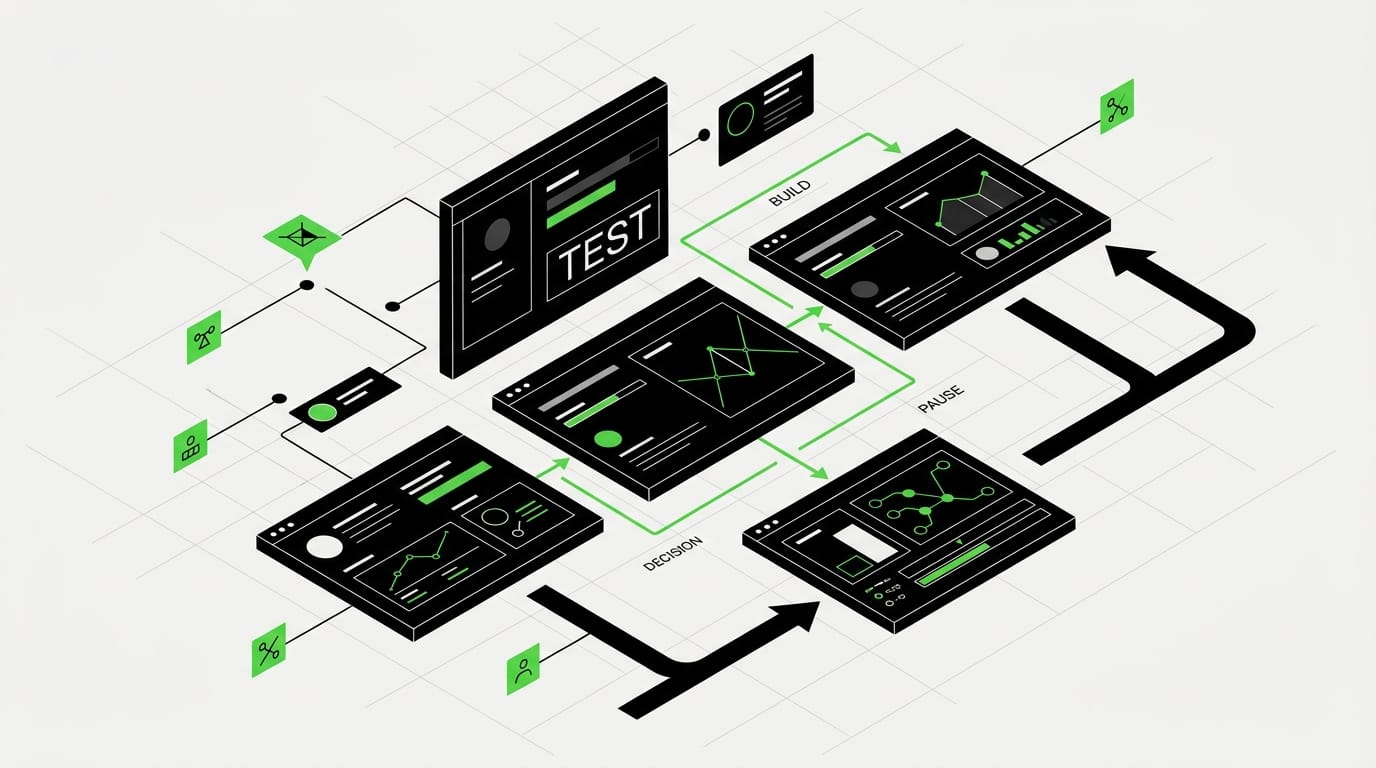
This is where senior design judgment matters. A prototype that is too rough can create false negatives because users cannot understand the offer. A prototype that is too polished can create false positives because people react to finish rather than value.
The right fidelity depends on the decision. If you are testing navigation, clickable structure matters. If you are testing a new positioning idea, copy and hierarchy may matter more than interaction. If you are testing enterprise workflow fit, roles, permissions, and task handoffs might need to appear even if the backend does not exist.
Day 5: test with users and make the decision
Friday should feel calm and slightly uncomfortable. Calm because the team knows the script. Uncomfortable because real customers often expose gaps the internal team has stopped seeing.
Nielsen Norman Group’s widely cited usability testing guidance argues that testing with five users can reveal about 85% of usability problems in a first study, with more value coming from repeated small tests than one large study. That is why the classic sprint uses five target customers. It is enough to expose patterns without turning the week into research theater.
During each session, avoid selling. Ask the participant to complete the task, explain what they think is happening, and react to the next step. The team should watch quietly, capture evidence, and resist the urge to explain the product when the prototype fails.
After the interviews, make one of these decisions:
- Build: The core assumption held up, and the team knows what to make next.
- Revise: The direction has promise, but the prototype exposed fixable gaps.
- Pause: The problem or audience was weaker than expected.
- Research: The test exposed a deeper unknown that needs discovery before design.
Common sprint mistakes that waste the week
The sprint format is simple enough to copy and easy enough to misuse. The process fails when the team treats the ceremonies as the work.
Watch for these mistakes:
- Too broad a challenge: “Improve onboarding” is too vague. “Help a sales-led buyer invite their team without admin support” is testable.
- No decision owner: A room can discuss forever. One person must own the tradeoff.
- Wrong participants: Testing with friendly users gives friendly answers.
- Prototype drift: The team starts adding nice-to-have screens because they enjoy making the prototype.
- Evidence avoidance: Leadership explains away what customers did because it conflicts with the preferred plan.
The last mistake is the expensive one. A sprint is only useful if the team is willing to let the evidence change the roadmap.
How to buy a sprint from a design partner
If you are hiring a partner to run the sprint, do not buy a calendar template. Buy judgment. The partner should help narrow the problem, shape the prototype, write the test, read the customer signals, and translate the findings into next steps.
Ask these questions before you sign:
- Who will lead the sprint, and have they led founder or executive rooms before?
- How will the sprint question be chosen before day one?
- Who writes the customer test script?
- What fidelity will the prototype reach by Thursday?
- How are findings turned into product, UX, or brand decisions after Friday?
- What happens if the test invalidates the preferred direction?
This is where DesignX sits well for founders and operators who need senior product thinking without hiring a full team. We are not a junior production bench. We work across UX/UI design, branding, web design, and consulting, which matters when the sprint question touches product value, interface clarity, and go-to-market story at the same time.
How the product design sprint process connects to the rest of your roadmap
The product design sprint process should create a decision, a prototype, a user evidence summary, and a short list of next moves. It should not create a giant PDF nobody reads.
After the sprint, your team should know which path belongs in the roadmap and which path should stay on the shelf. That can feed an MVP plan, a UX redesign, a design system effort, or a sharper agency brief.
If you are comparing delivery models, read our guide to design sprints vs traditional agencies. If you are deciding whether to build internally or bring in a partner, our in-house design vs agency cost comparison may help. For teams moving from sprint evidence into a build, the MVP design for startups guide is a good next read.
The same thinking applies to more mature products. Sprint findings often become inputs for enterprise UX patterns, SaaS onboarding UX, or a more focused UI/UX agency hiring process.
Frequently Asked Questions
What is the product design sprint process?
The product design sprint process is a structured week for answering one product question through mapping, sketching, choosing, prototyping, and testing. It is most useful when a team faces a risky product or feature decision and needs customer evidence before funding a build. The output should be a clearer decision, not a stack of workshop artifacts.
How long does a product design sprint take?
The classic sprint takes five days, with each day focused on a different type of work. Some teams compress or extend the format, but the tradeoff is focus. If you shorten the sprint, protect the decision, prototype, and user test because those are the parts that create the evidence.
Who should be in a product design sprint?
A sprint usually needs a decision owner, a facilitator, product or founder leadership, design, engineering, customer-facing knowledge, and someone who understands the business model. Keep the core group small enough to move fast. Bring extra experts in for short interviews instead of making the room crowded all week.
What should we test during a design sprint?
Test the assumption that would hurt most if it were wrong. That might be a buyer workflow, a value proposition, an onboarding step, a pricing moment, or a new product concept. If the test cannot change a roadmap decision, the sprint question is probably too soft.
Can a design sprint replace product discovery?
No. A sprint can create fast evidence around one decision, but it does not replace ongoing discovery, analytics, UX research, or market learning. Treat it as a focused decision tool inside a larger product process. Teams get into trouble when they expect one week to answer every question about a market.
When should we hire a design partner to run the sprint?
Hire a partner when the decision is expensive, politically loaded, or outside your team’s facilitation skill. A good partner brings structure, senior design judgment, and neutrality when internal teams are stuck. The right partner should also help turn Friday’s findings into a clear product or brand plan.
Final thought: a sprint is only as good as the decision it protects
The product design sprint process is not magic. It is a disciplined way to protect your team from funding the wrong idea too soon. When the question is sharp, the decision owner is present, the prototype is honest, and the test users match the risk, one week can save months of expensive drift.
If your team is weighing a product bet and needs senior design judgment before you commit to a build, start with DesignX. DesignX helps founders and operators turn risky product questions into clearer UX, stronger prototypes, and better design decisions.
Sources: GV Design Sprint guide, Character Capital Design Sprint guide, Nielsen Norman Group usability testing guidance.