
Artificial intelligence is fundamentally transforming brand design, with platforms like Looka and Brandmark generating millions of logos. This raises critical questions about AI’s capacity to capture the essence of a brand.
The AI branding revolution is here, and it’s forcing every business owner and designer to ask a critical question: can artificial intelligence capture the soul of a brand? In the past three years, platforms like Looka, Brandmark, and Tailor Brands have collectively generated millions of logos, promising professional branding at a fraction of traditional agency costs. Meanwhile, professional designers watch nervously as clients experiment with $29 logo generators before (sometimes) coming back for “the real thing.”
But this isn’t a simple story of robots replacing humans. The truth about AI brand design is far more nuanced, and more interesting. AI has proven genuinely capable in specific branding tasks, embarrassingly inadequate in others, and most promising when wielded by skilled designers who understand its strengths and limitations. The brands winning in 2026 aren’t choosing between AI and human creativity; they’re strategically combining both.
This complete guide examines what’s actually happening in the artificial intelligence branding space, beyond the hype and the fear. We’ll explore where AI tools excel, where they catastrophically fail, and how forward-thinking agencies are creating a hybrid approach that delivers better results than either humans or machines could achieve alone.
The AI Branding Landscape: Tools, Platforms, and Professional Alternatives
The Rise of Consumer AI Branding Platforms
Automated brand design platforms have democratized access to basic brand assets in unprecedented ways. Looka uses generative AI to create logo variations based on industry selection and style preferences, typically delivering 50+ options within minutes. Brandmark’s algorithm analyzes trending design patterns across millions of websites to generate contemporary-looking identities. Tailor Brands goes further, offering complete brand guidelines including color palettes, typography systems, and social media templates, all generated from a brief questionnaire.
These platforms share a common promise: professional-quality branding without professional-level investment. For micro-businesses, solopreneurs, and bootstrap startups, this represents genuine value. A coffee shop owner can generate a serviceable logo for $65 instead of waiting weeks and spending $2,500 on a traditional designer.
What Professional Agencies Actually Offer
Professional branding agencies like DesignX operate in a fundamentally different paradigm. The branding process begins with strategic discovery, understanding market positioning, competitive differentiation, target audience psychology, and long-term business vision. AI logo design tools can’t conduct stakeholder interviews, analyze competitor weaknesses, or identify untapped market opportunities.
Human designers synthesize research into visual systems that communicate specific strategic messages. They consider cultural connotations, industry expectations, subversive opportunities, and aesthetic evolution over time. They create flexible brand systems that adapt across touchpoints from billboards to app icons while maintaining coherent identity.
The Middle Ground: AI-Assisted Professional Tools
A third category is emerging: professional-grade tools that augment rather than replace designer expertise. Adobe Sensei powers intelligent features in Creative Cloud. Designs.ai offers component-level AI assistance. Fronty converts designs to code. These tools accelerate specific workflow steps while keeping strategic and creative decisions in human hands, a crucial distinction we’ll explore throughout this article.
Market Segmentation and Pricing Realities
The AI brand identity market has effectively segmented into three tiers. Entry-level automated platforms ($0-$300) serve price-sensitive micro-businesses. Mid-tier services ($500-$3,000) combine AI generation with light human refinement. Premium agencies ($5,000-$100,000+) use AI as a tool within complete strategic branding engagements. Each tier serves different needs, but conflating them creates dangerous misconceptions about what AI can actually deliver.
What AI Can Do Well in Branding
Color Palette Generation and Psychological Matching
AI excels at computational color theory tasks that would take human designers hours of manual exploration. Platforms like Huemint and Khroma use machine learning trained on millions of successful designs to generate harmonious color combinations. More impressively, they can match color palettes to emotional objectives or industry conventions.
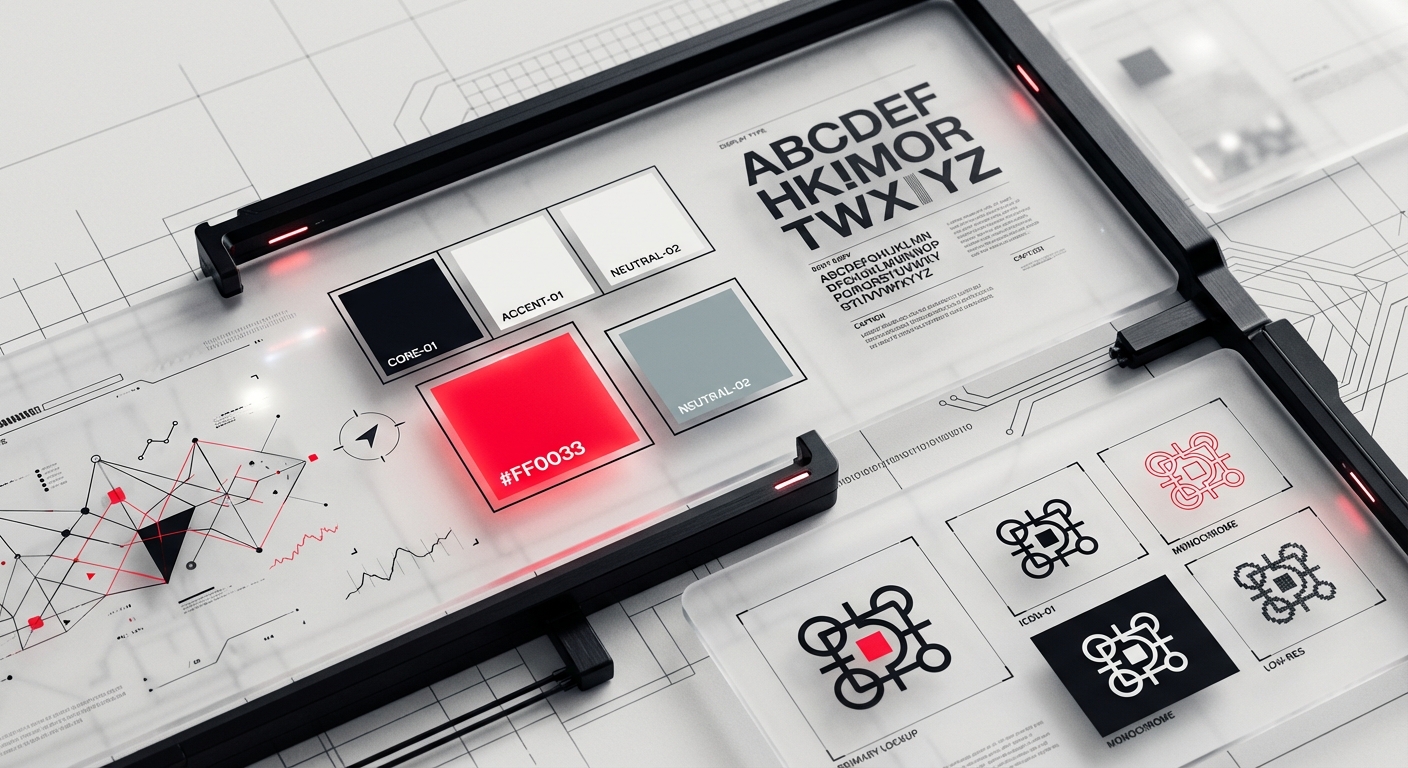
AI brand strategy tools can analyze competitor color usage, identify overused and underused palette territories in specific industries, and suggest differentiation opportunities. They process color accessibility requirements instantly, ensuring WCAG compliance across all combinations. For designers, this transforms color exploration from a bottleneck into a rapid ideation phase.
Mood Board Assembly and Visual Research
AI-powered tools like Midjourney, Pinterest’s visual search, and specialized platforms like Visualist.io can aggregate visual references at scales impossible for human researchers. Describe a brand aesthetic, ”minimalist luxury with warm organic textures”, and AI can surface thousands of relevant examples within minutes.
These tools identify visual patterns across references, extracting common elements like preferred contrast ratios, composition styles, or textural approaches. While human designers still curate the final mood board, AI dramatically accelerates the research and pattern-recognition phases of brand development.
Font Pairing Algorithms and Typography Systems
Typography pairing represents genuine AI success. Tools like Fontjoy use deep learning to identify complementary typeface combinations based on contrast, style compatibility, and visual rhythm. They understand the mathematical relationships that make certain serif-sans pairings work while others clash.
AI logo design platforms can test readability across sizes, suggest optical sizing adjustments, and even recommend font weights for specific applications. For body copy, AI tools analyze reading ease, suggesting line length, spacing, and size adjustments optimized for digital or print contexts. This computational approach to typography often surpasses junior designer intuition.
Brand Name Brainstorming and Linguistic Analysis
AI naming tools have proven surprisingly capable at linguistic creativity. Platforms analyze phonetic patterns, check domain availability, test names across languages for unintended meanings, and generate portmanteaus that human brainstormers might miss. They can produce hundreds of naming options filtered by criteria like length, memorability scores, or linguistic style.
Advanced tools like NameLix use neural networks trained on successful brand names to generate options that “feel” contemporary. They test pronounceability, check trademark databases, and analyze social media handle availability, administrative tasks that traditionally consumed hours of naming project time.
What AI Gets Wrong: The Critical Limitations of Automated Branding
Cultural Context and Symbolic Meaning
AI’s most catastrophic failures occur at the intersection of culture and meaning. Algorithms trained primarily on Western design can’t understand the symbolic significance of colors in Asian markets, the religious connotations of certain geometric patterns in Middle Eastern contexts, or the historical weight of visual elements in post-colonial regions.
A 2024 study documented AI branding tools generating logos with unintentionally offensive cultural references in 23% of international test cases. One AI brand design platform suggested a lotus flower logo for a Japanese restaurant, failing to recognize that lotus imagery is predominantly associated with South Asian and Buddhist contexts, not Japanese culture. These aren’t edge cases; they’re systematic blind spots in training data and algorithmic understanding.
Human designers working across cultures develop sensitivity to these nuances through experience, research, and often by collaborating with cultural consultants. AI has no mechanism for this contextual awareness and no ability to recognize when it’s operating outside its competence zone.
Emotional Resonance and Authentic Storytelling
Brands that endure create emotional connections through authentic narratives. AI can analyze sentiment and mimic emotional language patterns, but it cannot understand the authentic human stories that give brands meaning. It can’t recognize when a founder’s personal journey creates compelling brand narrative, or when community values offer differentiation opportunities.
Consider the branding for Patagonia, inseparable from Yvon Chouinard’s climbing history and environmental philosophy. No artificial intelligence branding system could have synthesized that identity from demographic data and industry benchmarks. The visual restraint, the anti-marketing marketing, the activist positioning, all emerge from deeply human values that algorithms can’t access or simulate.
Emotional resonance requires empathy, cultural fluency, and the ability to recognize what makes a particular story meaningful to a particular audience at a particular moment. These remain distinctly human capacities.
Strategic Differentiation and Market Positioning
AI branding tools optimize for aesthetic appeal and industry convention, which often produces the opposite of strategic differentiation. When every new fintech startup uses AI tools trained on existing fintech branding, the result is predictable visual homogeneity: gradients, sans-serif wordmarks, and blue-purple color schemes.
Professional AI brand strategy requires identifying where a brand should deliberately deviate from category conventions. Sometimes the strategically correct choice is intentionally “ugly,” retro, or chaotic, decisions that contradict AI’s optimization for aesthetic harmony and contemporary trends. AI can’t understand when breaking rules creates advantage.
Market positioning demands understanding competitive white space, predicting industry evolution, and sometimes making contrarian bets. These strategic dimensions require business acumen, market intuition, and creative risk-taking that exceed current AI capabilities.
The Subtleties of Visual Craft and Refinement
Experienced designers spend years developing sensitivity to micro-adjustments that separate good designs from great ones, the precise weight adjustment that improves a letterform, the subtle spacing change that creates better visual rhythm, the nearly imperceptible color shift that enhances sophistication.
Current AI logo design tools can’t match this level of craft refinement. They generate visually acceptable outputs but lack the capacity for iterative perfection that characterizes exceptional design work. The difference becomes obvious when AI-generated and human-refined designs are placed side-by-side: AI work often feels slightly “off” in ways difficult to articulate but immediately perceptible to trained eyes.
The Hybrid Approach: AI-Assisted Professional Brand Design
How Forward-Thinking Agencies Use AI Tools
Leading design agencies aren’t rejecting AI, they’re strategically integrating it into specific workflow stages. At DesignX, the AI brand design process typically looks like this: AI handles initial visual research aggregation, color exploration, and typography pairing suggestions. Human designers then apply strategic filters, cultural context, and creative judgment to these AI-generated options.
This hybrid approach compresses timeline while maintaining quality. What once required 40 hours of exploration might now take 20, but those 20 hours involve higher-level strategic and creative thinking rather than mechanical execution. Clients receive more explored options and faster iterations without sacrificing the strategic foundation that makes branding effective.
The Designer-AI Collaboration Workflow
The optimal workflow positions AI as a tireless assistant rather than autonomous creator. Designers provide strategic parameters, AI generates options at scale, designers curate and refine. For example, when developing a brand color palette, a designer might: (1) Define strategic color objectives (warm, accessible, differentiating from competitors), (2) Use AI tools to generate 50 palette variations meeting those criteria, (3) Curate to 5 finalist directions, (4) Manually refine and test those finalists across applications.
This collaborative model produces better results than either humans or AI working alone. AI explores combinatorial possibilities beyond human capacity; humans apply judgment AI can’t replicate. The combination creates both efficiency and creative expansion.
Training AI on Brand Guidelines for Consistency
Once brand foundations are established, AI excels at maintaining consistency across applications. Tools can be trained on specific brand guidelines, learning to recognize on-brand vs. off-brand executions, flagging guideline violations, and even generating templated applications like social media graphics that adhere to established systems.
This consistency enforcement role, previously requiring junior designers to reference guideline PDFs, is perhaps AI’s most immediately practical contribution to AI brand identity development. It frees human designers for more complex creative work while ensuring brand coherence across touchpoints.
When to Override AI Suggestions: Developing Designer Judgment
The most critical skill in AI-assisted design is knowing when to ignore AI output. This requires design expertise, recognizing when AI suggestions are generic, culturally inappropriate, or strategically misaligned. Junior designers sometimes over-rely on AI recommendations, lacking the confidence to override algorithmic suggestions even when instinct says something is wrong.
Effective AI-assisted branding requires designers to maintain creative authority, treating AI as one input among many rather than an oracle. The best outcomes emerge when designers can articulate why they’re rejecting AI suggestions, demonstrating understanding of both AI’s logic and its limitations.
Case Studies: AI-Assisted vs. AI-Only Brand Outcomes
Case Study 1: E-Commerce Startup, AI-Only Approach
A direct-to-consumer skincare brand launched in 2024 using entirely AI-generated branding from Looka. Total investment: $127. The resulting identity featured a minimalist leaf icon, sans-serif wordmark, and sage green color palette, visually pleasant but virtually indistinguishable from 200+ competitors in the clean beauty space.
Within eight months, the brand struggled with recognition and perceived premium positioning. Customer surveys revealed the branding communicated “generic natural products” rather than the innovative peptide science the products actually represented. The brand eventually invested in professional rebranding, adding $18,000 to costs they’d hoped to avoid, a classic false economy.
Case Study 2: Professional Services Firm, Hybrid AI-Assisted Approach
A consulting firm specializing in supply chain resilience worked with a branding agency using AI-assisted design. AI tools generated initial concept explorations, typography pairings, and color systems. Human designers then applied strategic insights about conveying stability amid chaos, resulting in a visual system that balanced structured geometry with dynamic elements.
The hybrid approach delivered the project 30% faster than traditional timelines while maintaining strategic depth. The resulting brand system successfully communicated technical expertise and adaptive thinking, qualities the AI explorations alone had failed to capture. Client investment: $12,000 for complete branding that genuinely differentiated in their market.
Case Study 3: Restaurant Group, AI Research, Human Execution
A restaurant group developing a new fast-casual concept used AI tools exclusively for research phases. Midjourney generated hundreds of aesthetic explorations based on described brand attributes. AI color tools mapped palette territories in the fast-casual dining category. Name-generation AI produced candidate lists filtered for domain availability.
Human designers then synthesized these AI-generated inputs into a cohesive brand strategy and visual identity. The approach compressed research from weeks to days while keeping strategic and creative decision-making in expert hands. The result: a distinctive brand that launched six weeks ahead of schedule with identity assets that tested strongly with target demographics.
Comparative Analysis: Success Factors and Failure Patterns
Across dozens of brand launches analyzed, patterns emerge clearly. AI branding succeeds when: (1) AI handles computational or aggregation tasks, (2) Human expertise guides strategy and final execution, (3) Budget limitations make pure AI approaches necessary and expectations are appropriately calibrated. AI branding fails when: (1) Complex strategic positioning is required, (2) Cultural sensitivity is critical, (3) Visual differentiation determines market success, (4) Long-term brand evolution must be considered.
AI Branding Mistakes That Kill Trust
The Generic Template Look
The most common AI branding failure is the “I’ve seen this before” effect. When prospects immediately recognize a brand identity as template-generated, it signals low investment, lack of differentiation, and potentially questionable business commitment. In premium or professional service categories, this perception is brand poison.
The template look emerges from AI tools training on similar datasets and optimizing for similar aesthetic criteria. Geometric logos, gradient color schemes, and trendy sans-serif typography proliferate because they score well on AI aesthetic metrics, creating visual homogeneity across AI-generated brands.
Cultural Insensitivity and Symbolic Errors
As discussed, AI’s blindness to cultural context creates genuine reputation risks. A AI brand design that incorporates religious symbols inappropriately, uses colors with negative cultural associations, or deploys imagery with unintended historical references can damage brand reputation before launch.
These errors are particularly insidious because they’re invisible to the AI tools and often to clients without cultural expertise. By the time problematic elements are identified, sometimes through social media backlash after launch, rebranding becomes an emergency expense far exceeding the initial “savings” from automated design.
Inconsistent Cross-Platform Execution
AI tools often generate primary brand assets (logo, colors) without considering cross-platform performance. A logo that looks perfect on the AI platform may become illegible at app icon sizes, lose visual impact in grayscale, or fail to work on dark backgrounds. Professional designers test these scenarios; AI generators typically don’t.
This inconsistency creates brand dilution and operational headaches. Marketing teams struggle to adapt AI-generated assets to real-world applications, often resorting to unauthorized modifications that further fragment brand consistency.
Lack of Strategic Flexibility and Evolution
Brands need to evolve as businesses grow and markets shift. AI-generated AI brand identity systems often lack the strategic architecture for flexible evolution. They’re optimized for a single moment and aesthetic rather than designed as adaptive systems that can mature while maintaining core recognition.
Professional brand systems include guidelines for expansion, rules for adaptation, and strategic rationale explaining why choices were made, creating roadmaps for evolution. AI outputs typically provide assets without strategic context, leaving businesses without guidance when they need to extend or adapt their branding.
Missing the “Why” Behind Design Decisions
Perhaps the most critical limitation: AI can’t explain the strategic reasoning behind design choices. When stakeholders ask “Why this color?” or “Why this icon?” AI-generated brands have no answer beyond aesthetic optimization. This absence of strategic rationale undermines confidence and makes it impossible to evaluate whether branding aligns with business objectives.
Professional branding deliverables include strategic rationale, explaining how visual choices communicate positioning, differentiate from competitors, and resonate with target audiences. This documentation isn’t cosmetic; it’s essential for organizational buy-in and consistent brand stewardship over time.
Frequently Asked Questions About AI Branding
Can AI completely replace brand designers?
Not for complete branding projects that require strategic positioning, cultural context, and emotional storytelling. AI can replace designers for basic logo generation in price-sensitive scenarios, but brands requiring differentiation, premium positioning, or cultural sensitivity need human expertise. The question isn’t whether AI can replace designers generally, but whether your specific branding needs fall within AI’s current capabilities, which for most businesses with growth ambitions, they don’t.
How much does AI branding cost compared to professional agencies?
Automated brand design platforms typically charge $0-$500 for basic logo and identity packages. Professional agencies charge $5,000-$100,000+ depending on scope and complexity. The cost difference is real, but so is the value difference. AI tools generate assets; agencies deliver strategic positioning, market differentiation, and flexible brand systems. For many startups, AI tools provide adequate interim branding until growth justifies professional investment.
What’s the best AI branding tool available in 2026?
The “best” tool depends on your specific needs and expertise level. For pure automation, Looka and Brandmark offer the most polished experiences. For AI-assisted professional work, Adobe Sensei (integrated into Creative Cloud) and Midjourney (for visual research) provide powerful capabilities. However, no single AI tool delivers complete professional-quality branding, most successful approaches combine multiple AI tools with human expertise.
How do I know if my brand needs professional design or if AI is sufficient?
Ask yourself: (1) How critical is differentiation in your market? (2) Does your brand story require nuanced communication? (3) Will you operate across diverse cultural contexts? (4) Do you need premium positioning? (5) Is your brand your primary competitive advantage? If you answered “yes” to multiple questions, professional design is likely worth the investment. If your brand primarily competes on product, price, or distribution rather than brand perception, AI tools may suffice.
Can I start with AI branding and upgrade to professional design later?
Yes, and many businesses follow this path. However, understand that rebranding involves costs beyond design fees, updated marketing materials, website redesigns, and potential customer confusion during transitions. If you anticipate needing professional branding within 18-24 months, the total cost of AI-then-professional often exceeds investing in professional design initially. Consider AI branding as potentially temporary from the start.
What tasks should I use AI for in branding projects?
AI excels at: visual research aggregation, color palette exploration, typography pairing suggestions, name brainstorming, and consistency enforcement across applications. Use AI for these computational and aggregation tasks while retaining human judgment for: strategic positioning, cultural context evaluation, final creative direction, and brand narrative development. The hybrid approach maximizes both efficiency and quality.
Will AI branding tools improve enough to replace professional designers?
AI will certainly improve, handling increasingly sophisticated branding subtasks. However, the strategic, cultural, and empathetic dimensions of branding involve distinctly human capacities unlikely to be automated soon. The more probable future: AI becomes an increasingly powerful tool within designer workflows, changing what designers do but not eliminating the need for design expertise. The profession will evolve, but complete AI brand strategy will remain human-guided for the foreseeable future.
Conclusion: The Future of Human-AI Collaboration in Branding
The AI branding revolution isn’t the threat or the panacea that extremists suggest. It’s a tool evolution that’s redistributing value across the branding ecosystem, automating mechanical tasks, accelerating research phases, and democratizing access to basic brand assets while simultaneously raising the bar for what constitutes genuinely strategic branding work.
The brands that will thrive in this new landscape aren’t those that choose exclusively AI or exclusively human design. They’re the ones that strategically use AI’s computational strengths while investing in human expertise for the strategic, cultural, and creative dimensions that algorithms can’t replicate.
For businesses evaluating their branding options in 2026, the question isn’t “AI or agency?” but rather “What does my brand actually need?” If you’re a micro-business needing serviceable visual identity on a minimal budget, modern AI tools deliver genuine value. If you’re building a brand as a competitive asset, requiring differentiation, emotional resonance, and strategic positioning, professional expertise remains irreplaceable.
The exciting frontier isn’t AI replacing designers; it’s skilled designers wielding AI tools to explore more creative territories, iterate faster, and deliver better strategic outcomes than either humans or machines could achieve alone.
Ready to explore how strategic branding can differentiate your business in an increasingly automated world? Contact DesignX to discuss a branding approach that combines modern tools with the human insight your brand deserves.
Related Reading
- The Impact of Artificial Intelligence in Graphic Design: Exploring the Future of AI in Design | DesignX
- Unlocking Brand Success: Graphic Design as a Service (DAAS) Explained
- Design Sprints vs Traditional Agencies: A Cost-Benefit Analysis for Modern Teams