
Your SaaS product is live. Users sign up. But something’s wrong.
Activation sits below 30%. Support tickets cluster around three features. Trial-to-paid conversion stuck at 4%, no matter what you tweak. You ran usability tests, shipped fixes, A/B tested button colors. Nothing moved.
This is where a UX audit service for SaaS pays for itself.
Not because your team can’t design. UX problems compound. Each patch adds inconsistency. Eventually the whole experience becomes harder to use than anyone realizes, because you stopped seeing it the way new users do.
This guide covers what a SaaS UX audit includes, how much it costs in 2026, what separates good work from checkbox exercises, and how to evaluate partners.
What a UX Audit for SaaS Is
A UX audit reviews your product’s user experience against your business goals, user expectations, and usability standards.
The word “audit” sounds dry. A good one isn’t. It’s investigative. The goal: connect UX friction to metrics that matter, churn, activation, support volume, feature adoption, NPS.
A proper SaaS UX audit typically includes:
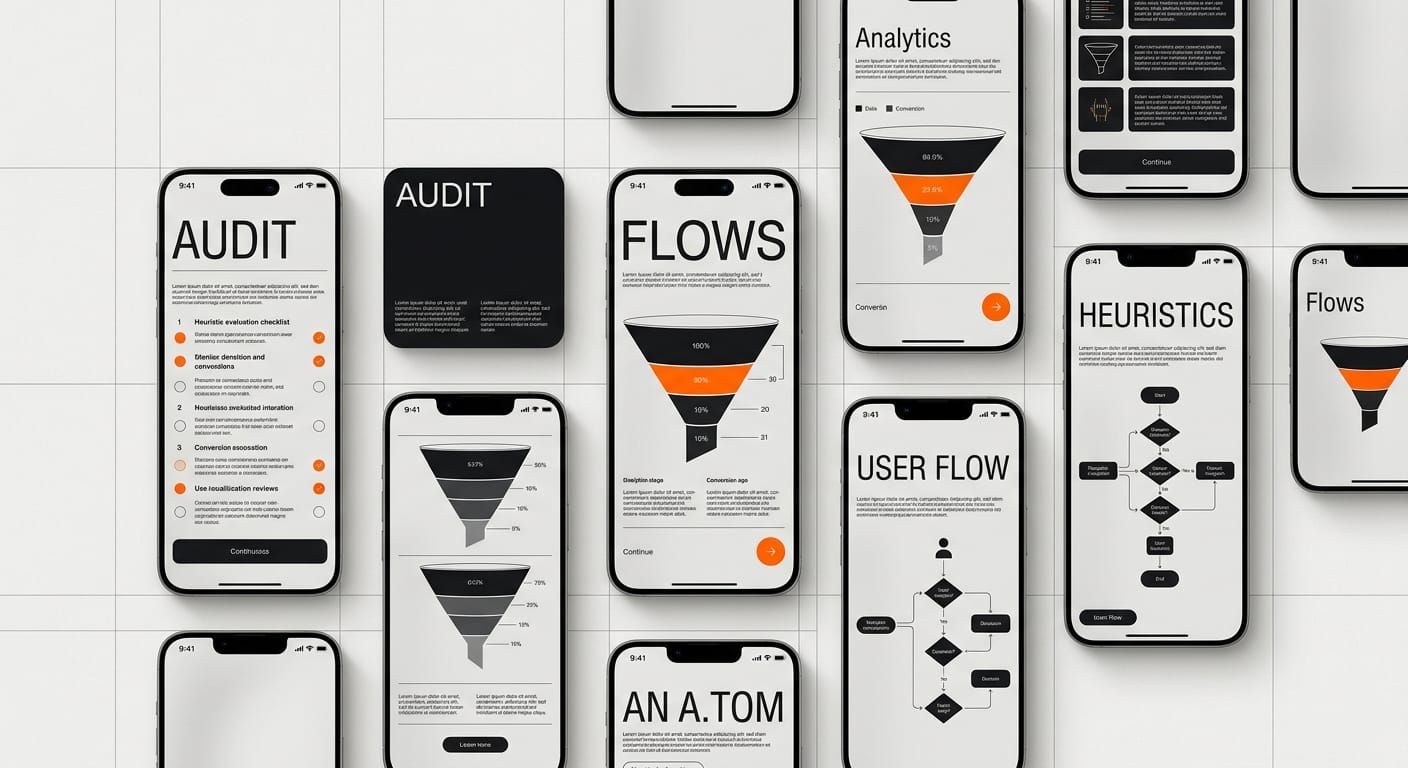
- Heuristic evaluation: senior designers walk every user flow against usability principles, flagging issues by severity
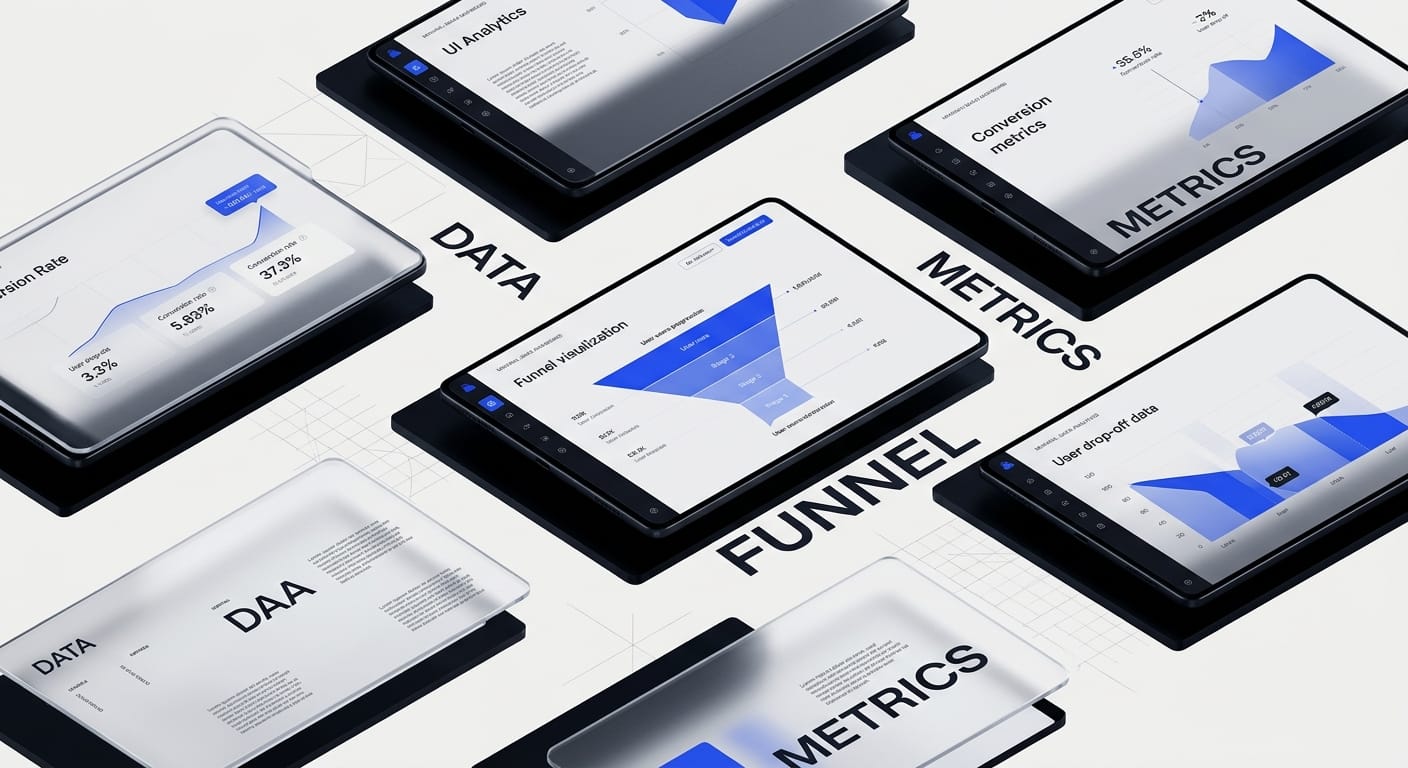
- Analytics review: drop-off analysis, session recordings, funnel data from Mixpanel, Amplitude, FullStory
- User interview synthesis: 5 to 8 structured interviews with real users to surface mental model gaps the data misses
- Competitive benchmarking: where you stand against category leaders in navigation, onboarding, core task flows
- Accessibility check: WCAG 2.1 AA minimum for enterprise software
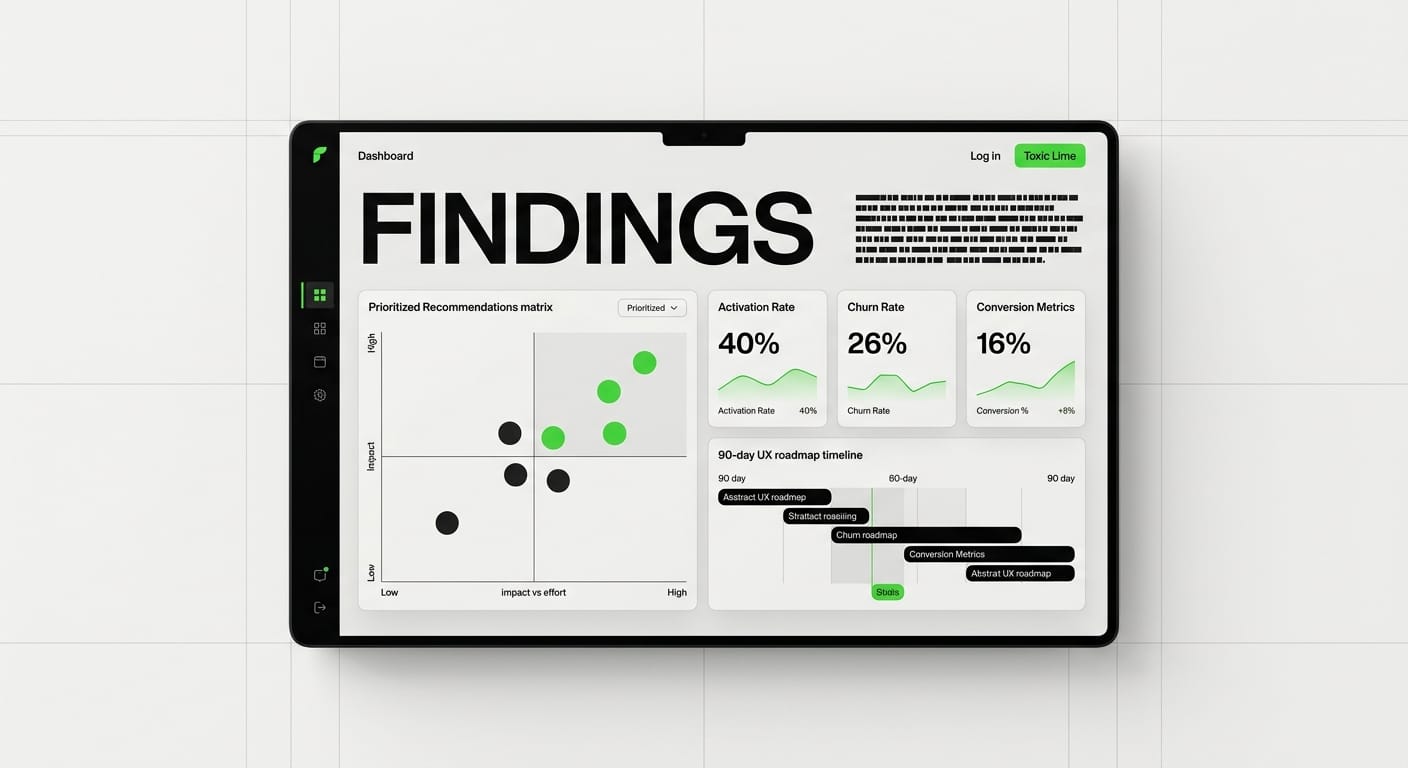
- Prioritized recommendations: issues ranked by impact and implementation effort
The final deliverable should be a report your engineering team can act on. Not a 60-page PDF that lives in Google Drive forever.
5 Signs Your SaaS Product Needs a UX Audit Now
Most teams wait too long. By the time they commission an audit, they’ve tried six other fixes. Pull the trigger earlier when:
1. You can’t explain your churn. Exit surveys say “too complicated” or “couldn’t figure out X.” Those are UX flags, not product-market fit flags.
2. Activation stuck below 40%. If fewer than 4 in 10 users reach your “aha moment,” the path there is broken. Analytics show where people leave. An audit shows why.
3. Power users can navigate, new users can’t. This is the onboarding expertise gap. Your product got complex enough that it requires tribal knowledge to operate. Classic signal for structural navigation problems.
4. Support volume scales with your user base. Support tickets shouldn’t grow proportionally as you add users. If they do, that’s a UI clarity problem.
5. You’re preparing for a funding round or enterprise sales push. Investors and enterprise buyers evaluate product polish. A UX audit before Series A or a large contract pitch is high-ROI.
How Much Does a UX Audit Service for SaaS Cost?
Pricing varies by scope and provider type. Market breakdown for 2026:
- Freelancers: $3,000-$8,000 for mid-range work. Hourly rates $75-$200. You get one perspective. Quality varies by experience.
- Boutique agencies: $8,000-$25,000 for thorough product audits covering multiple flows. This range includes senior designers, user interviews, analytics review, prioritized action plan.
- Large consultancies: $30,000-$100,000+. You pay for the brand. Junior teams do the work.
For a SaaS product with 3 to 5 core user flows and a trial-to-paid conversion problem, boutique agencies at $10,000-$18,000 hit the right range. Two to four weeks of senior design time, enough to do it properly without consultancy overhead.
At DesignX, our design engagements follow clear scope agreements with no hourly surprises and no scope creep.
What the Best UX Audits Deliver (And What Bad Ones Miss)
The difference between useful and useless comes down to specificity tied to your business goals.
A bad audit gives you a list of heuristic violations with no business context. “The button label is unclear.” “Navigation is inconsistent on mobile.” These observations aren’t wrong, but they don’t tell you what to fix first or why it matters financially.
A good audit connects findings to metrics. “The empty state on the reporting dashboard has no clear next action. In session recordings, 67% of new users who reach this screen close the tab within 90 seconds. Fixing this is worth more than fixing your onboarding checklist.”
When evaluating any UX audit service for SaaS, ask for example output before engaging. Look for:
- Issue severity rankings (not everything is critical)
- Metrics attached to findings where data exists
- Specific recommendations, not generic best practices
- Implementation effort estimates so engineering can sequence fixes
- Design mockups for top issues (not just written descriptions)
If the proposal doesn’t mention your analytics data or reference specific user behaviors, red flag. An audit without data access is opinion, not diagnosis.
The DesignX Approach to SaaS UX Audits
We’ve run audits for SaaS products across B2B enterprise, fintech, healthcare, e-commerce. Our B2B enterprise work taught us early that enterprise tools have a specific failure mode: designed for power users, abandoned by anyone who needs onboarding.
How we structure an audit engagement:
Week 1: Discovery and data collection. We request analytics access (Amplitude, Mixpanel, GA4, session recording tools), conduct stakeholder interviews to understand business goals, recruit 5 to 8 users for moderated sessions.
Week 2: Analysis. Senior designers run heuristic evaluation on every major flow. We synthesize user interview recordings, pull funnel drop-off data, run competitive benchmarking against category leaders.
Week 3: Report and readout. We deliver a prioritized findings report, a 90-day UX roadmap, design mockups for top-priority issues. We present live with your product team and engineering lead so questions get answered, not emailed back and forth for weeks.
The output is a document your team uses. Our clients reference the audit roadmap in sprint planning for months after delivery.
If you’re considering a full redesign after the audit, we can scope that as a follow-on. Many clients do both: audit first to validate scope, then redesign with a clear brief instead of a vague mandate to “make it better.”
How to Choose the Right UX Audit Partner
Four questions worth asking every agency you consider:
Do you work with analytics tools, or just opinions? Any agency not requesting analytics access before starting is running a heuristic review, not a UX audit. Different things.
Will senior designers do the work, or hand it to juniors? This is the oldest agency bait-and-switch. Ask who will work on your product. Request portfolios. A senior designer with enterprise SaaS experience catches problems juniors haven’t seen.
What does the deliverable look like? Request a sample. If they can’t share one, problem. The format determines whether your team can act on it.
Can you show me where a past audit recommendation moved a metric? The best agencies track outcomes. If they can’t point to “we identified a checkout flow issue that led to 15% conversion improvement,” be skeptical. This is how we approach work. Our Klein Tools engagement produced 23% increase in dealer adoption. Audits that produce nothing measurable weren’t real audits.
What a UX Audit Can’t Fix
Worth being direct: a UX audit is diagnostic. It surfaces problems. It doesn’t create solutions, and it can’t fix fundamental product-market fit issues.
If users aren’t signing up because they don’t understand the value proposition, that’s positioning. If they sign up but churn because the product doesn’t deliver what it promises, that’s product-market fit.
A UX audit is most valuable when the product has real value users recognize, but the experience creates unnecessary friction between intent and action. That’s the common case for SaaS products past their first 100 paying customers.
If you’re pre-product-market fit, spend the money on faster user testing cycles instead.
Frequently Asked Questions
How long does a SaaS UX audit take?
A thorough audit of a medium-complexity SaaS product (3 to 5 core user flows) takes 2 to 4 weeks. Simpler single-flow audits can be done in 5 to 7 business days. Enterprise products with 10+ user roles often require 6 to 8 weeks to cover full scope. Beware any agency promising a full audit in under a week. They’re running a heuristic checklist.
What data should I share with the audit team?
Share analytics tool access (Mixpanel, Amplitude, GA4), session recording access (FullStory, Hotjar, LogRocket), support ticket data from the past 90 days, existing user research. More data = more specific findings. Findings without data are hypotheses.
How much does a UX audit for SaaS cost?
Boutique agencies charge $8,000-$25,000 for comprehensive SaaS audits covering multiple flows, user interviews, analytics review, prioritized action plan. Freelancers range $3,000-$8,000. Large consultancies start at $30,000. For most growth-stage SaaS teams, the $10,000-$18,000 boutique range delivers best return.
Is a UX audit the same as a usability test?
No. Usability testing observes users doing tasks in controlled settings. A UX audit is broader diagnostic combining heuristic evaluation, analytics analysis, competitive benchmarking, user research. Usability tests answer “can users do X?” An audit answers “why is X underperforming, and what’s the ROI of fixing it?”
What’s the difference between a UX audit and a design audit?
A design audit focuses on visual consistency: do components, colors, typography follow your design system? A UX audit focuses on behavioral outcomes: do users complete goals, and where do they fail? Most good agency audits cover both, because visual consistency issues create cognitive friction that surfaces as UX problems.
Can I run a UX audit in-house?
Yes, but with limitations. Internal teams have blind spots about their own product because they understand context new users don’t have. The value of external audits comes partly from that outsider perspective. A hybrid approach works: in-house team runs analytics analysis, external team runs heuristic evaluation and user interviews.
How do I know if audit recommendations are worth implementing?
Good audits include implementation effort estimates alongside impact ratings. That gives you a prioritization matrix: high-impact, low-effort fixes go to the top of your sprint backlog. Any recommendation lacking a business rationale tied to a specific metric like activation rate, churn, or support volume should be questioned. “It would be cleaner” isn’t a prioritization reason.
Ready to See What’s Slowing Down Your SaaS?
A UX audit won’t fix everything. But it shows you where users struggle, which problems cost you most, what to tackle first.
DesignX runs senior-led UX audit services for SaaS products at every stage, from seed-funded startups to enterprise products with 100,000+ users. Our team has designed for HP, Oura Ring, Bodybuilding.com, Klein Tools. We bring that breadth to every engagement.
If you’re ready to stop guessing and start fixing the right things, let’s talk.
If you want a senior design partner to turn this into a sharper product, brand, or website, see how DesignX works.