
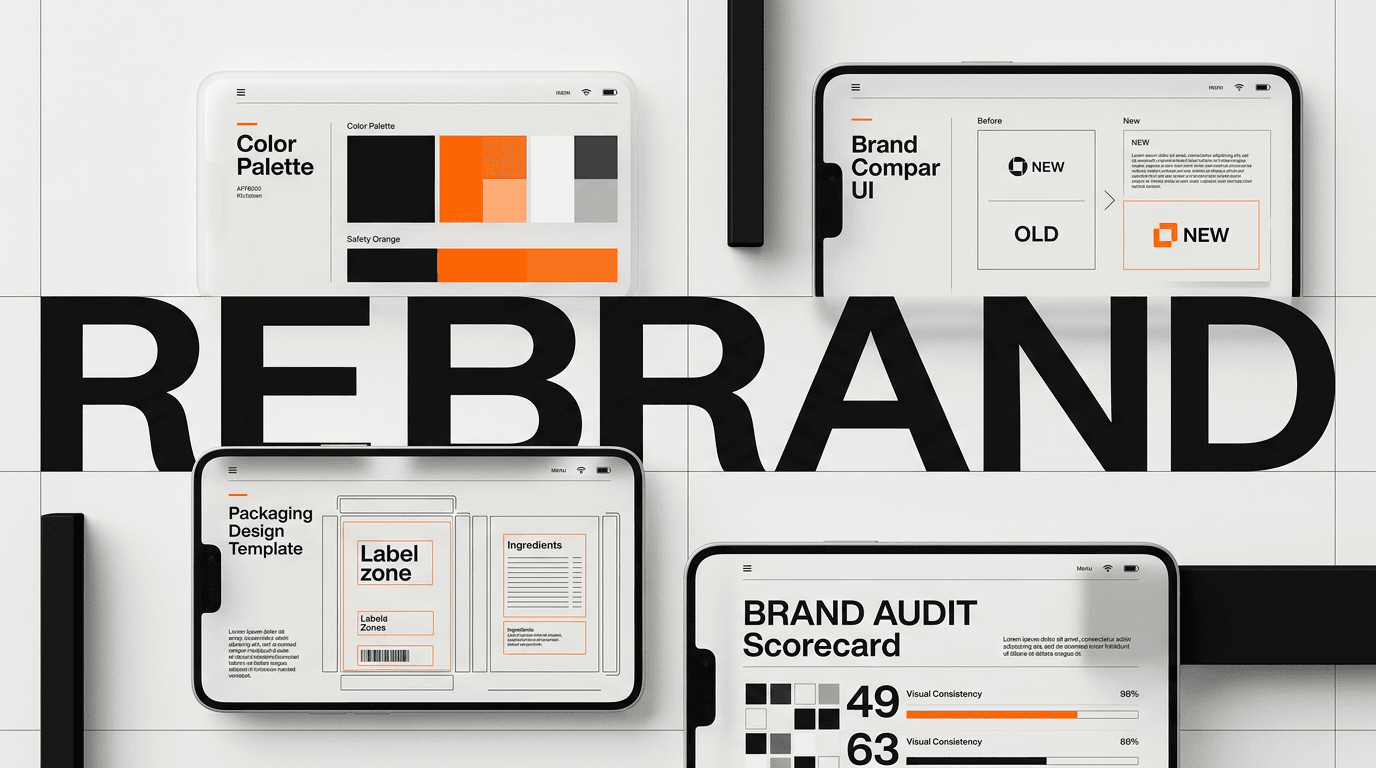
Founders must understand the difference between a brand refresh and a full rebrand. A refresh evolves the core identity, while a rebrand involves more significant changes.
Deciding: Rebrand or Refresh Your Food and Beverage Brand?
Founders often ask us about the difference between a brand refresh and a full rebrand. It is not just semantics. Each path requires different levels of commitment, cost, and risk. Understanding which one your food and beverage brand needs is the first critical step.
A brand refresh is an evolution. You keep the core identity, but you update its presentation. Think of it like giving your home a new coat of paint and some modern furniture. The structure remains. DesignX helped Klein Tools refresh their catalog design. They needed to modernize their existing brand language across 40,000+ SKUs, not invent a new one. The core Klein Tools identity was strong, but its presentation needed an update to drive dealer adoption.
A full rebrand is a revolution. You are changing the very foundation of how your brand is perceived. This often involves a new name, logo, visual system, and messaging. It is a fundamental shift. When Oura Ring launched, they needed a complete brand identity from scratch. There was no existing equity to refresh; it was about building a new perception in the market.
Signs You Need a Refresh
Consider a refresh if your core brand story still resonates, but its visual expression feels dated. Here are common indicators:
- Your packaging or logo feels out of step with current design trends. The brand itself is fine, but it looks old.
- Minor shifts in consumer preferences mean your product positioning needs a subtle nudge. You are not changing who you are, just how you talk about it.
- Competitors have updated their visuals, making your brand appear less current on the shelf. You want to maintain parity, not lead a visual revolution.
- You want to expand into a new, but related, sub-category, and your existing visuals need to stretch a little to accommodate it.
Coca-Cola offers a classic example of a refresh strategy. They have updated their logo and packaging many times over decades. The core red, the Spencerian script, the contour bottle shape, these elements always persist. They evolve, but they do not abandon their heritage.
Signs You Need a Full Rebrand
A full rebrand is necessary when your current brand identity no longer serves your business goals. This is a larger undertaking, often driven by significant strategic shifts:
- Your market perception is negative, confused, or simply inaccurate. The current brand actively works against you.
- You are entering entirely new product categories or targeting significantly different demographics. Your old brand cannot speak to the new audience.
- The business has undergone an acquisition, merger, or a significant internal restructuring that changes its fundamental offering.
- Your product or service has changed so dramatically that the old brand promise no longer applies. The product itself is different.
- You have faced significant public relations challenges that have permanently damaged existing brand equity.
Tropicana’s 2009 packaging rebrand is often cited as a cautionary tale. They changed their iconic orange with a straw to a more minimalist, generic design. Sales dropped 20% in two months, leading them to revert to the old packaging. The problem was not the brand itself, but the drastic visual change that alienated loyal customers. Their brand equity was tied to a very specific visual cue.
Another example involves startups. We worked with Apellix, a drone startup. Their initial visual identity did not reflect their sophisticated robotics technology. We gave them a complete rebrand. This helped them attract serious investors and enterprise clients. Their original brand was simply not equipped for their ambitions.
Protecting Your Brand Equity During Transition
Whether you refresh or rebrand, maintaining brand equity is paramount. It is the accumulated goodwill and recognition your customers have for you. Throwing it all away is a mistake. Your goal is not to erase history, but to build on it.
We often start by identifying “visual anchors.” These are the non-negotiable elements of your brand identity. They must carry through any transition. It could be a specific color, a unique graphic element, a particular font style, or even a tagline. For DesignX’s work with Bodybuilding.com, the brand had evolved significantly over the years. Our task was to modernize without losing the core visual identity tied to strength and fitness. We carried forward specific color palettes and a sense of powerful typography, even as we refined the overall aesthetic.
Messaging consistency also matters. Even if the visuals change, your core story, mission, and values should remain stable. This provides a narrative bridge for your customers. They see a new look, but they hear the same authentic voice.
Identifying Core Brand Assets
Before any design work begins, take inventory. What makes your brand instantly recognizable? What do customers associate with you? This is more than just a logo. It includes:
- Color Palette: Is there a signature color or combination that defines your brand? Consider Tiffany blue, McDonald’s red and yellow.
- Typography: Does your brand use a distinctive font or a specific typographic style that customers recognize?
- Specific Graphic Elements: Think about patterns, illustrations, or unique icons. The Nike swoosh is a prime example.
- Tone of Voice: How does your brand communicate? Is it playful, serious, educational, authoritative? This should remain consistent.
- Key Imagery Styles: Do you use specific photography styles, such as bright and airy, dark and moody, or documentary style?
Sometimes, this requires asking your customers directly. Conduct surveys. Ask what comes to mind when they think of your brand. Their answers will reveal what truly holds equity.
The Phased Rollout Strategy
A gradual introduction minimizes risk and allows for iteration. Instead of a sudden, overnight change, consider a phased approach:
- Digital First: Update your website, social media profiles, and email templates before you touch physical products. This is less costly and easier to revert if feedback is negative.
- Limited Product Release: Introduce new packaging on a single product line or in a specific region. Monitor sales data and customer reactions.
- Seasonal or Campaign-Driven Release: Align your brand refresh with a specific marketing campaign or seasonal product launch. This provides a natural narrative hook.
- Internal Rollout: Get your own employees on board first. They are your first brand ambassadors. Provide them with updated brand guidelines and talking points.
A phased rollout prevents the shock of an abrupt change. It allows your audience to adjust. It also helps you manage inventory. You can deplete old stock before new packaging hits the shelves. This prevents costly write-offs.
The Practicalities of Packaging Changeover Logistics
For food and beverage brands, packaging is often the brand itself. Changing it involves a complex logistical dance. This is where many founders face unexpected hurdles and costs.

You need a detailed plan for inventory management. Old packaging materials cannot be simply thrown away. New materials need to be ordered, produced, and delivered. This requires coordination with multiple suppliers: designers, printers, co-packers, and raw material providers.
Regulatory compliance is another major consideration. Any changes to ingredients, nutrition information, or certifications mean new labels. These need approval. Overlooking this can lead to costly recalls or fines.
Inventory Management and Waste Reduction
Effective inventory planning is critical. You cannot have both old and new packaging on shelves indefinitely. Here is how we approach it:
- Audit Current Stock: Know exactly how much existing packaging material you have and how quickly it is consumed.
- Forecast Depletion: Work backward from your desired launch date for the new packaging. Calculate how many production runs are needed to use up old materials.
- Order Strategically: Place orders for new packaging materials only when you are certain old stock will be depleted within a short window. This often means a 3-6 month overlap between the final old packaging run and the first new packaging run.
- Minimize Obsolete Inventory: Your goal is to have zero or near-zero obsolete packaging at the end of the transition. This saves money and reduces waste.
- Consider Repurposing: In some cases, labels or pouches can be overprinted or repurposed, but this is rare and depends on the specific material.
The cost of throwing away thousands of dollars worth of perfectly good packaging material can be significant. Plan meticulously.
Working with Suppliers and Manufacturers
Your suppliers are partners in this process. Clear communication is key:
- New Dielines and Print Files: Provide your printers and co-packers with final, approved dielines and high-resolution print-ready files well in advance. Specify color matching (e.g., Pantone numbers) precisely.
- Proofing Process: Always review physical proofs from your printer. Digital proofs are useful, but nothing replaces seeing the actual printed material. Check colors, text, and cuts.
- Lead Times: New tooling, printing plates, and material procurement all have lead times. Build these into your project schedule. Do not assume your old lead times apply.
- Quality Control: Establish clear quality control checks for the new packaging materials. Ensure they meet durability, print quality, and food-grade standards.
Often, we recommend having a DesignX team member or a designated project manager present during the initial production runs of new packaging. This “press check” ensures everything is executed correctly the first time.
Regulatory and Legal Considerations
This is not an area to cut corners. Food and beverage packaging is heavily regulated:
- Nutrition Facts Panel: Any changes to ingredients or serving sizes require an updated nutrition panel. Ensure compliance with FDA or local food safety regulations.
- Ingredient List: If you are reformulating or adding new components, the ingredient list must be updated. This includes allergen statements.
- Certifications: If your product is Organic, Non-GMO, Gluten-Free, or has other certifications, ensure the new packaging accurately reflects these, and that your certifications are current.
- Trademark Updates: If your brand name or logo changes significantly, register the new trademarks. Review existing legal disclaimers.
- Barcodes: Ensure new packaging features scannable, accurate UPC or EAN barcodes. Test them.
Consult with a food law expert early in the redesign process. They can review your new packaging files for compliance before production begins. This preempts expensive mistakes.
Designing for Retailer Success
A beautiful package means nothing if it does not perform on the shelf. Retailers have specific needs. Your redesign must consider how your product will look in a crowded store environment. This includes not just the primary package, but also secondary packaging, shelf appeal, and digital presence.
When we work with clients like HP, a key part of the process is designing packaging that works across diverse retail environments. A product might be on an end cap, a gondola, or stacked in a pallet display. The design needs to be adaptable, legible, and striking in all these scenarios.
Optimizing Shelf Presence
Your packaging design needs to grab attention and communicate quickly. Shoppers make decisions in seconds:
- Color Blocking: Use consistent brand colors across your product line. This creates a “billboard effect” on the shelf, making your brand easier to spot.
- Clear Hierarchy of Information: The brand name, product type, and key benefit should be immediately visible
Frequently Asked Questions
Deciding: Rebrand or Refresh Your Food and Beverage Brand ?
Founders often ask us about the difference between a brand refresh and a full rebrand. It is not just semantics. Each path requires different levels of commitment, cost, and risk. Understanding which one your food and beverage brand needs is the first critical step.
How should teams approach protecting your brand equity during transition?
Whether you refresh or rebrand, maintaining brand equity is paramount. It is the accumulated goodwill and recognition your customers have for you. Throwing it all away is a mistake. Your goal is not to erase history, but to build on it.
What should teams know about the practicalities of packaging changeover logistics?
For food and beverage brands, packaging is often the brand itself. Changing it involves a complex logistical dance. This is where many founders face unexpected hurdles and costs. You need a detailed plan for inventory management.
How should teams approach designing for retailer success?
A beautiful package means nothing if it does not perform on the shelf. Retailers have specific needs. Your redesign must consider how your product will look in a crowded store environment. This includes not just the primary package, but also secondary packaging, shelf appeal, and digital presence.