
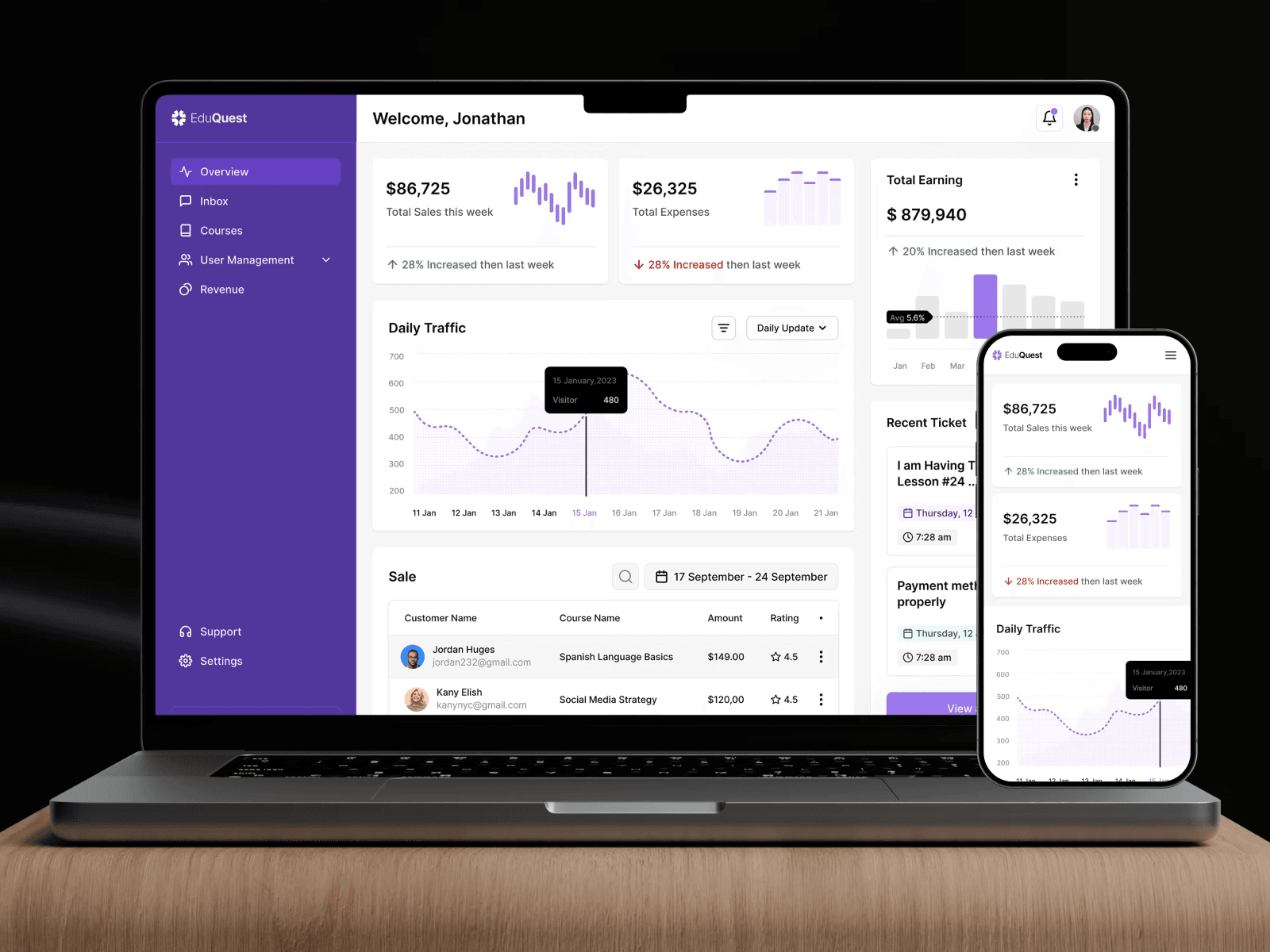
Eduquest aimed to address fragmented learning experiences and low engagement in its software. DesignX partnered to re-imagine their learning management software for an intuitive experience.
Educational institutions and corporate training departments often struggle with fragmented learning experiences, leading to low engagement, inefficient content delivery, and a lack of actionable insights. DesignX partnered with Eduquest to re-imagine their learning management software, addressing these critical pain points head-on by creating a truly intuitive and powerful platform.
Project Overview
| Client Type | Industry | Project Type | Timeline | Deliverables | Tools Used |
|---|---|---|---|---|---|
| Software Company | EdTech (Education Technology) | Full Product UI/UX Redesign, Design System Development | 8 Months | User Research Reports, Information Architecture, Wireframes, Interactive Prototypes, High-Fidelity Mockups, Design System, Usability Test Reports, Handoff Documentation | Figma, Maze, Miro, Adobe Illustrator, Notion |
The Challenge
Eduquest approached DesignX facing significant hurdles in a rapidly evolving EdTech landscape. Their existing learning management software, while functional, suffered from a dated interface and an architecture that no longer served the dynamic needs of modern educators and learners. Educators found course creation to be an overly complex and time-consuming process, lacking the flexibility to incorporate diverse media types or implement interactive learning modules without extensive technical workarounds. This rigidity directly hampered their ability to design engaging content.
For learners, the platform offered a disorienting user experience, characterized by unintuitive navigation, inconsistent visual cues, and a lack of personalized progress tracking. Students frequently reported difficulty finding relevant course materials, tracking their assignments, or understanding their overall performance, leading to frustration and reduced completion rates. Engagement tools were rudimentary, failing to foster collaborative learning environments or provide immediate feedback, which is crucial for retention.
From a business perspective, these issues translated into a static user base, lukewarm adoption rates, and a growing churn risk. Eduquest’s market position was being eroded by newer, more agile competitors offering superior user experiences. The lack of a scalable, user-centric design also made it difficult for Eduquest to introduce new features or adapt to evolving educational methodologies, stifling their growth potential and preventing them from truly empowering their users. They needed a strategic design partner to architect a solution that would not only modernize their platform but redefine the learning experience.
Our Approach
Our engagement with Eduquest began with an intensive discovery phase, focused on unearthing the core problems from multiple vantage points. We conducted extensive stakeholder interviews with Eduquest’s leadership, product managers, and engineering teams to align on business objectives and technical constraints. This was complemented by a deep dive into user needs through comprehensive research: we deployed surveys to over 500 educators and 1,200 learners, facilitated one-on-one interviews with key user archetypes, and observed existing platform usage through contextual inquiries. A thorough competitive analysis also provided insights into market benchmarks and opportunities for differentiation.
This initial research informed the development of detailed user personas and journey maps, allowing us to visualize the entire user lifecycle and pinpoint critical pain points and moments of delight. We then moved into information architecture restructuring, simplifying navigation and ensuring logical content organization. Our iterative design process began with low-fidelity wireframes, quickly progressing to interactive prototypes. Each design iteration was subjected to rigorous usability testing with actual educators and learners, providing invaluable feedback for refinement. We championed a continuous feedback loop, integrating insights from A/B tests and user sessions directly into subsequent design sprints. This user-centric, data-driven approach ensured every design decision was validated, building confidence in a solution that genuinely addressed the identified challenges and positioned Eduquest for market leadership.
Key Design Decisions
Modular, Drag-and-Drop Course Builder
The existing course creation process on Eduquest was a significant bottleneck for educators, demanding multiple steps and lacking visual feedback, often requiring external tools for content assembly. Our analysis revealed that educators desired flexibility and efficiency above all else. To address this, we designed a completely new, modular drag-and-drop course builder. This system allows educators to construct courses using pre-defined content blocks, such as text modules, video embeds, quizzes, assignments, and interactive discussions, all within a visual canvas. The interface provides real-time previews, immediate feedback on content arrangement, and easy reordering capabilities. The “why” behind this decision was to dramatically reduce the cognitive load on educators, transforming course creation from a technical chore into an intuitive, creative process. This empowers them to focus on pedagogical effectiveness rather than platform mechanics, leading to richer, more diverse course content and significantly cutting down the time required to publish new educational materials.
Personalized Learning Pathways and Progress Dashboards
Learner disengagement and a lack of clarity regarding academic progress were major issues. Students often felt lost within the platform, unsure of what to prioritize or how their current efforts contributed to their overall learning goals. Our research indicated a strong desire for more personalized experiences. We implemented a dynamic system for personalized learning pathways that suggests modules and resources based on a learner’s past performance, declared interests, and learning style preferences. Coupled with this, we developed highly visual and interactive progress dashboards for learners. These dashboards provide a clear overview of completed modules, pending assignments, performance metrics, and upcoming deadlines, all consolidated in one accessible location. The reasoning for this dual approach was to enhance learner autonomy and motivation. By offering tailored guidance and transparent progress tracking, we aimed to make the learning journey feel more relevant and achievable, thereby boosting engagement, retention, and ultimately, success rates for students across all disciplines.
Unified Communication and Collaboration Hub
Fragmented communication channels proved to be a critical barrier to effective learning and teaching. Educators struggled to manage inquiries spread across emails, separate forum posts, and external chat applications, while learners found it difficult to engage with peers or seek timely clarification from instructors. To rectify this, we designed and integrated a unified communication and collaboration hub directly into each course interface. This hub features real-time chat functionality, dedicated discussion forums for specific topics, and a centralized announcement board for instructors. The design emphasizes immediate accessibility, clear notification systems, and easy moderation tools for educators. The core “why” here was to centralize and simplify all interactions related to a course. By providing a single, intuitive space for communication, we sought to foster a stronger sense of community, encourage peer-to-peer learning, and streamline instructor support, drastically reducing the friction associated with asking questions or engaging in group activities. This decision directly translated to improved communication efficiency and a more connected learning environment.
Design Highlights
Our design for Eduquest prioritizes clarity, consistency, and cognitive ease, ensuring an experience that is both sophisticated and approachable. The visual identity draws from a carefully selected color palette: a primary deep blue (representing trust, knowledge, and professionalism) forms the foundation, accented by vibrant teals and oranges. These secondary colors are strategically used for calls to action, interactive elements, and
Frequently Asked Questions
What problem did the eduquest Learning Management Software Design work need to solve?
Eduquest approached DesignX facing significant hurdles in a rapidly evolving EdTech landscape. Their existing learning management software, while functional, suffered from a dated interface and an architecture that no longer served the dynamic needs of modern educators and learners. Educators found course creation to be an overly complex and time-consuming process, lacking the flexibility to incorporate diverse media types or implement interactive learning modules without extensive technical workarounds. This rigidity directly hampered their ability to design engaging content.
How did DesignX approach the eduquest Learning Management Software Design work?
Our engagement with Eduquest began with an intensive discovery phase, focused on unearthing the core problems from multiple vantage points. We conducted extensive stakeholder interviews with Eduquest’s leadership, product managers, and engineering teams to align on business objectives and technical constraints. This was complemented by a deep dive into user needs through comprehensive research: we deployed surveys to over 500 educators and 1,200 learners, facilitated one-on-one interviews with key user archetypes, and observed existing platform usage through contextual inquiries. A thorough competitive analysis also provided insights into market benchmarks and opportunities for differentiation.
Which design decisions mattered most in the eduquest Learning Management Software Design project?
Modular, Drag-and-Drop Course Builder The existing course creation process on Eduquest was a significant bottleneck for educators, demanding multiple steps and lacking visual feedback, often requiring external tools for content assembly. Our analysis revealed that educators desired flexibility and efficiency above all else. To address this, we designed a completely new, modular drag-and-drop course builder. This system allows educators to construct courses using pre-defined content blocks, such as text modules, video embeds, quizzes, assignments, and interactive discussions, all within a visual canvas.
What stands out in the final Eduquest Learning Management Software Design design?
Our design for Eduquest prioritizes clarity, consistency, and cognitive ease, ensuring an experience that is both sophisticated and approachable. The visual identity draws from a carefully selected color palette: a primary deep blue (representing trust, knowledge, and professionalism) forms the foundation, accented by vibrant teals and oranges. These secondary colors are strategically used for calls to action, interactive elements, and
Related Reading from DesignX
Related DesignX reading: For more context on the design decisions behind this work, see enterprise UX patterns, B2B UX design, MVP design for startups.