
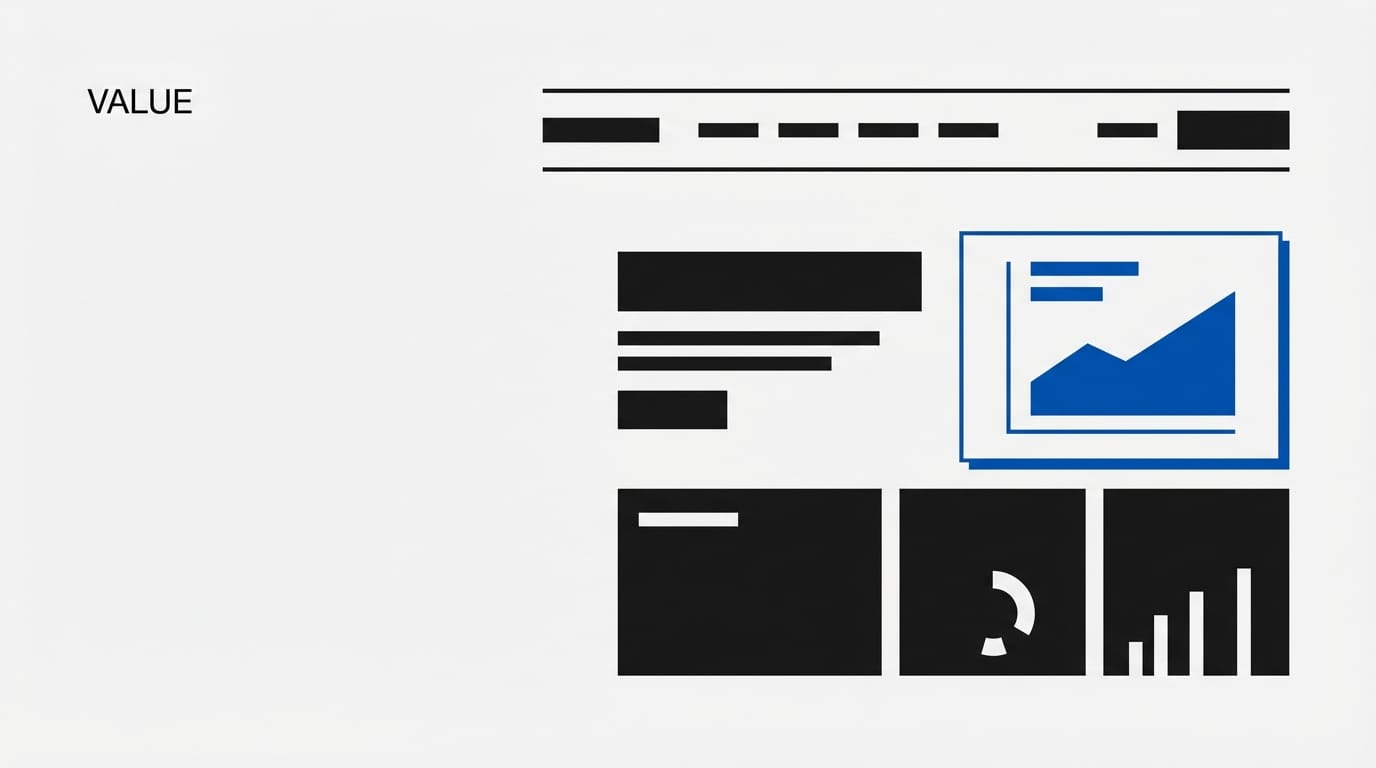
Enterprise buyers give your homepage about 17 seconds to answer four questions: can you handle our scale, do you understand our problem, can we trust you, and what happens next. This breakdown covers exactly what your homepage needs to communicate to keep that audience clicking deeper instead of bouncing to a competitor.
The 17-Second Gauntlet: Why Your B2B SaaS Homepage Design Needs to Work Harder
Enterprise buyers are not browsing. They are evaluating. They have a problem, and they are on a mission to find a solution that works for their specific scale and complexity. Our data, supported by industry research from groups like Gartner and Forrester, consistently shows that the average B2B buyer spends about 17 seconds on your homepage before deciding to click deeper, bounce, or dismiss your product entirely. That’s a tiny window to make a big impression, especially when your B2B SaaS homepage design has to convey trust, capability, and relevance to a sophisticated audience.
This isn’t about flashy animations or buzzwords. It’s about direct communication. These buyers care about four things above all else: category clarity, proof that you serve companies like theirs, signals about your integration ecosystem, and a clear statement of your security posture. Miss any of these, and those 17 seconds are up.
Category Clarity: The First Hurdle
Imagine you’re an IT director at a Fortune 500 company. You’ve been tasked with finding a new platform for, say, internal knowledge management. You land on a homepage. What’s the first thing you want to know? What exactly *is* this product? Too many B2B SaaS homepages fail this basic test.

Why Generic Messaging Fails
Many companies fall into the trap of using vague, aspirational language. “We empower businesses to achieve their full potential.” “Solutions that drive growth.” This tells an enterprise buyer nothing specific. They have specific problems. They need specific solutions. A marketing slogan that could apply to a dozen different software types is a red flag. It suggests a lack of focus, or worse, a product that doesn’t truly understand its market. When we worked with HP on their design systems, a core principle was always about direct utility. People aren’t looking for “solutions,” they’re looking for answers to “how do I do X better?”
How to Achieve Clarity
Your hero section, the content visible without scrolling, must immediately state what your product is and for whom. Use plain language. Avoid jargon unless it’s industry-standard jargon your target audience uses daily. For example:
- “AI-powered anomaly detection for manufacturing operations.”
- “Cloud-based project management for large-scale construction firms.”
- “Customer data platform built for regulated financial services.”
These examples are direct. They state the category, the core function, and often, the target buyer. If your B2B SaaS homepage design doesn’t make this crystal clear in the first few seconds, you’ve lost them. We recommend a simple formula: “Product X is a [category] for [target audience] that helps them [solve specific problem/achieve specific benefit].” Test this with people outside your company. If they can’t explain what you do in one sentence, you’re not clear enough.
Proof at Scale: Show, Don’t Tell
Enterprise buyers are risk-averse. They are investing significant capital, time, and reputation into adopting a new system. They need assurance that your product can handle their scale, their data volume, their user count, and their specific industry demands. This goes beyond a simple logo farm.
Beyond the Logo Farm
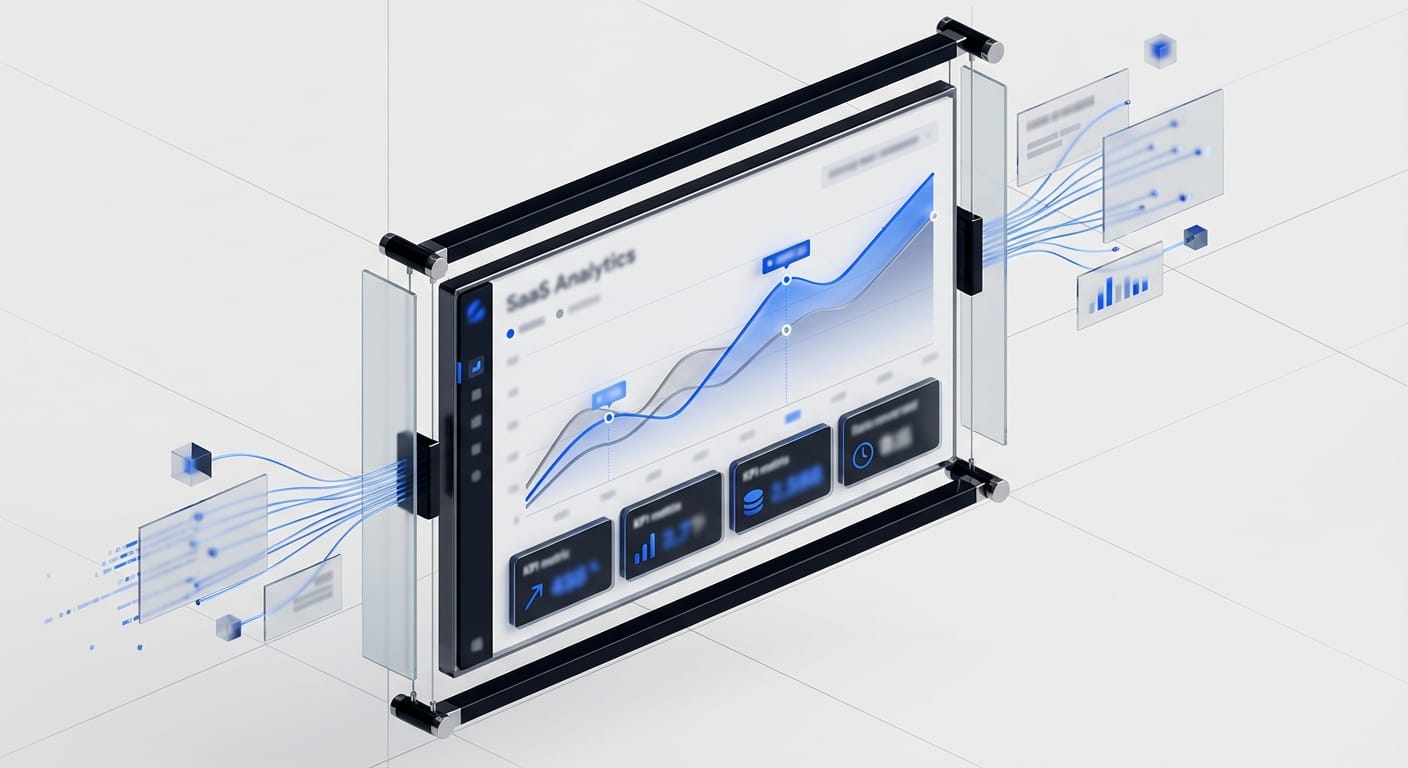
Displaying a dozen well-known logos is a start, but it’s often not enough. An enterprise buyer looks at those logos and asks: “Did they just do a small pilot project? Are these companies truly using the product at scale? Are they in my industry?” We’ve seen many homepages with impressive logos where, upon deeper inspection, the case studies were for small divisions or proof-of-concept projects. That doesn’t instill confidence.
Instead of just logos, consider:
- Highlighting specific industry leaders in your target verticals.
- Featuring direct quotes from executives at large organizations.
- Showcasing quantifiable results achieved by enterprise clients.
- Linking directly to detailed case studies that explain the scope and impact of your work with large companies.
When DesignX redesigned the catalog system for Klein Tools, we focused on showing the measurable impact: a 23% dealer adoption lift across 40,000+ SKUs. That’s concrete proof of our ability to handle complex, large-scale projects and deliver tangible results. Your homepage needs to convey similar depth for your B2B SaaS product.
Specificity Wins
Instead of a generic “Trusted by Fortune 500 companies,” say “Powering 3 of the top 5 global logistics companies.” Or, “Managing over $100 billion in assets for leading financial institutions.” These statements are specific, verifiable, and speak directly to the scale and industry relevance an enterprise buyer seeks. Show, for example, the number of users, transactions, or data points processed monthly for your largest clients if those numbers are impressive and relevant.
Integration Ecosystem: The Digital Handshake
No enterprise system lives in a vacuum. It connects to everything else. Enterprise buyers are not looking for another siloed solution. They are looking for a piece of their existing technology puzzle. The ability to integrate with their current tech stack is often a non-negotiable requirement.
Why Integrations Matter for Enterprise
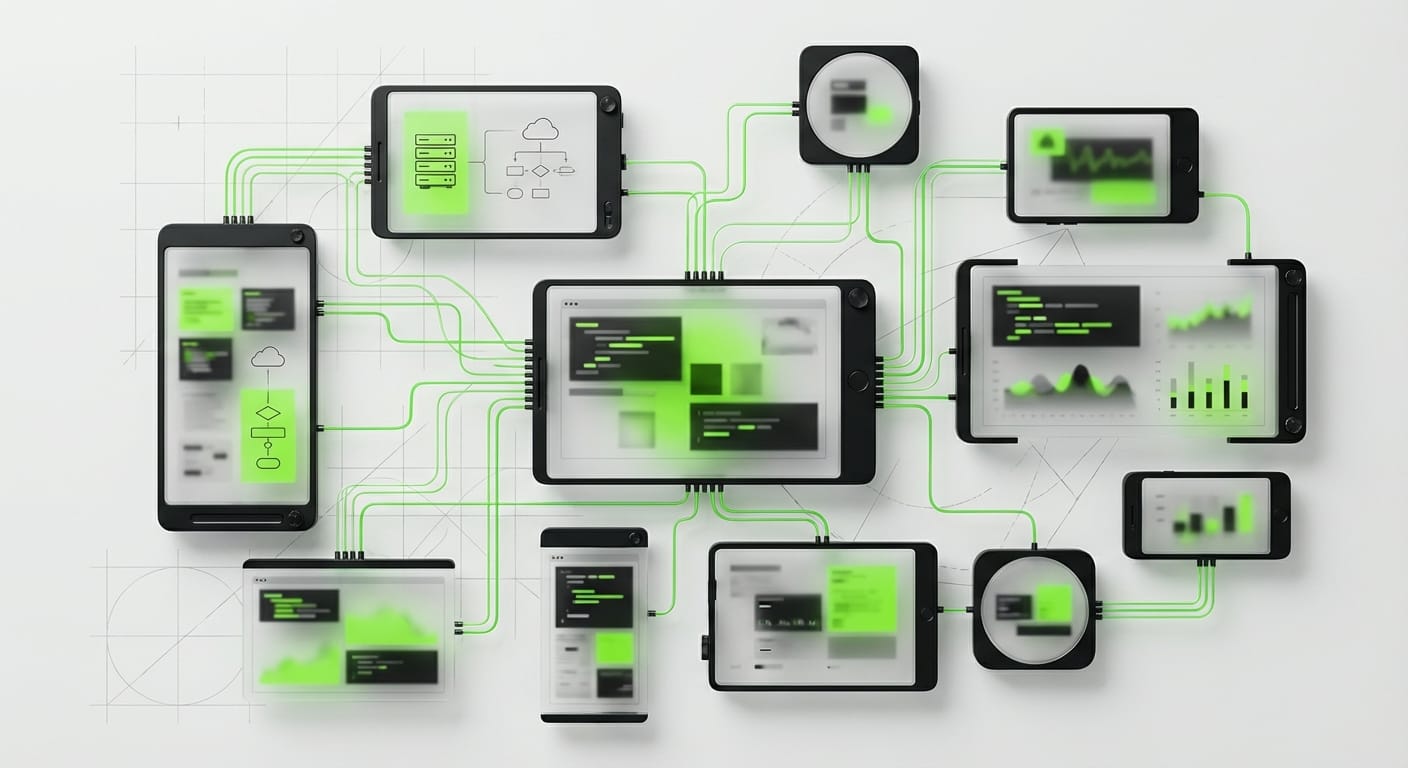
Enterprise IT departments already manage dozens, sometimes hundreds, of software applications. Implementing a new SaaS product that doesn’t play well with others creates enormous headaches, requiring custom development, data duplication, and manual processes. This adds cost, complexity, and risk. Buyers want to see that your product can connect to their CRM, ERP, HRIS, data warehouses, and other mission-critical systems. Think Salesforce, SAP, Oracle, Microsoft Dynamics, Workday, ServiceNow, Snowflake, Tableau. These are the giants your product needs to shake hands with.
Communicating Your Ecosystem
Your B2B SaaS homepage design should clearly signal your integration capabilities. This can be done through:
- A dedicated “Integrations” section or page linked prominently from the navigation.
- Displaying logos of key integration partners, especially those widely used in enterprise.
- Stating your API-first approach or developer-friendly tools.
- Mentioning specific marketplace listings, like Salesforce AppExchange or AWS Marketplace.
Don’t just say “integrates with your existing tools.” List them. Show a visual representation of your product connecting to common enterprise platforms. This demonstrates forethought and an understanding of the enterprise technology landscape.
Security Posture: Trust is Non-Negotiable
For enterprise buyers, security is paramount. A data breach can mean millions in losses, regulatory fines, and irreparable damage to reputation. They are not just concerned about their own data, but also their customers’ data. If your B2B SaaS homepage design doesn’t quickly address security, many enterprise buyers will move on.

The Enterprise Security Checklist
Enterprise buyers, or their security teams, will be looking for specific certifications and practices. These are not optional in this market:
- SOC 2 Type 2 compliance.
- ISO 27001 certification.
- GDPR and CCPA compliance.
- Data encryption standards (in transit and at rest).
- Information about your data centers and hosting providers (e.g., AWS, Azure, GCP).
These aren’t just badges to display. They represent rigorous audits and ongoing commitments to data protection. When we helped Oura Ring with their launch identity, a core consideration was establishing trust through design; for B2B SaaS, that trust extends deep into security protocols.
Displaying Your Commitment
Your homepage needs a clear, direct path to your security information. This usually means a “Security” link in the footer or main navigation. On that page, list your certifications, explain your data handling policies, and describe your infrastructure. For the homepage itself, a concise statement or a few key certification logos in the footer can act as an immediate signal of your commitment. For example, “SOC 2 Type 2 Certified. GDPR Compliant.” This immediately addresses a major concern for enterprise decision-makers.
Beyond the Big Four: Other Signals Enterprise Buyers Scan
While category clarity, proof at scale, integration capabilities, and security posture are the absolute essentials, enterprise buyers also look for other indicators of reliability and partnership potential.
Performance and Reliability
Uptime is not just a feature; it’s an expectation. Enterprise systems need to be operational 24/7 with minimal downtime. While you might not list detailed uptime statistics on your homepage, mentions of “enterprise-grade reliability” or “99.99% uptime SLA” can grab attention. If your product powers critical operations, buyers will want to know it’s built to withstand heavy loads and constant use.
Support and Service
Enterprise clients expect dedicated support, not just a help desk ticket system. On your homepage, signals like “24/7 dedicated support,” “SLA-backed service,” or “Customer Success Managers” can differentiate you. They want to know that if something goes wrong, they have a direct line to someone who understands their business and can resolve issues quickly. This is about partnership, not just a transaction.
Pricing Transparency (or Lack Thereof)
For enterprise, pricing is rarely simple, and often custom. While a public pricing page might not be feasible or desirable, the absence of *any* mention of how pricing works can be a barrier. A simple “Contact Sales for Enterprise Pricing” or “Tiered pricing based on usage and features” is better than silence. It acknowledges that you understand their needs are complex and require a conversation, rather than a one-size-fits-all approach.
The DesignX Approach to B2B SaaS Homepage Design
At DesignX, we don’t just make things look good. We build design systems and interfaces that drive business outcomes. Our process for B2B SaaS homepage design starts with deep user research, often interviewing your target enterprise buyers to understand their true pain points and evaluation criteria. We apply frameworks like the Jobs-to-be-Done theory to ensure your homepage messaging directly addresses what your buyers are trying to achieve. From there, we prototype, test, and refine, focusing on clarity, trust signals, and a conversion path that aligns with the enterprise sales cycle. We’ve applied this methodology for clients like Bodybuilding.com and Apellix, ensuring their digital presence speaks directly to their audience’s needs and moves them to action.
Actionable Steps for Your Homepage
Take these steps to improve your B2B SaaS homepage design for enterprise buyers:
- Review your hero section: Can a stranger understand what your product does and for whom in under 5 seconds?
- Audit your social proof: Are you just listing logos, or are you showing specific, quantifiable results from enterprise clients?
- Map your integrations: Clearly list the enterprise systems your product integrates with. Consider a dedicated integrations page.
- Verify your security: Ensure your SOC 2, ISO, GDPR, and other compliance statements are visible and easy to find.
- Evaluate support signals: Is it clear what kind of support an enterprise client can expect?
Ready to attract and convert more enterprise buyers with a homepage that speaks their language?
Contact DesignX to talk through your project.