
If you are searching for UI/UX design agency pricing, you probably do not need another vague answer about how “it depends.” You need a way to decide what level of spend matches the stakes of your product, your funnel, and your team.
Here is the DesignX point of view: most SaaS teams do not overpay because design is expensive. They overpay because they buy the wrong kind of design help. A lightweight subscription gets used like a strategy partner. A freelancer gets asked to solve cross-functional product issues alone. Or a full agency gets hired for a stream of small production tasks that never needed an agency in the first place.
That mismatch is where budgets go sideways.
UI/UX design agency pricing: what SaaS teams actually pay in 2026
These ranges are the ones we see most often when the work is scoped around real product or conversion goals, not random screen counts.
| Engagement | Typical range | Best fit |
|---|---|---|
| UX audit or diagnostic sprint | $5,000 to $15,000 | You know there is friction, but not where it lives |
| Single high-value flow redesign | $15,000 to $40,000 | Onboarding, pricing, checkout, or demo conversion paths |
| Website or product redesign phase | $30,000 to $120,000+ | Multiple journeys, new IA, deeper UI systems work |
| Senior-led agency retainer | $9,700+/month | Ongoing product velocity with strategy and implementation support |
| Design subscription service | $599 to $2,399+/month | Steady production work with lower decision risk |
The last row matters. As of April 15, 2026, ManyPixels publicly lists plans from $599 to $2,399 per month. That is useful context, but it is not the same buy as a senior product design partner. You are buying throughput there, not deep product judgment.
DesignX sits in a different lane. Our own projects usually start around $15,000 to $25,000, and our fractional design retainers start at $9,700 per month because the work includes senior strategy, UX thinking, interface design, and real implementation support. If the problem touches positioning, conversion, workflow complexity, or stakeholder alignment, that difference matters.
What moves UI/UX design agency pricing up or down
If two agencies give you wildly different numbers, it is usually because they are pricing different kinds of risk.
1. Product complexity
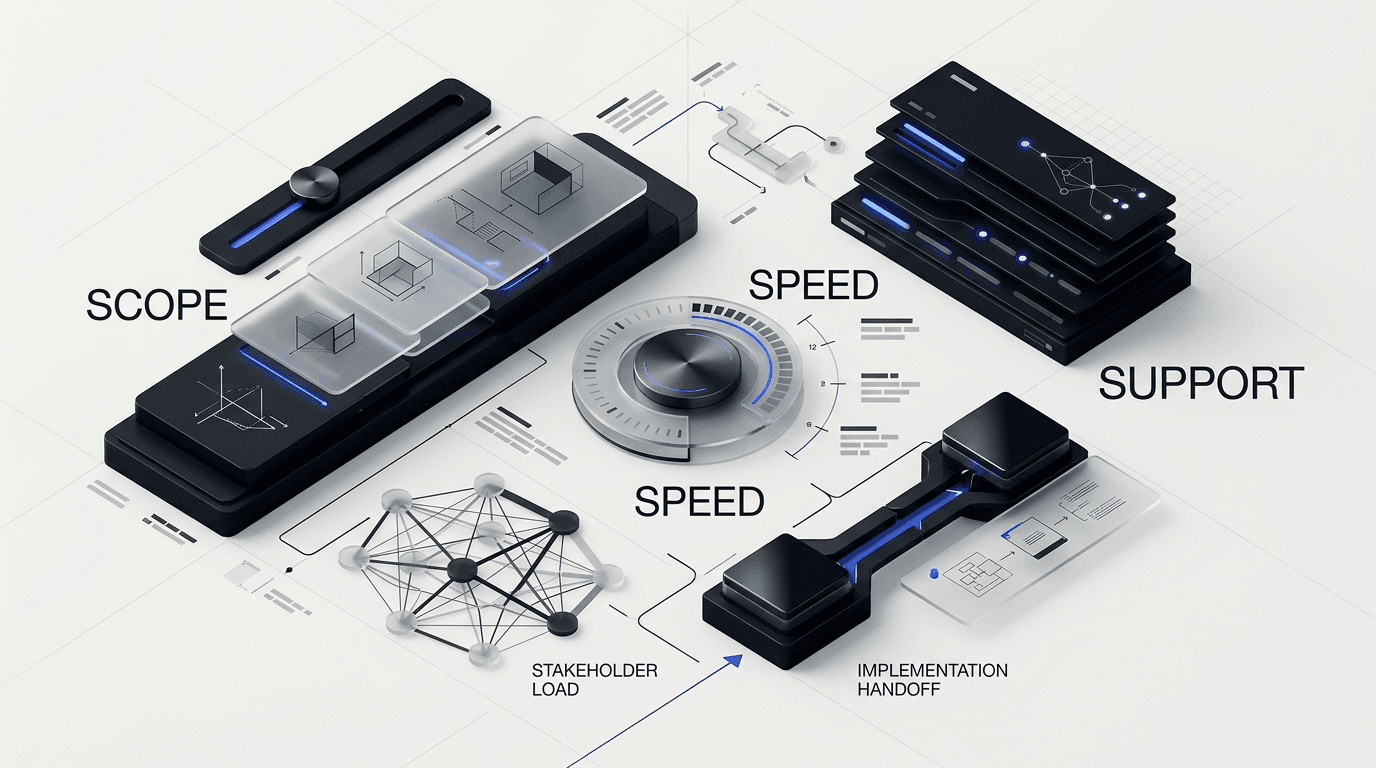
A SaaS marketing site with a simple lead form is one thing. A permission-heavy dashboard with dense data states, role-based logic, empty states, and billing edge cases is another. When the product is more complex, design time goes up because the team has to think through the parts users only notice when they are broken.
2. Decision stakes
If a wrong decision only means you revise a landing page later, the cost of being wrong is low. If the wrong decision slows activation, hurts sales demos, or confuses enterprise buyers, the cost of being wrong is much higher. That is where senior agency pricing tends to earn its keep.
3. Implementation support
Some teams only want polished screens. Others need annotated flows, component logic, QA support, and back-and-forth with engineering. The second version costs more, but it also prevents the classic handoff failure where a design looks good in Figma and falls apart in code.
4. Speed
A calm six-week sprint is cheaper than a compressed two-week push with heavy founder feedback, daily reviews, and parallel deliverables. Time pressure is rarely free. Somebody absorbs that cost.
5. Stakeholder load
A founder-led team with one clear decision-maker moves faster than a company where marketing, product, sales, and leadership all need separate buy-in. Review overhead changes pricing more than most buyers expect.
When agency pricing is worth it, and when it is not
This is where a lot of buyers get tripped up. They compare an agency quote to a freelancer or subscription quote as if the inputs are interchangeable. They are not.
Use a freelancer when: the scope is narrow, the art direction is already clear, and you can manage the work yourself. A freelancer is often the smartest buy for one-off page design, marketing assets, or a contained UI task.
Use a subscription when: you have a steady queue of lower-risk work. Think social assets, presentation design, ad variations, simple landing page updates, or predictable production support. Cheap subscriptions look expensive only when you give them work they were never meant to solve.
Use an agency when: you need strong diagnosis, sharper product thinking, tighter conversion logic, or a partner who can move across brand, web, and product without dropping the thread. If your buyer journey is leaky and multiple teams have opinions, agency pricing often protects you from a much bigger downstream bill.
That is why the “cheapest quote wins” logic breaks so often. Cheap design is only cheap if it gets you to the right answer quickly. If it creates rework, slows engineering, or misses the real business problem, it was not cheap at all.
Klein Tools is a good example of where this distinction matters. Their catalog ecosystem involved 40,000+ SKUs and a dealer experience problem with real revenue consequences. That was not a one-request-at-a-time queue problem. It required system thinking, coordination, and sharper decision-making. The result was a 23% lift in dealer adoption after the redesign, which is the kind of outcome that changes what “expensive” means.
Common pricing models, with the tradeoffs buyers actually feel
Fixed project fee
This works best when the scope is well defined and everyone agrees on what success looks like. It is good for a homepage overhaul, a pricing page redesign, or a focused onboarding sprint. It gets shaky when your team is still discovering the problem while the project is already underway.
Discovery or audit sprint
This is the best first buy for many SaaS teams. You spend less upfront, get a sharper view of the friction, and create a real roadmap before committing to a larger engagement. It is often the highest-ROI line item in the whole relationship.
Monthly retainer
Retainers work when design is not a one-time event for you. They are useful when you need ongoing product work, conversion improvements, experiments, and implementation support across a quarter or two. A retainer fails when the backlog is vague and nobody owns priorities.
Subscription design
Subscription design looks attractive because the monthly number is easy to understand. It can be a great deal for production work. The problem starts when teams expect strategic product calls, research depth, or cross-functional thinking from a model built around queue velocity.
How to budget for UI/UX agency work without overbuying
The cleanest way to keep UI/UX design agency pricing under control is to buy in phases.
- Start with the journey that matters most. That might be homepage to demo, trial signup to activation, or pricing page to booked call.
- Define the business question. Are you trying to lift activation, shorten sales cycles, improve lead quality, or clean up enterprise trust issues?
- Pay for diagnosis before full redesign. If you cannot explain what is broken, you are not ready to buy a huge redesign.
- Set aside implementation budget. A lot of teams spend the full budget on design and then act surprised when launch quality drops in handoff.
- Hold back room for iteration. The first round should get you closer to the answer. It should not pretend to be the final word on day one.
If you want a simple split, a healthy planning model is often 20% for diagnosis, 60% for execution on the highest-value flow, and 20% for implementation QA and iteration. That is a much safer use of budget than blowing everything on a broad visual refresh that feels fresh but leaves the conversion problem untouched.
Questions to ask before you sign an agency proposal
These five questions will tell you more than the portfolio will.
- What business outcome is this scope meant to move? If the answer is vague, the pricing probably is too.
- Who is actually doing the work each week? Senior sales, junior delivery is a common failure mode.
- What happens during implementation? Screens alone are not a launch plan.
- How do you handle edge cases and state changes? Good UI is not just the happy path.
- What would make you recommend a smaller engagement first? A strong agency should be willing to downscope if that is the smarter move.
If you are evaluating options now, this guide pairs well with our breakdown of design agency pricing more broadly, our comparison of design agency vs freelancer vs subscription, and our piece on website redesign ROI. If your product team is still deciding whether an external partner is the right move, read MVP design for startups, B2B UX design, startup branding, and AI-generated UI design next.
The DesignX rule for pricing decisions
If you need more output, buy output. If you need better decisions, buy decision quality.
That is the whole game.
For startups and SaaS teams, agency pricing makes sense when the work sits close to revenue, product adoption, or buyer trust. If you are changing the story your site tells, reworking a pricing page, tightening onboarding, or trying to make a dashboard easier to buy and use, the price should be judged against the cost of staying stuck, not against the cheapest line item on the internet.
Ready to make your design budget work harder? Let’s talk.
Frequently Asked Questions
How much does a UI/UX design agency cost for a SaaS company?
Most SaaS teams should expect a wide range because the work itself varies so much. A focused audit or strategy sprint can start around $5,000, while a deeper redesign with multiple journeys and implementation support can move into the tens of thousands. The right comparison is not only price. It is scope, risk, and the cost of getting the wrong answer.
Why is UI/UX design agency pricing higher than a subscription service?
A subscription service is usually priced around production capacity and queue speed. An agency is usually priced around diagnosis, senior judgment, and the work needed to make design decisions hold up in the real world. If your problem is mostly output, a subscription can be enough. If your problem is strategic, cross-functional, or conversion-related, the cheaper model often becomes more expensive later.
Should we pay for a UX audit before a full redesign?
In most cases, yes. A good audit helps you see where friction lives before you spend real money changing everything around it. That protects the budget and gives your team a better brief for the next phase. It also makes it easier to compare agency proposals on the same problem instead of on different assumptions.
What is usually included in agency pricing?
A strong agency proposal should spell this out in plain language. At minimum, you should expect discovery, flow or IA thinking, interface design for the agreed scope, review rounds, and a handoff package. Better proposals also include edge-case thinking, implementation support, and QA guidance. If those pieces are missing, the quote may look cheaper than it looks on paper.
How can we tell if an agency quote is fair?
Look at the depth of thinking behind the number. A fair quote should connect the work to a business goal, show who is doing the work, define the scope in plain language, and explain what happens after design review. If the proposal is just a pile of screens and hours, it is hard to know what you are actually buying. Fair pricing is usually the price of a clear process, not just a lower number.
If you want a senior design partner to turn this into a sharper product, brand, or website, see how DesignX works.