
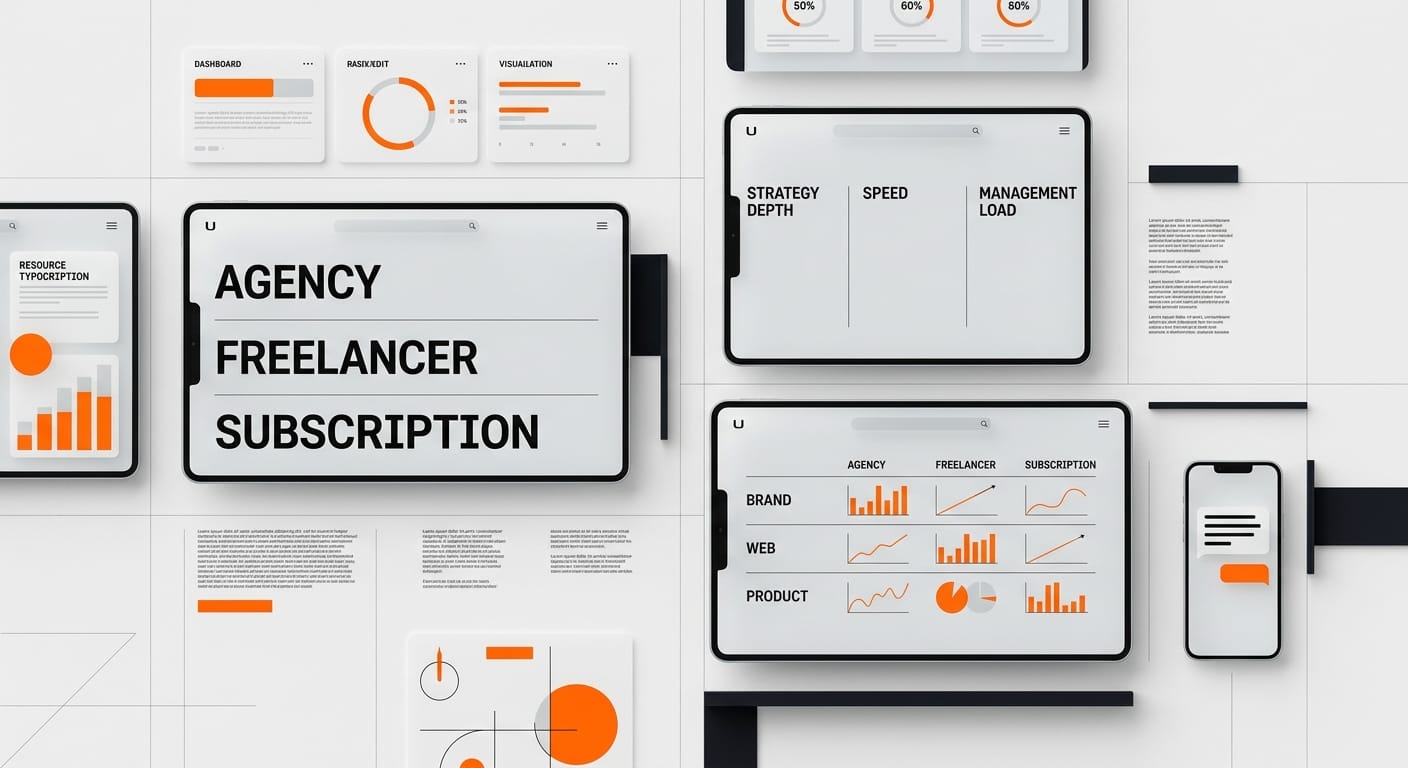
If you are comparing design agency vs freelancer vs subscription, you are not just buying design output. You are choosing how much strategy comes with the work, how much management your team has to absorb, and how much risk sits inside your launch.
That is why these decisions go sideways so often. A freelancer can look cheap until your marketing lead becomes the project manager and creative director. A subscription can look fast until the queue hits a homepage rewrite, a landing page, and a product onboarding flow in the same week. An agency can look expensive until the launch actually has to work.
At DesignX, we have seen all three models do solid work in the right context. We have also seen teams lose a quarter because they forced the wrong model onto the wrong problem. This guide breaks down where each one fits for branding, web, and product design work, and where it starts to break.
Design Agency vs Freelancer vs Subscription: The Quick Answer
| Model | Best fit | Typical cost signal | Main trade-off |
|---|---|---|---|
| Freelancer | Tight scopes, fast specialist help, one clear owner on your side | Upwork currently lists graphic designers at $15 to $35 per hour, web designers at $15 to $30, and UX designers at $25 to $39 | Low sticker price, higher management load and continuity risk |
| Subscription | Steady production work, design requests that can move through a queue, predictable monthly spend | As of April 14, 2026, DesignJoy advertises $4,995 per month with one request at a time and average 48-hour delivery. ManyPixels lists plans from $599 per month with one daily output and 1 to 2 day delivery | Fast for throughput, weaker for strategy, complex UX, and multi-threaded work |
| Agency | Brand positioning, website redesigns, product UX, launches, and cross-functional work | Varies widely. At DesignX, most project work lands in the $15k to $25k range, with fractional retainers starting at $9.7k per month | Higher upfront spend, lower decision risk when the work is high stakes |
Here is the blunt version. If you already know what to make, a freelancer or subscription can be smart. If you still need to figure out what should exist, how it should convert, and what the system has to support across teams, that is agency work.
That distinction matters because the cheapest option often becomes the most expensive once rework, missed handoffs, and internal coordination start piling up. If you want broader pricing context, our design agency pricing guide is a useful companion.
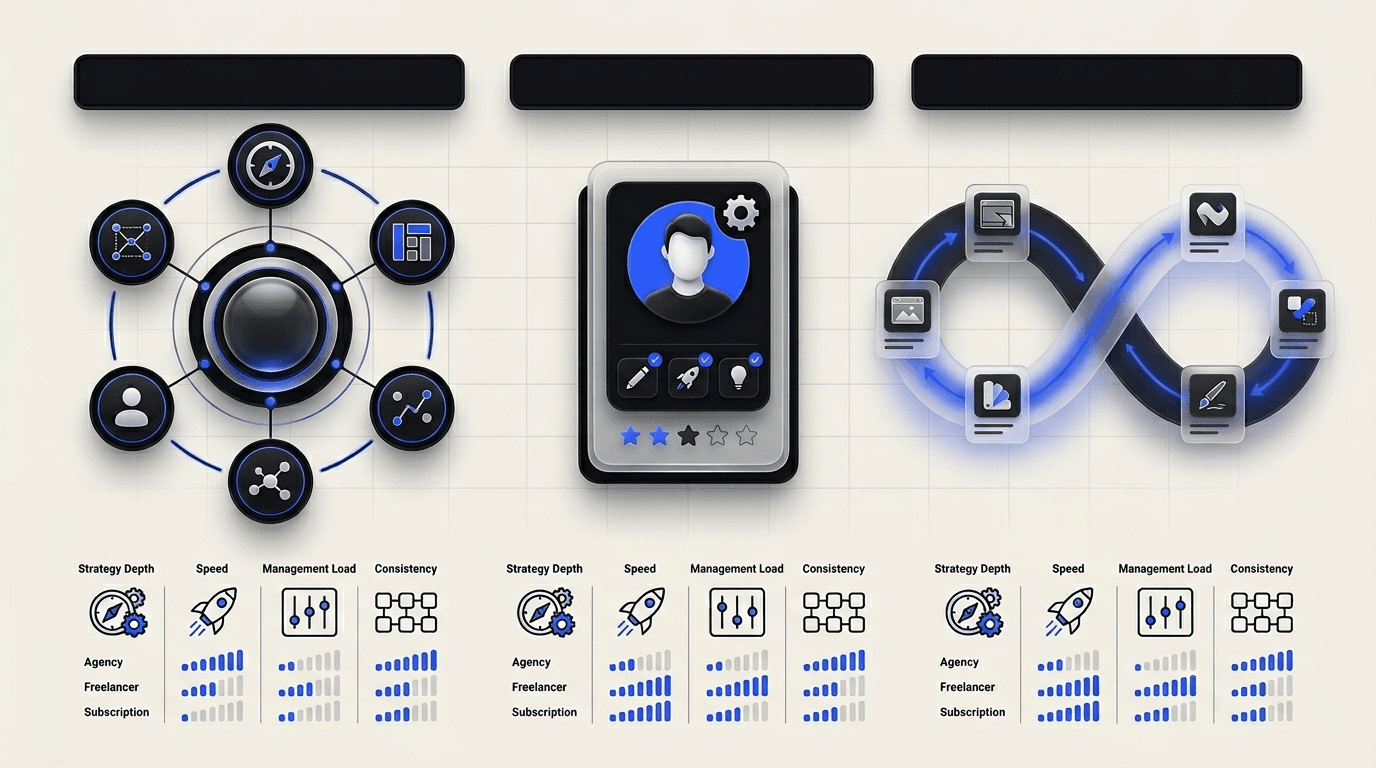
When a Freelancer Is the Right Call
A strong freelancer is great when the problem is already framed. You know the scope, the outcome is visible, and one person with the right skill can carry the work without needing strategy workshops, stakeholder alignment, or a lot of cross-functional coordination.
That is one reason the model keeps growing. On April 23, 2025, Upwork said 28 percent of U.S. knowledge workers were freelancing or working independently. There is real talent in that market, and for the right job it is a fast way to buy skill without committing to a team structure.
Use a freelancer when you need things like:
- a landing page refresh with a clear brief
- marketing site design support after the direction is already set
- a product UX audit from a specialist
- ad creative, email graphics, decks, or campaign assets
The catch is management overhead. Someone on your team still has to write the brief, review the work, connect design choices to business goals, and catch downstream issues before they ship. If that person is a founder or growth lead who already has too much on their plate, the low hourly rate stops being the real cost.
Freelancers also create a bus-factor problem. If one person disappears, gets booked, or loses context midstream, the project slows down fast. That risk is manageable for a one-off page. It is not manageable when the work affects your brand system, website conversion flow, and product experience at the same time.
When a Design Subscription Makes Sense
The subscription model works best when your team has a steady stream of requests and most of them can move through a queue. Think sales collateral, paid social creative, email graphics, blog images, simple landing pages, or routine web and brand production.
The appeal is easy to understand. As of April 14, 2026, DesignJoy advertises one request at a time with average 48-hour delivery. ManyPixels says its Advanced plan starts at $599 per month, includes one daily output, and usually delivers in 1 to 2 business days. If your bottleneck is asset production, that can be a clean buy.
Where subscriptions break is where judgment gets messy. ManyPixels says outright that if you need multiple meetings with a brand strategist to figure out what you want, the service may not be the right fit. It also says it does not cover complex UI/UX, prototyping, or coding. That is not a flaw in the model. It is the model being honest about what a queue can handle well.
A design subscription is usually strongest when you already have strategic direction and need efficient execution against it. It is weaker when you are sorting out category positioning, information architecture, website messaging, conversion paths, or a product system that touches engineering and PM. Those jobs need live thinking, trade-offs, and back-and-forth, not just throughput.
In other words, subscriptions are production engines, not decision engines. That makes them useful, but only if you are clear about the difference.
When an Agency Is Worth It
An agency earns its keep when the work matters enough that getting it wrong is expensive. That includes repositioning your brand, redesigning a website that drives pipeline, reworking a product onboarding flow, or bringing structure to a design problem that spans marketing, product, and leadership.
This is where an agency has an unfair advantage over the other two models. You are not hiring one pair of hands. You are buying a system for decisions, quality control, prioritization, and delivery. Strategy, design, feedback management, and execution live closer together, which cuts down on internal translation work.
That matters even more when multiple stakeholders are involved. One founder wants speed. Marketing wants conversion lift. Product wants consistency. Engineering wants something they can actually build. A senior agency team can absorb those pressures and keep the work coherent. A freelancer or subscription often pushes that alignment burden back onto your team.
For high-stakes website work, this is also why teams often move toward agency help after trying lighter options first. If you are planning a site overhaul tied to revenue, our guides on website redesign ROI and design sprints vs traditional agencies are useful next reads.
The Hidden Costs That Change the Math
Most comparison posts stop at price. That is not enough. The real decision sits in the hidden costs around the work.
1. Briefing cost
The less strategic support you buy, the more your team has to define the problem up front. That sounds efficient until nobody actually has the time or design judgment to do it well.
2. Review cost
Cheap production gets expensive when a founder, marketer, and PM all spend hours rewriting feedback in Slack, Loom, and comment threads. That labor rarely shows up on the invoice, but it is still real.
3. Rework cost
If a freelancer or subscription gets halfway through a website before the messaging shifts, you can end up paying twice, once for the first pass and again for the correction. Agency work costs more up front partly because the decision-making is built in earlier.
4. Employer cost, if you are comparing against hiring
If the alternative is bringing the work in-house, remember that salary is not the full number. On March 20, 2026, the U.S. Bureau of Labor Statistics reported that benefits accounted for 29.9 percent of private-industry compensation in December 2025. That does not mean an agency is always cheaper than a full-time hire. It does mean the spreadsheet should reflect the real employer cost, not just base pay.
Design Agency vs Freelancer vs Subscription for Branding, Web, and Product Design
Branding
For a logo extension, campaign art direction, or cleanup work inside an existing system, a freelancer can do well. For ongoing collateral, a subscription can be efficient. For positioning, identity direction, messaging, and a brand system that needs to hold across sales, marketing, and product, agency work usually wins because the business questions are part of the design problem.
If your company is still sharpening who it is and how it should look in-market, read our startup branding guide first. It will help you avoid buying surfaces before you settle the story.
Web design
A freelancer can be a strong fit for a simple landing page or a focused refresh. A subscription can help when you need a steady cadence of page variants, campaign assets, or lighter website production. An agency is usually the better call when the site has to combine messaging, CRO, visual identity, information architecture, and build-ready handoff.
This is the line many buyers miss. Website work is rarely just page decoration. It is positioning, offer clarity, hierarchy, trust signals, and user flow. That is why our own website and brand engagements often sit closer to the agency model than the queue model.
Product design
Product work has the least room for vague ownership. A freelancer can help on a flow audit, a compact feature, or a burst of specialized UX support. A subscription is usually the weakest option here because product work depends on discovery, edge cases, collaboration with engineering, and design systems thinking. For a broader product surface, especially in B2B or healthcare, agency support tends to be more durable.
If product UX is part of your decision, our pieces on B2B UX design and MVP design for startups go deeper on where senior product judgment changes outcomes.
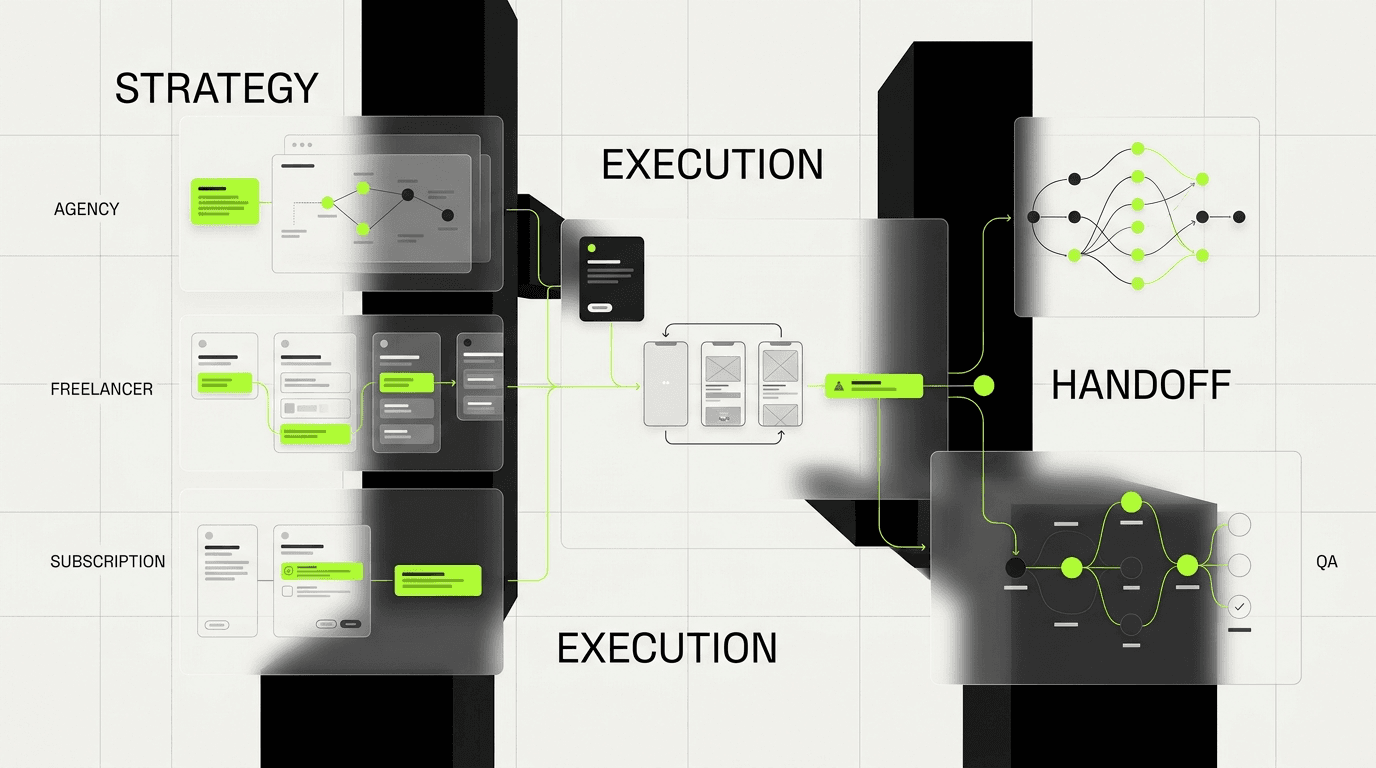
A Five-Question Framework for Making the Call
If you are still stuck, use these five questions.
- Is the work strategically important? If the answer is yes, move toward agency support.
- Can your team write a sharp brief and direct quality? If yes, a freelancer becomes more viable.
- Is the workload steady and queue-friendly? If yes, a subscription may fit.
- Will the work touch more than one function? If yes, agency support gets stronger fast.
- What happens if the first pass is wrong? If the cost of being wrong is high, buy the model with the best decision process, not the lowest rate.
That last question usually decides it. Teams do not regret overpaying for design nearly as often as they regret underbuying the structure around it.
So Which Option Is Right for Your Brand?
If you need targeted execution and already know what good looks like, pick a freelancer. If you need a steady stream of lower-risk design output and can live with queue constraints, pick a subscription. If you need strategy, systems, sharper judgment, and a team that can carry work across brand, web, and product, pick an agency.
That is the clean answer to design agency vs freelancer vs subscription. The right choice is less about design style and more about problem shape. If the scope is narrow, a freelancer can work well. If the workload is steady and queue-friendly, a subscription can be efficient. If the work is high-stakes, crosses teams, or needs sharper strategic judgment, an agency is usually the better bet.
There is also a middle ground that buyers often want but comparison posts miss. Some teams need agency-level thinking up front, then a lighter retained rhythm once the system is built. That is where DesignX tends to fit best. We do not try to sell strategy when you only need production, and we do not pretend a production model can solve a strategy problem.
If you want help figuring out which model fits your current stage, talk with DesignX. We can usually tell in one conversation whether you need a specialist, a queue, or a senior team.
Frequently Asked Questions
Is a design subscription cheaper than hiring a freelancer?
Sometimes, but the better question is what kind of work sits inside the monthly fee. A freelancer can be cheaper for a one-off landing page, audit, or burst of specialized help because you only pay for the scoped work. A subscription starts to win when your team has constant requests and enough volume to keep the queue full. If the workload is inconsistent, the monthly fee can become dead spend.
Can one freelancer handle branding, website design, and product UX?
Some senior freelancers can cover more than one lane, but that does not mean they should own every lane at once. Branding, web, and product work ask for different muscles, and the handoffs between them matter. The more the project spans strategy, messaging, UX, and stakeholder alignment, the more one-person delivery starts to strain. That is usually the point where an agency team becomes safer.
When does an agency beat a subscription?
An agency wins when the work needs live judgment, not just steady production. That includes repositioning a brand, restructuring a website, designing a new product flow, or guiding a launch with multiple stakeholders in the loop. Subscription models are built to keep requests moving. Agencies are built to make harder calls, manage trade-offs, and keep the whole system coherent.
Should an early-stage startup avoid agencies?
Not automatically. If the startup only needs a few graphics or a simple marketing page, an agency may be too much structure for the job. If the company is trying to nail positioning, ship an MVP, and look credible to buyers or investors, agency support can save money by preventing weak decisions and rework. The question is not stage alone, it is how expensive the wrong answer would be.
What if we need strategy first and production later?
That is a common pattern, and it is usually a good one. A team can use agency support to set direction, build the system, and make the hard choices first. After that, a freelancer, internal hire, or subscription can carry more of the production work against a clearer standard. This approach works well for brands that need senior thinking up front but do not want to keep a heavier delivery model forever.
If you want a senior design partner to turn this into a sharper product, brand, or website, see how DesignX works.
Related DesignX reading: fractional design team comparison adds context for teams comparing agency, sprint, and subscription paths.