
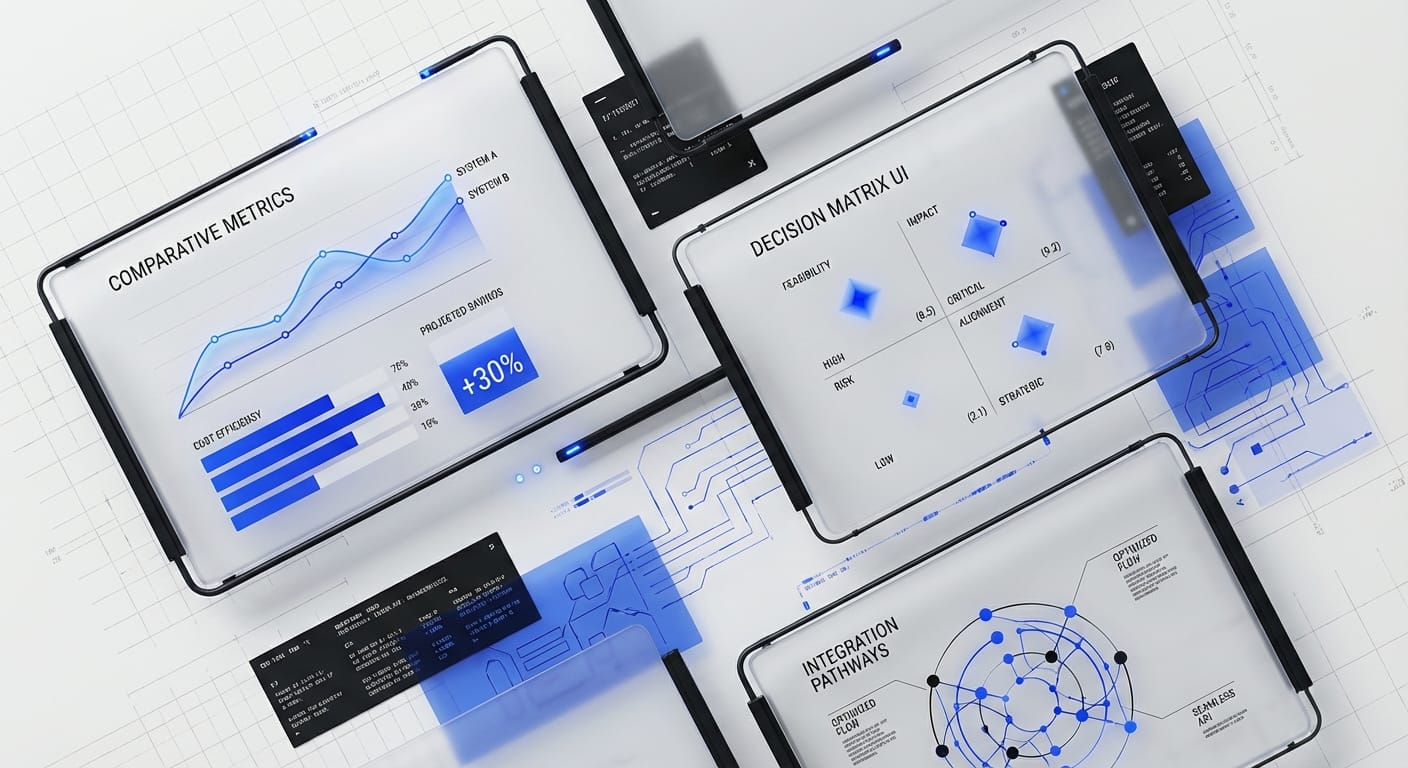
The decision between in-house designers and a design agency involves velocity, risk, and capability. Cost is only one visible part of this complex decision for product teams.
Every product company reaches the moment where someone asks: should we hire designers in-house or work with an agency?
The question sounds like a cost question. It’s actually a velocity, risk, and capability question. The cost is just the most visible part.
Here’s an honest look at both options, built from 20+ years of working on both sides of the decision, at companies like Shopify, eBay, and HP, and now running DesignX with clients who’ve tried both.
The Real Cost of In-House Design
A senior product designer in 2026 costs $120,000 to $180,000 in base salary depending on location and experience. Add 25-30% for benefits, payroll taxes, and equipment. You’re at $150,000 to $230,000 per year before you’ve hired a design manager, a UX researcher, or anyone to handle brand and marketing design separately from product design.
That number also assumes you hire the right person on the first try. Design roles have a 30-40% first-year turnover rate in competitive markets. A failed hire costs 1.5x to 2x the annual salary when you factor in recruiting, onboarding, and the gap between when they leave and when their replacement is fully productive.
The real in-house cost picture per year for a small but capable product design function:
- 2 senior designers: $300,000 to $400,000
- 1 design manager (part-time or shared): $80,000 to $120,000
- Tools, subscriptions, research tools: $15,000 to $30,000
- Recruiting costs (assuming 1 backfill per year): $20,000 to $50,000
You’re looking at $400,000 to $600,000 per year for a lean team that still has capability gaps.
The Real Cost of an Agency
A serious design agency engagement for a product company runs $5,000 to $25,000 per month for ongoing retainer work, or $30,000 to $150,000 for a scoped project. The wide range reflects the scope, seniority, and deliverable depth.
The math comparison that companies usually run:
- Agency retainer at $15,000/month = $180,000/year
- Two in-house designers = $450,000+ all-in
On paper the agency is cheaper. But the comparison is incomplete, because the two options aren’t delivering the same thing.
What You Actually Get From Each
In-house design gives you:
- Deep institutional knowledge of your product and users over time
- Faster day-to-day iteration and collaboration with engineering
- Direct availability for small, ongoing design tasks that don’t justify agency billing
- Cultural alignment and accountability that’s harder to enforce externally
An agency gives you:
- Access to a range of specializations that no two-person team can cover (product design, brand, web, motion)
- Outside perspective on problems your team is too close to
- Faster ramp-up on major initiatives (agencies have solved your problem before)
- The ability to scale up or down without hiring and firing
The comparison only makes sense if you’re honest about what you actually need.
Where In-House Wins
If your product ships continuously, has a large and complex design surface, and needs designers embedded in daily standups and sprint ceremonies, in-house wins. The collaboration overhead with an external agency adds real friction to that kind of work.
If you’re in hypergrowth and need design decisions made in hours, not days, the communication cycle with an agency can slow you down.
And if design is genuinely a core competitive differentiator for your product, if the quality of your UX is why customers choose you, then the institutional depth that comes from a team that has lived with your product for years is worth the cost.
Where an Agency Wins
If your design needs are project-heavy but not continuous, an agency is almost always the better financial decision. Paying $450,000 a year for designers who are at 60% utilization is expensive underuse.
If you need a capability you don’t have in-house, a full rebrand, a new product line design, a website overhaul, agencies have done it before. Your first hire in that specialty hasn’t.
If you’re a startup that needs to prove product-market fit before building a design team, an agency gets you to market faster, and the results tell you what to hire for.
The Option Most Companies Miss
The best setup for most mid-market product companies is a hybrid: one strong in-house design lead who owns product design day-to-day, paired with an agency for brand work, major initiatives, and overflow.
That’s what many of DesignX’s clients run. One internal design director who knows the product deeply. DesignX handles brand evolution, site redesigns, new product design sprints, and anything requiring a team that goes deeper than one person can.
The in-house designer manages the agency relationship. Everyone knows their lane. The company gets depth and continuity without building a department they don’t need year-round.
The Questions to Ask Before Deciding
- What percentage of our design work is ongoing iteration vs. project-based?
- Do we need design across multiple specializations, or primarily one?
- Can we afford 18 months to hire, onboard, and get a designer fully productive before we see real output?
- If we hire and things don’t work out, what does that cost us?
There’s no universal answer. But most companies underestimate how long it takes to hire well, onboard properly, and get a designer to full contribution. A good agency is productive in week one.
FAQ
Is it cheaper to hire in-house or use a design agency?
For project-heavy work, agencies are usually cheaper when you account for full in-house employment costs. For continuous, high-volume design work where you have consistent utilization, in-house can be more cost-effective at scale.
How long does it take to hire a good designer in-house?
Realistically 2 to 5 months from posting to an accepted offer, plus 30 to 90 days to full productivity. Budget 6 months minimum before you have the output you’re planning for.
Can an agency replace an in-house design team entirely?
For most companies, no. Agencies are most effective for defined projects, major initiatives, and specialized work. The ongoing product iteration that requires embedded collaboration is better handled in-house. The hybrid model, internal design lead plus an external agency, works well for most mid-size product companies.
What are the biggest risks of using a design agency?
The two most common issues are knowledge transfer (when an engagement ends, institutional knowledge walks out the door) and communication overhead on fast-moving projects. Both are manageable with clear documentation requirements and defined handoff processes built into the contract.
When should a startup hire its first in-house designer?
When design is a daily, ongoing function that drives product decisions, not a project-based need. For most early-stage startups, an agency or senior design contractor gets you further faster than a first full-time hire.
Bottom Line
The right answer depends on your volume, velocity, and what you’re trying to build. Don’t make this decision based on a cost comparison that ignores half the real costs on each side.
If you’re working through this decision and want an honest perspective on whether an agency makes sense for your situation, talk to us. We’ll tell you if we’re the right fit or if hiring in-house makes more sense.