
Traditional agencies cost more than their invoice due to long redesign timelines, like six months, leading to delayed pipeline and slower product learning. Design sprints offer faster outcomes, lower execution risk, and clearer accountability, making 30-day delivery a winning model for leadership teams.
If your redesign takes six months before anything ships, you are paying more than the agency invoice. You are also paying in delayed pipeline, slower product learning, and months of internal drag.
That is why more leadership teams are rethinking the old agency model. They want outcomes faster, with lower execution risk and clearer accountability.

Why this comparison matters now
Traditional agency engagements were built for a different era. Long discovery phases, heavy decks, and multi-round approvals made sense when market cycles moved slower. Today, SaaS categories shift quickly, buyer expectations change quarterly, and teams need evidence before scaling investment.
In this environment, speed without quality is dangerous. Quality without speed is expensive. The right model delivers both.
The two models in plain terms
Traditional agency model: Large scope, long timeline, milestone billing, and handoff-heavy process. Work often moves from strategy to design to development in separate waves.
Design sprint model: Focused scope, fixed delivery window, cross-functional decisions in real time, and direct path from concept to implementation assets. Teams ship faster and learn faster.
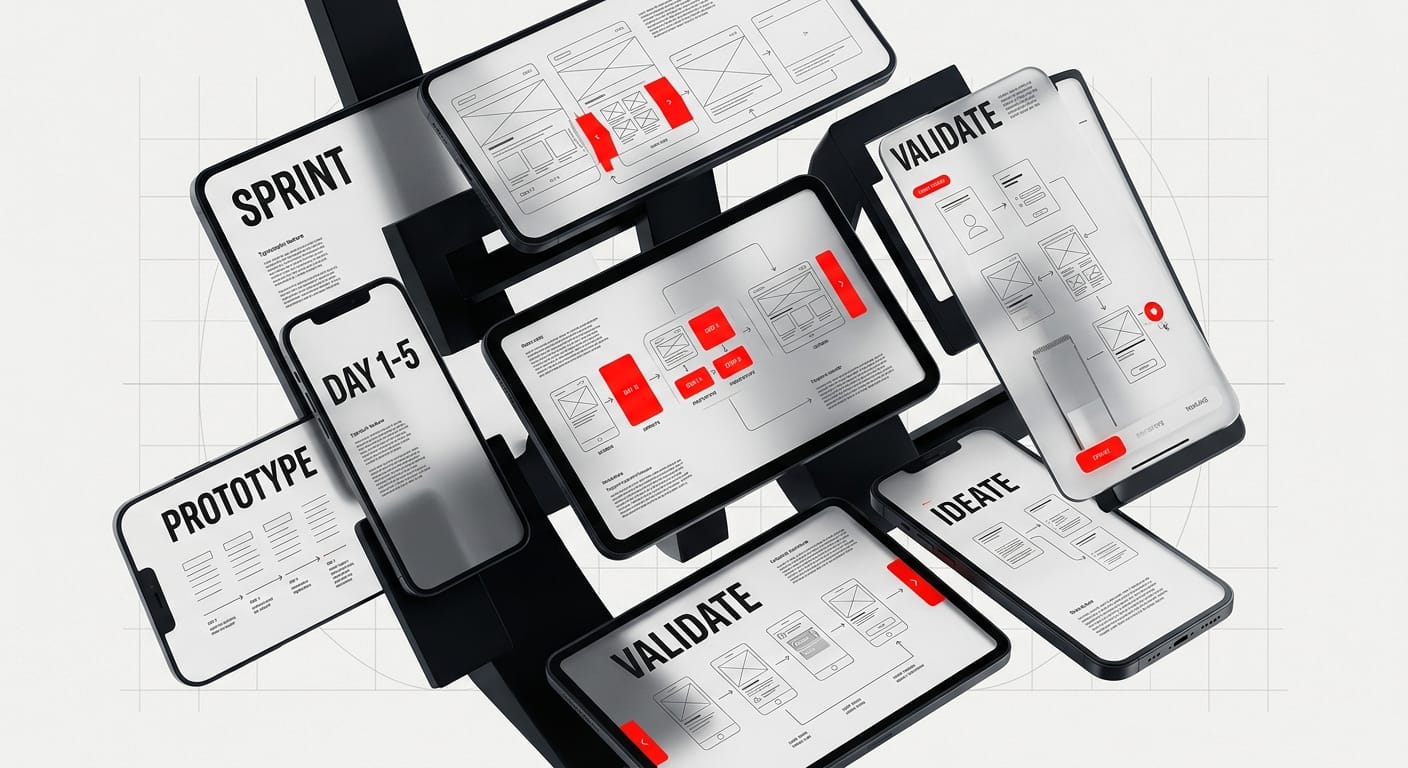
Timeline comparison. Where months disappear
Many traditional engagements begin with 4 to 8 weeks of discovery, then another 6 to 12 weeks of design rounds, then development handoff and QA cycles that stretch further. By the time launch happens, assumptions made early in the project may already be stale.
A strong sprint model compresses this by aligning key stakeholders early, limiting revision loops, and making scope discipline non-negotiable. DesignX‘s 30-day sprint framework is built for this: diagnose high-impact pages and flows, redesign with conversion intent, then ship assets with implementation clarity.
Cost comparison. Invoice cost vs true business cost
Leaders often compare agency options on proposal price only. That is incomplete. True cost has at least five parts:
- Vendor fees: Statement of work and change orders.
- Internal coordination cost: Time from marketing, product, engineering, and leadership.
- Opportunity cost: Revenue delayed while key pages or flows remain underperforming.
- Rework cost: Iterations caused by unclear decisions or weak handoffs.
- Execution risk cost: Lost momentum when launch slips.
When you include these factors, a cheaper proposal can become more expensive than a focused sprint.
Sample cost-benefit scenario for a growth-stage SaaS company
Consider a SaaS company with a monthly pipeline goal tied to website demo conversions.
- Traditional path: 5 to 7 month redesign cycle, broad scope, extended approvals.
- Sprint path: 30-day focused redesign on highest-value pages and demo flow.
If the sprint launches four months earlier and even modestly improves conversion, the recovered pipeline value can outweigh pricing differences quickly. The earlier you ship meaningful improvements, the sooner the business compounds.
This is why finance leaders increasingly ask for speed-adjusted ROI, not just vendor rates.
Outcome quality. The common objection to sprints
A fair question comes up often. Does faster delivery reduce strategic depth? It can, if the sprint is run as a rushed production exercise. It does not, if the sprint has clear structure and senior decision involvement.
High-performing sprints maintain quality through:
- Upfront KPI alignment before design starts.
- Tight problem framing and scope boundaries.
- Daily feedback rhythm with decision makers present.
- Production-ready outputs for engineering, not vague concept files.
- Post-launch measurement plan tied to business outcomes.
Speed becomes an advantage when it is paired with discipline.
Where traditional agencies still make sense
Traditional models can still be right in certain cases.
- Global rebrands with many sub-brands and legal constraints.
- Complex offline and retail rollouts requiring long coordination windows.
- Multi-year transformation programs with procurement-heavy structures.
Even in these cases, many teams now carve out sprint tracks for digital conversion work so they can show progress while broader initiatives continue.
How DesignX positions the 30-day model
DesignX built its sprint approach for companies that need premium design quality without enterprise drag.
- Week 1: Audit, baseline metrics, and prioritization of highest business-impact surfaces.
- Week 2 and 3: Redesign core journeys with conversion intent and implementation practicality.
- Week 4: Finalize assets, handoff with precision, and align measurement for post-launch learning.
The goal is not to redesign everything. The goal is to move the metrics that matter first, then scale from proof.

Decision checklist for CMOs, founders, and VPs
If you are choosing a model this quarter, ask these questions.
- How quickly do we need impact on conversion or activation metrics?
- Do we have clear KPI ownership for this project?
- Can our internal team make decisions weekly, or only monthly?
- Is scope focused enough to ship meaningful change in 30 days?
- What is the cost of waiting two extra quarters for launch?
Your answers usually make the right model obvious.
Final takeaway
The real debate is not sprints versus agencies as labels. The real debate is whether your delivery model matches current business speed and accountability needs. For many modern teams, sprint-based design wins because it reduces delay, controls hidden costs, and ties creative work to measurable outcomes quickly.
When results matter this quarter, a focused 30-day sprint is often the most rational choice.
Procurement and governance. The overlooked variable in delivery speed
Many teams blame creative process when projects slow down, but governance is often the bigger bottleneck. If legal, security, brand, and executive stakeholders only review work at the end of long phases, rework is almost guaranteed. Sprint models reduce that risk by creating frequent review points and smaller decision packets.
For enterprise buyers, this matters because delay has a compounding cost. A missed launch date can affect campaign timing, pipeline targets, and product adoption goals in the same quarter. Delivery model choice should be treated as an operating decision, not just a vendor preference.
How to estimate opportunity cost with more precision
A simple opportunity model can improve decision quality fast. Start with current monthly conversion volume, average qualified opportunity value, and expected lift range from planned changes. Then compare time-to-launch across delivery models. The difference in expected pipeline during the delay window is your opportunity cost estimate.
Even conservative assumptions often show that speed-to-impact outweighs small differences in proposal pricing. This is why focused sprint engagements can be financially rational even when sticker price appears similar to a slower project.
Implementation readiness. Where many redesigns fail
The handoff from design to engineering is where hidden costs multiply. Traditional engagements sometimes deliver polished visuals but limited implementation detail. Engineering then spends extra cycles interpreting behavior, states, and edge cases.
A strong sprint model addresses this by producing implementation-ready specifications, state logic, component behavior, and prioritization notes tied to KPI impact. That reduces ambiguity and prevents expensive interpretation work after approval.
What to ask before choosing any agency model
- How many decision meetings are required before launch-ready assets are produced?
- What percentage of scope is validated against business KPIs before design starts?
- How are engineering edge cases documented and owned?
- What is the expected learning cycle after launch, and who runs it?
If a partner cannot answer these questions clearly, timeline and budget risk are higher than the proposal suggests.
Bottom line for leadership teams
Choose the model that helps you ship meaningful work, learn from market response, and reinvest based on evidence. The best delivery framework is the one that reduces delay and increases confidence at the same time.
Related Reading
- Design Sprints vs Traditional Agencies: A Cost-Benefit Analysis for Modern Teams
- AI Design Tools in 2026: The Complete Stack for Modern Design Teams
- The 5 Best Web Design Agencies in Boise (2026 Review)
Further Reading
- SaaS Dashboard Design: 27 Best Practices
- Graphics Design Firm
- DesignX GoodFirms Recognition
- UI vs UX Design
Frequently Asked Questions
Why this comparison matters now?
Traditional agency engagements were built for a different era. Long discovery phases, heavy decks, and multi-round approvals made sense when market cycles moved slower. Today, SaaS categories shift quickly, buyer expectations change quarterly, and teams need evidence before scaling investment. In this environment, speed without quality is dangerous.
What should teams know about the two models in plain terms?
Traditional agency model: Large scope, long timeline , milestone billing, and handoff-heavy process. Work often moves from strategy to design to development in separate waves. Design sprint model: Focused scope, fixed delivery window, cross-functional decisions in real time, and direct path from concept to implementation assets. Teams ship faster and learn faster.
What should teams know about timeline comparison. where months disappear?
Many traditional engagements begin with 4 to 8 weeks of discovery, then another 6 to 12 weeks of design rounds, then development handoff and QA cycles that stretch further. By the time launch happens, assumptions made early in the project may already be stale. A strong sprint model compresses this by aligning key stakeholders early, limiting revision loops, and making scope discipline non-negotiable. DesignX ‘s 30-day sprint framework is built for this: diagnose high-impact pages and flows, redesign with conversion intent, then ship assets with implementation clarity.
How should teams compare cost comparison. invoice cost vs true business cost?
Leaders often compare agency options on proposal price only. That is incomplete. True cost has at least five parts: Vendor fees: Statement of work and change orders. Internal coordination cost: Time from marketing, product, engineering, and leadership.
What should companies know about sample cost-benefit scenario for a growth-stage SaaS company?
Consider a SaaS company with a monthly pipeline goal tied to website demo conversions. Traditional path: 5 to 7 month redesign cycle, broad scope, extended approvals. Sprint path: 30-day focused redesign on highest-value pages and demo flow. If the sprint launches four months earlier and even modestly improves conversion, the recovered pipeline value can outweigh pricing differences quickly.