
Top design agencies are leveraging AI to deliver better work faster, significantly reducing project turnaround times by 40-60%. This integration amplifies the quality of design rather than replacing human designers.
Design agencies using AI are outpacing their competitors by 40-60% in project turnaround time, according to recent industry surveys. But speed isn’t the whole story. The real transformation happening across top-tier agencies isn’t about replacing designers, it’s about amplifying what makes great design work exceptional in the first place.
At DesignX, we’ve spent the past two years integrating AI in design agency workflow processes, from initial discovery through final delivery. What we’ve learned challenges the narrative that AI threatens creative work. Instead, we’ve discovered that AI-powered design process tools free our team to focus on what humans do best: strategic thinking, nuanced problem-solving, and crafting experiences that resonate with users.
This isn’t theoretical. This is how we work every day, and how the most forward-thinking agencies are reshaping the industry while delivering measurably better outcomes for clients.
The AI-Augmented Agency Model
From Replacement Anxiety to Strategic Partnership
The conversation around agency AI adoption has shifted dramatically. Early fears about AI replacing designers have given way to a more sophisticated understanding: AI is a tool that amplifies human expertise, not a replacement for it.
We’ve structured our agency around this principle. Every designer, strategist, and researcher on our team has access to AI tools specifically chosen for their workflow. But these tools don’t make decisions, they accelerate the mechanics of design work so our team can spend more time on strategic decisions that actually move the needle for clients.
The Compound Effect on Agency Economics
Design agency automation through AI creates a compound advantage. When research takes hours instead of days, when wireframe variations generate in minutes instead of hours, and when documentation writes itself, the time savings don’t just speed up individual tasks, they transform what’s possible within a project timeline.
At DesignX, this means we can explore three times as many conceptual directions in discovery, iterate twice as fast in the design phase, and deliver complete documentation that used to require dedicated project managers. Our clients get better work, and our team experiences less burnout from repetitive tasks.
Building the Infrastructure
How agencies use AI successfully comes down to infrastructure. We’ve built custom workflows that connect AI tools directly into our design systems, project management platforms, and delivery pipelines.
This isn’t about adopting every new AI tool that launches. It’s about strategic integration of proven tools that serve specific, measurable purposes in our workflow. Every tool we integrate must clear a high bar: Does it free up time for more strategic work? Does it maintain or improve quality? Can it scale across projects?
AI in the Discovery Phase
Research Synthesis at Scale
User research generates massive amounts of qualitative data, interview transcripts, survey responses, behavioral analytics, support tickets. Traditionally, synthesizing this data took weeks. Now, we use AI to process hundreds of pages of research in hours, identifying patterns, contradictions, and insights that might take human researchers days to uncover.
At DesignX, we run research transcripts through AI analysis tools that identify recurring themes, sentiment patterns, and verbatim quotes that support emerging insights. Our researchers then validate these findings, add context, and shape them into actionable recommendations.
The result? We move from research completion to strategic insights in 2-3 days instead of 2-3 weeks, giving us more time to actually design solutions informed by those insights.
Competitive Analysis That Goes Deep
AI-powered design process tools can analyze dozens of competitor websites, apps, and digital experiences simultaneously. We feed competitor URLs into AI tools that evaluate UX patterns, content strategy, visual hierarchy, information architecture, and interaction design approaches.
What used to require a team member to manually screenshot, categorize, and analyze competitor experiences now happens automatically. Our strategists receive complete competitive analysis reports that they can immediately use to identify white space opportunities and differentiation strategies.
Persona Generation Grounded in Real Data
We’ve moved beyond demographic-based personas to AI-assisted behavioral personas built from actual user data. By analyzing customer data, support interactions, product usage patterns, and research findings, AI helps us identify genuine user segments based on behaviors, goals, and pain points, not assumptions.
Our team then enriches these data-driven personas with qualitative insights from user interviews, creating multi-dimensional user models that inform every design decision. The AI handles the pattern recognition across massive datasets; our strategists provide the human interpretation that makes personas actionable.
Research Documentation That Writes Itself
Discovery deliverables, research reports, insight decks, persona documents, are time-intensive to produce. We now use AI to generate first drafts of research documentation directly from our findings databases.
The AI structures the content, incorporates relevant data points and quotes, and creates coherent narratives. Our researchers then edit for accuracy, add strategic interpretation, and refine the storytelling. What used to take 3-4 days of documentation time now takes 1 day, with higher consistency across projects.
AI in the Design Phase
Rapid Ideation Without Creative Fatigue
Early-stage ideation benefits enormously from volume. The more directions you explore, the more likely you are to find unexpected solutions. But human designers have finite energy for generating variations, especially of initial concepts that may not make the final cut.
We use AI image generation and design tools to create dozens of exploratory directions in minutes. These aren’t final designs, they’re springboards for creative thinking. A designer can describe a concept, generate 10 variations, identify the most promising elements, and then craft refined versions by hand.
This approach generates more creative territory in less time while keeping the designer in control of strategic decisions and final execution.
Component and Pattern Generation
For design systems and UI component libraries, AI can generate variants of existing components based on defined parameters. Need a button style in 12 different states? Need to see how a card pattern works with varying content lengths? AI can generate these systematically.
At DesignX, we’ve built workflows where designers define component specifications and constraints, then AI generates all necessary variants. Designers review, refine, and approve. This eliminates hours of repetitive screen creation and ensures complete coverage of edge cases.
AI-Assisted Copywriting for UI
Interface copy, button labels, error messages, empty states, onboarding instructions, requires both strategic thinking and time-consuming iteration. We use AI to generate multiple copy options for every UI element, giving our UX writers a strong starting point.
Our writers provide the AI with brand voice guidelines, user context, and functional requirements. The AI generates 5-10 options for each element. Writers then select the strongest options, refine the language, and ensure consistency across the entire experience.
This collaborative approach maintains brand voice quality while dramatically reducing the time required to produce complete interface copy.
Design QA and Accessibility Checking
AI-powered tools now scan designs for accessibility issues, inconsistent spacing, misaligned elements, and deviations from design system specifications. These tools catch errors that human eyes might miss after hours of detail work.
We run every design file through automated QA before internal review. The AI flags potential issues, color contrast problems, inconsistent type scales, misaligned grids, which designers then address. This ensures higher quality deliverables and reduces revision cycles with clients.
AI in the Delivery Phase
Asset Generation and Export Automation
Export processes, generating assets in multiple formats, sizes, and resolutions, are tedious and error-prone when done manually. We’ve automated asset generation using AI-powered export tools that understand context and requirements.
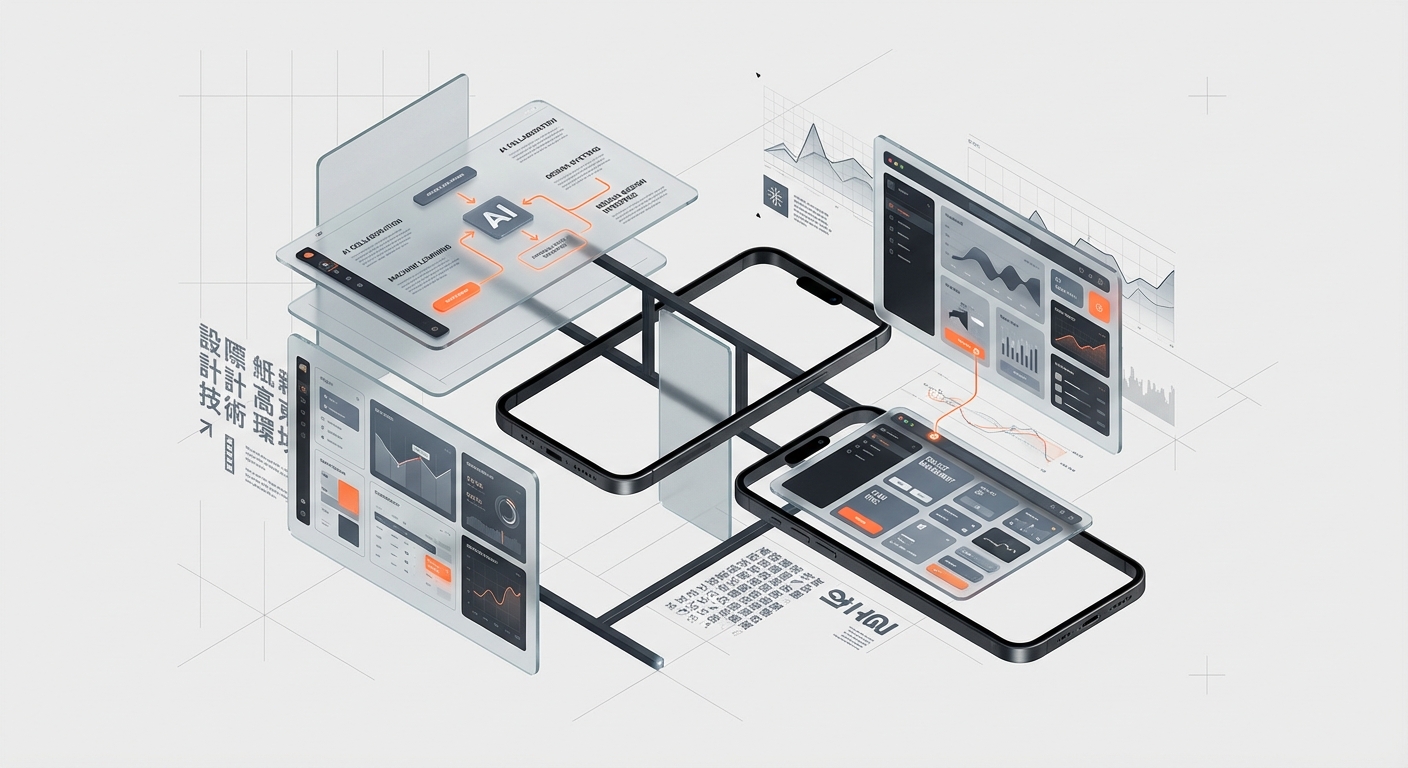
Our designers specify asset requirements once. The system generates all necessary versions automatically, light and dark mode variants, responsive breakpoints, platform-specific formats (iOS, Android, web), localized versions, and accessibility alternatives.
What used to require half a day of designer time per project now happens automatically, with higher consistency and fewer errors.
Intelligent Documentation Generation
Design handoff documentation, component specs, interaction notes, user flow descriptions, must be complete but takes significant time to create manually. We use AI to generate first-draft documentation directly from design files.
The AI analyzes Figma files, identifies components and their properties, documents interaction patterns, and generates written specifications. Designers then review and add context that requires human judgment, rationale for design decisions, edge case handling, implementation notes.
This hybrid approach produces more thorough documentation in a fraction of the time, improving developer handoff and reducing implementation questions.
Automated Design-to-Code Translation
Modern AI tools can convert designs to production-ready code with surprising accuracy. While we don’t ship AI-generated code without review, it provides developers with a strong starting point that captures layout, spacing, typography, and basic interactions.
At DesignX, designers and developers work together to review AI-generated code, refining it to match our technical standards and performance requirements. This reduces development time by 30-40% compared to building from scratch, allowing more time for polish and optimization.
Quality Assurance Across Touchpoints
Pre-launch QA for digital products involves checking hundreds of screens, interactions, and responsive behaviors. AI-powered QA tools can automatically test designs across devices, browsers, and screen sizes, flagging visual regression issues and interaction problems.
We combine automated AI testing with human QA, using AI to catch technical issues while human testers evaluate experiential quality. This layered approach catches more issues earlier, reducing post-launch fixes and client revisions.
Real Results: Speed and Quality Improvements
Measurable Time Savings Across Project Phases
Since integrating AI in design agency workflow processes, we’ve tracked measurable improvements across every project phase. Discovery timelines have decreased by 45%, design iteration cycles are 35% faster, and delivery preparation takes 40% less time.
These aren’t marginal gains, they’re significant changes that allow us to deliver more value within the same project budgets. Clients receive more exploration, more iterations, and more complete deliverables without extended timelines or increased costs.
Quality Improvements From AI Augmentation
Speed without quality is worthless. What surprised us most about design agency automation wasn’t just the time savings, it was the quality improvements. When designers aren’t exhausted from repetitive tasks, they make better strategic decisions. When QA is automated, fewer errors reach clients. When documentation is complete, implementations match design intent more accurately.
Our client satisfaction scores have increased 23% since adopting AI workflows. Project revision requests have decreased by 31%. These metrics confirm that AI augmentation improves both efficiency and outcome quality.
Competitive Advantage in Client Acquisition
Agency AI adoption has become a differentiator in new business conversations. When prospects learn about our AI-augmented workflows, they understand we can deliver more strategic value in less time, a compelling advantage in a competitive market.
We’ve won projects specifically because clients wanted to work with an agency at the forefront of industry evolution. Our ability to articulate how we use AI strategically, not as a cost-cutting measure but as a quality-amplification tool, resonates with sophisticated clients.
Team Satisfaction and Retention Benefits
Perhaps the most unexpected benefit of how agencies use AI successfully has been team satisfaction. Designers appreciate spending more time on creative and strategic work instead of repetitive production tasks.
Our team retention has improved significantly since implementing AI workflows. Exit interviews consistently mentioned excessive repetitive work as a pain point. AI tools have directly addressed this concern, improving both work quality and designer happiness.
What AI Can’t Replace (And Shouldn’t)
Strategic Thinking Requires Human Judgment
AI can process data and identify patterns, but it can’t make strategic decisions that balance business goals, user needs, technical constraints, and brand positioning. That requires human judgment informed by experience, context, and intuition.
At DesignX, every AI recommendation passes through human strategic review. We use AI to expand our options and accelerate execution, but humans make the decisions that determine project success.
Empathy Is Fundamentally Human
Understanding user emotions, motivations, and unspoken needs requires human empathy. AI can analyze behavioral data and sentiment, but it can’t understand what it feels like to struggle with a confusing interface or feel delighted by a thoughtful interaction.
Our designers and researchers bring empathy to every project, seeing beyond data to understand the human experience we’re designing for. AI informs this understanding but can’t replace it.
Taste Is Learned, Not Computed
Design taste, knowing what works, what feels right, what communicates effectively, comes from years of experience, cultural awareness, and aesthetic development. AI can generate variations and suggest options, but it can’t develop or apply design taste.
Design agencies using AI successfully understand this distinction. We use AI to generate options and accelerate execution, but human designers make aesthetic decisions that determine whether a design feels premium, trustworthy, playful, or sophisticated.
Client Relationships Depend on Human Connection
Clients hire agencies for expertise, yes, but also for partnership, communication, and trust. These relationship elements are fundamentally human. AI can improve our work product, but it can’t replace the strategic partnerships we build with clients.
We’ve found that transparent communication about our AI workflows actually strengthens client relationships. When clients understand how we use AI to deliver better work faster, they appreciate our innovation and strategic approach.
How DesignX Integrates AI: Our Specific Workflows
Discovery: AI-Assisted Research Synthesis
Our discovery process begins with stakeholder interviews, user research, and data analysis. We record all interviews (with permission) and use AI transcription services to generate searchable transcripts within hours.
These transcripts feed into our AI research analysis tool, which identifies themes, extracts key quotes, and maps findings to user journey stages. Our research team reviews the AI-generated synthesis, validates insights against their qualitative impressions, and shapes findings into strategic recommendations.
This workflow reduced our research synthesis time from 8-10 days to 3-4 days, giving us more time for strategic planning and client collaboration.
Design: Rapid Wireframe Generation
For early-stage wireframes, speed matters more than pixel perfection. We use AI-powered wireframe generation tools where designers describe user flows and page requirements in natural language.
The AI generates initial wireframe layouts that capture the structural concepts. Designers then refine these wireframes, adjusting hierarchy, flow, and content organization based on strategic priorities and user needs.
This approach lets us explore 3-4 times as many structural options early in the design process, leading to stronger final solutions informed by broader exploration.
Design: AI Copywriting for Interface Text
Every DesignX project includes complete interface copywriting, buttons, labels, error messages, empty states, tooltips, onboarding instructions. This text is crucial for usability but time-consuming to write comprehensively.
We’ve built a workflow where UX writers provide our AI copywriting tool with brand voice guidelines, user context, and functional requirements for each interface element. The AI generates 5-8 options for each element, which writers review, refine, and approve.
This workflow ensures complete interface copy across every project state while reducing writing time by approximately 50%.
Delivery: Automated Asset Export and Documentation
Our delivery phase previously required 1-2 full days of designer time for asset export and documentation. We’ve now automated most of this process using AI-powered export tools and documentation generators.
Designers specify export requirements once, file formats, naming conventions, size variants, platform requirements. The system generates all assets automatically and creates initial documentation from the design files.
Designers review the output, add context and implementation notes, and approve the final deliverable package. This workflow reduced delivery prep from 2 days to 4-6 hours while improving consistency and completeness.
Frequently Asked Questions
Does using AI make design work less creative?
No, quite the opposite. AI in design agency workflow processes eliminates repetitive, mechanical tasks, giving designers more time and energy for creative work. When you’re not exhausted from exporting 50 asset variants or writing your tenth error message of the day, you have more capacity for strategic thinking and creative problem-solving.
At DesignX, our designers report feeling more creative since adopting AI workflows because they spend more time on work that genuinely requires human creativity and less time on production mechanics.
How do you ensure AI-generated work maintains quality standards?
Every AI output at DesignX passes through human review and refinement. AI generates options, accelerates execution, and handles repetitive tasks, but humans make all final decisions about what ships to clients.
We treat AI as a junior team member, capable and fast, but requiring oversight and direction from experienced designers and strategists. This approach maintains quality while capturing efficiency benefits.
Don’t clients worry that they’re paying for AI work instead of human expertise?
Transparency solves this concern. We’re upfront about how agencies use AI in our workflows, positioning it as a competitive advantage that allows us to deliver more value.
Clients appreciate that AI enables us to explore more creative directions, iterate faster, and deliver more complete documentation, all of which directly benefit them. They’re paying for outcomes and expertise, not hours of repetitive work.
What AI tools do you actually use at DesignX?
Our AI-powered design process incorporates multiple specialized tools: AI transcription services for research interviews, pattern recognition tools for research synthesis, AI-assisted wireframe generators, copywriting tools trained on brand voice, accessibility checking tools, and asset export automation.
We continuously evaluate new tools but integrate them slowly, ensuring they genuinely improve quality and efficiency before adopting them agency-wide.
How long did it take to implement AI workflows across your agency?
Agency AI adoption at DesignX was gradual, taking approximately 18 months to fully integrate across all project phases. We started with low-risk applications like transcription and asset export, then expanded to more complex workflows like research synthesis and design generation as we built confidence and refined processes.
Rushing AI implementation creates chaos. We focused on one project phase at a time, trained the team thoroughly, and refined workflows based on real project feedback.
Will AI eventually replace human designers?
No. Design requires strategic thinking, empathy, aesthetic judgment, and client relationship skills that AI can’t replicate. Design agencies using AI successfully understand that AI is a tool for augmentation, not replacement.
The designers who will thrive in the AI era are those who embrace these tools to amplify their capabilities while developing the uniquely human skills that AI can’t replicate, strategy, taste, empathy, and creative vision.
How do you train designers to use AI tools effectively?
We approach AI tools like any other professional skill, through training, practice, and mentorship. New team members receive onboarding on our AI workflows, including when to use AI tools, how to review and refine AI output, and when human judgment should override AI suggestions.
We also conduct monthly team reviews where designers share AI workflow tips, discuss challenges, and refine our processes based on collective learning.
Conclusion: The AI-Augmented Agency Advantage
The future of design agencies isn’t about choosing between AI and human creativity, it’s about strategically combining both to deliver exceptional work efficiently. Design agencies using AI thoughtfully are outperforming competitors, winning more clients, and creating better work experiences for their teams.
At DesignX, AI integration has transformed how we work without changing who we are. We’re still a team of strategic designers and researchers who care deeply about craft, user experience, and client success. AI simply allows us to spend more time on the work that matters and less time on mechanical tasks that don’t require human judgment.
The agencies that will lead the industry forward are those that embrace AI in design agency workflow processes while maintaining the human expertise, creative vision, and strategic partnership that clients value most.
Ready to Work With an AI-Augmented Agency?
If you’re looking for a design partner that combines modern AI capabilities with high-quality human expertise, let’s talk. DesignX delivers the strategic thinking, creative excellence, and execution speed that modern brands need to stay competitive.
Schedule a discovery call to learn how our AI-augmented workflows can accelerate your next design project without compromising on quality or strategic value.