
TL;DR: Design system governance enterprise work is the operating model that keeps components, tokens, documentation, and shipped UI aligned across large product teams. The winning model is rarely pure central control or pure committee work. It is a small core team with named product champions, clear decision rights, release rules, adoption data, and an exception path teams can trust.
- Use governance to decide who owns components, who approves change, and how exceptions expire.
- Track adoption, component detachment, token overrides, accessibility defects, and release health.
- Pick centralized, federated, or hybrid governance based on product sprawl, team maturity, and engineering support.
- Treat the design system like product infrastructure, not a static UI kit.
Design system governance enterprise teams need more than a shared Figma library. They need a decision system. Without one, the design system becomes a suggestion box: designers detach components, engineers fork patterns, product teams ship near-duplicates, and leadership wonders why the “single source of truth” feels optional.
We see this pattern in enterprise UX work all the time. The first version of a system earns applause because it cleans up visible mess. The second phase is harder because adoption, ownership, accessibility, documentation, and code parity all have to work at once. That is governance.
At DesignX, our bias is simple: governance should reduce friction for good decisions. If it only adds meetings, teams route around it.
Design system governance enterprise teams should define before scaling
Governance is the set of rules, roles, rituals, and metrics that keep a design system useful after launch. It answers six questions:
- Who owns the system roadmap?
- Who can approve a new component, token, variant, or breaking change?
- How does a product team request a pattern the system does not cover?
- What quality gates must a contribution pass before release?
- How are teams told about changes, migration work, and deprecations?
- Which data proves the system is used in shipped products?
The mistake is treating governance as bureaucracy. Good governance is closer to product management. It turns scattered requests into a backlog, gives teams a path for edge cases, and protects the system from slow decay.
The 2026 zeroheight Design Systems Report gives useful context. It surveyed 147 design system practitioners, with 39% from companies above 5,000 employees and 25% from companies between 1,000 and 5,000 employees. The same report found 83% of organizations had a dedicated design system team in 2026, up from 78% in 2025, yet 61% of design system teams said they did not have enough people to meet their goals. That gap is where governance matters. A team can have a design system function and still be outmatched by enterprise demand.
For DesignX clients with large catalogs, multi-brand portfolios, or complex B2B workflows, this is familiar. Our Klein Tools work involved a product catalog ecosystem with 40,000+ SKUs, where consistency had to survive real dealer, product, and content constraints. Enterprise systems fail when the model assumes every team works from a clean canvas.
Choose the governance model that matches your enterprise reality
Most enterprise teams land in one of four operating models. The right choice depends less on design taste and more on product sprawl, engineering bandwidth, and trust between central and product teams.
| Model | Best fit | Main risk | Governance move |
|---|---|---|---|
| Centralized | Smaller product portfolios, early system rebuilds, strong need for consistency | The core team becomes a bottleneck | Set service levels for requests and publish a monthly release plan |
| Federated | Large product portfolios with mature product designers and engineers | Decision drift and unclear accountability | Use product champions with defined time allocation and decision rights |
| Hybrid | Most enterprise teams with many products and a small core system group | Too many voices, slow reviews | Keep core foundations centralized and product patterns federated |
| Sponsored core team | Companies rebuilding a neglected system or merging brands after growth | Short-term cleanup without a long-term owner | Pair outside support with internal maintainers from day one |
Pure centralization looks clean on a slide, but it can miss product reality. Pure federation feels inclusive, but it often collapses when contribution work loses to feature work. For enterprise teams, hybrid is usually the safer default: a core team owns foundations, while product champions bring real use cases into the system.
If your design system supports one SaaS product, centralization may be enough. If it supports multiple business units, platforms, or brands, use hybrid governance. If every business unit already has its own UI language, start with a sponsored core team that can audit, consolidate, and hand off the model to internal owners.
The DesignX governance stack for enterprise design systems
We use a five-layer stack when evaluating design system governance enterprise programs. It keeps the conversation grounded in operating choices, not tool preferences.
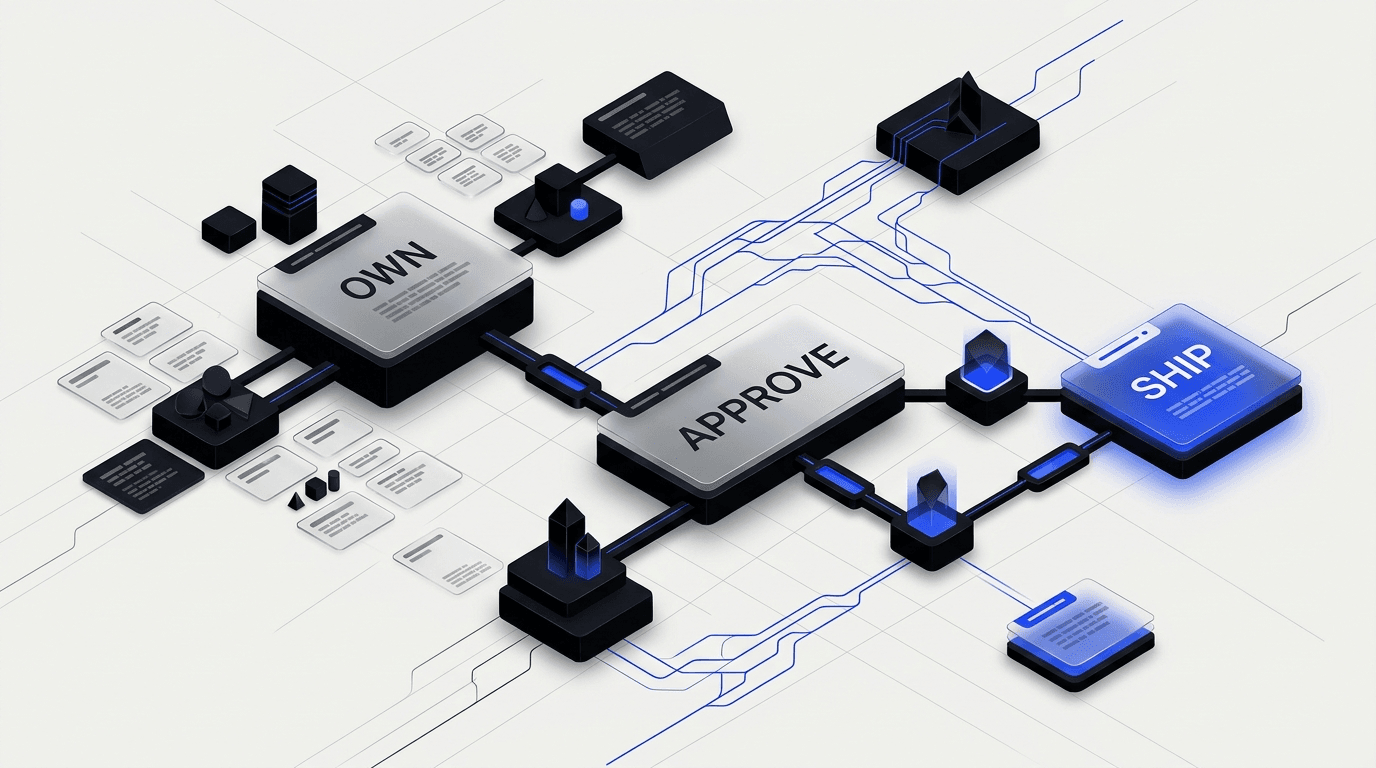
1. Ownership layer
Name the accountable owner for the system. Not “design.” Not “engineering.” A person or small group. The owner controls the roadmap, conflict path, release cadence, and system health report.
Then define product champions. Champions are not casual volunteers. They represent a product area, bring use cases into the system backlog, test changes against live product needs, and share release notes with their teams.
2. Decision layer
Every component needs a decision path. A simple RACI works:
- Responsible: designer and engineer preparing the contribution.
- Accountable: design system owner.
- Consulted: product champion, accessibility reviewer, engineering lead.
- Informed: product teams using the affected component.
This prevents the most expensive enterprise failure mode: everyone gives feedback, but no one decides.
3. Contribution layer
Create one path for change. It should cover new components, variants, token changes, documentation edits, accessibility fixes, and deprecations.
A clean component lifecycle looks like this:
- Propose: the team submits the use case, evidence, affected products, and reuse potential.
- Review: the core team checks overlap with existing patterns and decides if the request belongs in the system.
- Build: design and code move together, with tokens, states, responsive behavior, and accessibility covered.
- Document: guidance explains when to use it, when not to use it, and common mistakes.
- Release: teams get a version note, migration guidance, and support window.
- Measure: usage, overrides, issues, and feedback inform the next release.
The contribution path should be short enough that teams use it. If asking for a component feels slower than building a custom one, governance has already lost.
4. Quality layer
Governance needs gates. The gates should be practical and visible:
- Design token compliance for color, spacing, typography, radius, and elevation.
- Component states for default, hover, focus, active, disabled, loading, error, and empty states where relevant.
- Accessibility checks against WCAG 2.2, including keyboard behavior, focus order, contrast, names, and error messaging.
- Code parity between design library and production component.
- Documentation for usage, props, content rules, and known limits.
The W3C published WCAG 2.2 as a Recommendation on December 12, 2024. Enterprise teams should treat accessibility rules as release gates, not late QA notes. That is especially true for finance, healthcare, government, and B2B software with complex workflows.
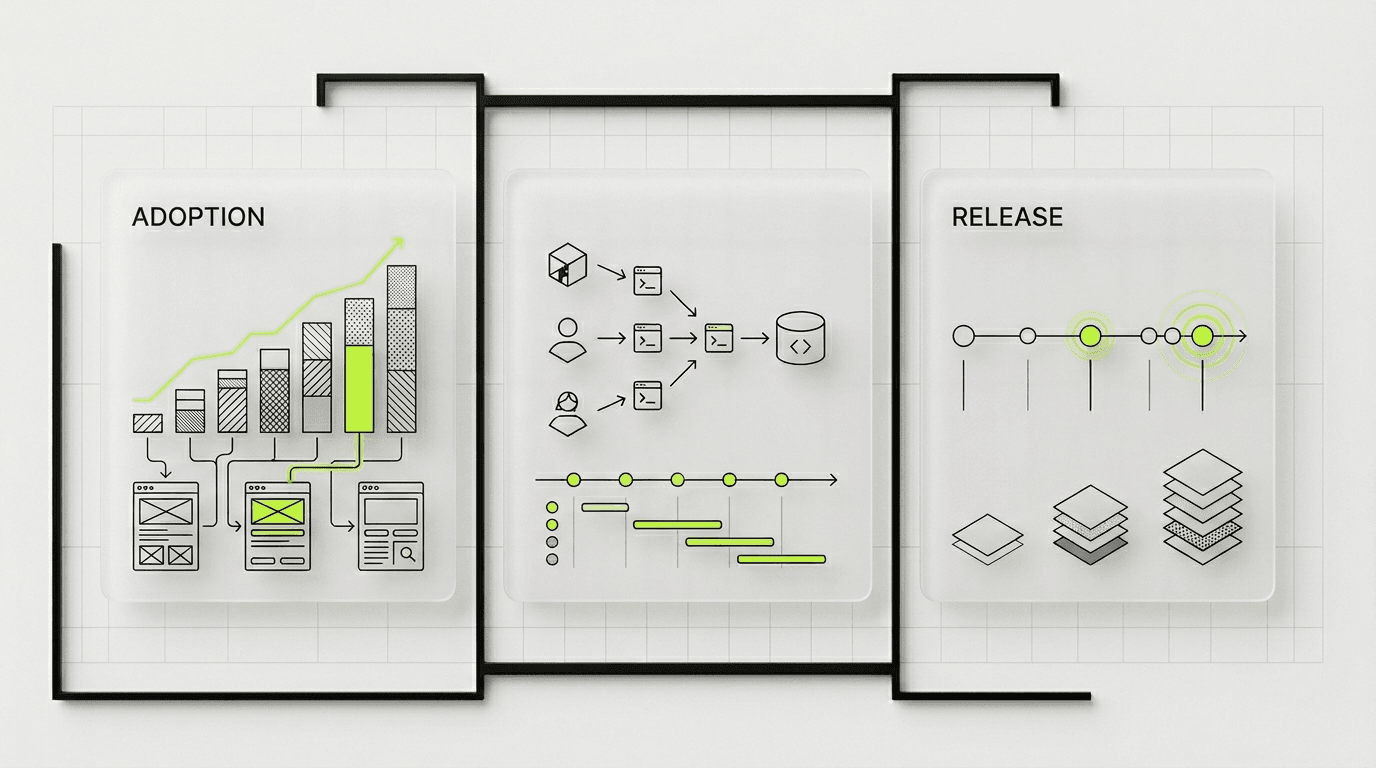
5. Measurement layer
Figma’s design system experiment found designers completed a task 34% faster when they had access to a relevant, current design system. Figma also notes that three-fourths of its enterprise customers use design systems across their whole organization. Those numbers are useful, but only if your own system is current, findable, and trusted.
Track metrics that tell you whether teams use the system in real work:
- Adoption: percentage of product files, repos, or surfaces using approved libraries.
- Component usage: top components, unused components, and patterns with high detachment.
- Token health: overrides, hard-coded values, and unauthorized theme drift.
- Request flow: time from request to decision, build, documentation, and release.
- Quality: accessibility defects, visual QA issues, and component bugs found after release.
- Support: documentation searches, unanswered questions, office hour topics, and Slack requests.
Metrics should create action. If a form field has high detachment, the answer is not to shame teams. The answer is to learn whether the component lacks a state, has poor documentation, or does not support a real enterprise use case.
A design system governance enterprise scorecard
Use this scorecard in a quarterly review. Rate each area from 1 to 5, then pick two areas to fix in the next 90 days.
| Area | 1 looks like | 5 looks like |
|---|---|---|
| Ownership | No clear owner, decisions happen in side channels | Named owner, champion group, escalation path |
| Contribution | Teams add patterns ad hoc | Single request path with intake criteria and service levels |
| Code parity | Figma and production drift apart | Design and code releases stay paired |
| Documentation | Docs explain what exists but not how to use it | Docs cover usage, edge cases, content, accessibility, and migration |
| Adoption | Usage is assumed | Usage is measured by team, product, and component |
| Exceptions | One-offs become permanent | Exceptions have owners, expiry dates, and migration plans |
| Accessibility | Checked late or only by QA | Built into component standards and release gates |
If your average score is below 3, do not start by redesigning the UI kit. Start by fixing ownership and contribution. A prettier library without a decision model will decay again.
Where enterprise governance usually breaks
The same problems appear across large teams.
Governance is launched as a document, not a behavior
A PDF cannot govern a system. Teams need rituals: intake review, contribution critique, accessibility review, release notes, migration support, and quarterly health checks.
The core team owns too much
If every decision waits for the central group, the central group becomes the reason teams avoid the system. Move product-specific patterns to champions, but keep foundations like typography, color, spacing, forms, navigation, and accessibility rules under core ownership.
Exceptions are invisible
Enterprise software needs exceptions. The problem is not the exception. The problem is an exception that has no owner, no expiry date, and no path back into the system.
Documentation is treated as cleanup
Docs are part of the component. If a pattern is not documented, it is not ready. This is why our design system documentation work treats usage guidance, examples, and maintenance notes as product assets.
Leadership asks for ROI but receives activity
Number of components is activity. Number of docs pages is activity. Enterprise leaders need better signals: faster production cycles, fewer UI defects, reduced design debt, cleaner onboarding, stronger accessibility, and higher adoption across key workflows.
How to start in the next 30 days
If the system already exists, do not pause product work for a six-month governance reset. Start with a thin operating model and prove it through one release cycle.
- Audit drift: review five high-traffic workflows and document component forks, token overrides, missing states, and accessibility issues.
- Name owners: assign a system owner, engineering partner, and product champions for the first two product areas.
- Publish decision rights: define who approves components, variants, tokens, breaking changes, and exceptions.
- Create intake: launch one request form with evidence fields, reuse potential, affected products, urgency, and decision deadline.
- Set release cadence: pick a monthly release window with changelog, migration guidance, and support hours.
- Measure one thing: start with adoption or component detachment. Add more metrics once teams trust the first one.
- Review with leadership: report what changed, where teams are blocked, and what capacity is needed next.
This is where a senior external partner can help. The value is not just producing components. It is getting leadership, design, engineering, and product aligned on the model that will keep those components alive.
How DesignX helps enterprise teams govern design systems
DesignX helps enterprise teams audit UX debt, rebuild design systems, clean up documentation, and define governance models that product teams can use. Our team brings senior design experience from Apple, Shopify, eBay, Bodybuilding.com, HP, Oura Ring, Panasonic, and Klein Tools, with $500M+ in revenue influenced through brand and product design work.
Governance is often tied to broader enterprise UX work. If your team is standardizing complex workflows, start with enterprise UX patterns. If the system supports internal tools, review B2B UX design. If dashboards are a major surface, our SaaS dashboard design guide gives product-specific context. If you are deciding whether to bring in outside help, compare models in our design agency pricing guide.
Design system governance enterprise work should end with a system teams trust, not a theater of approvals. The measure is simple: product teams can ship faster, users see more consistent interfaces, engineers have fewer one-off builds, and leaders can see where the system needs investment.
Ready to make your enterprise design system easier to adopt and harder to break? Let’s talk about UX and design-system help from DesignX: designx.co/#pricing.
FAQ: design system governance for enterprise teams
What is design system governance in an enterprise?
Design system governance in an enterprise is the operating model for how UI components, design tokens, documentation, code, and usage rules are owned and changed. It defines decision rights, contribution paths, release gates, exception rules, and adoption metrics so the system stays useful across teams.
Which governance model is best for enterprise design systems?
Most enterprise teams should start with a hybrid model. A small core team owns shared foundations such as tokens, typography, forms, accessibility, and release quality, while product champions help evaluate product-specific patterns. This gives the system enough control to stay consistent and enough product input to stay usable.
How do you measure design system adoption?
Measure adoption through library usage, component insertions, detachment rates, token overrides, code package usage, documentation searches, and product surfaces using approved components. Pair the data with interviews. A low adoption number tells you where to look, but teams explain why it is happening.
Who should own design system governance?
A named design system owner should be accountable, with a design lead, engineering partner, product champions, and accessibility reviewer involved in decisions. Avoid shared ownership with no final decision-maker. Enterprise systems need broad input, but they also need one clear path to a decision.
How often should an enterprise design system release updates?
Monthly releases work well for many enterprise systems because they create a predictable rhythm without overwhelming product teams. Urgent accessibility or production fixes can ship faster. Breaking changes should include a migration plan, support window, and clear deadline for old pattern removal.
How do you prevent design system drift?
Prevent drift by pairing Figma and code releases, reviewing token overrides, requiring approved components in design QA, tracking exceptions, and measuring component detachment. Drift is usually a workflow issue. Fixing it requires better contribution paths and clearer release rules, not more visual policing.