
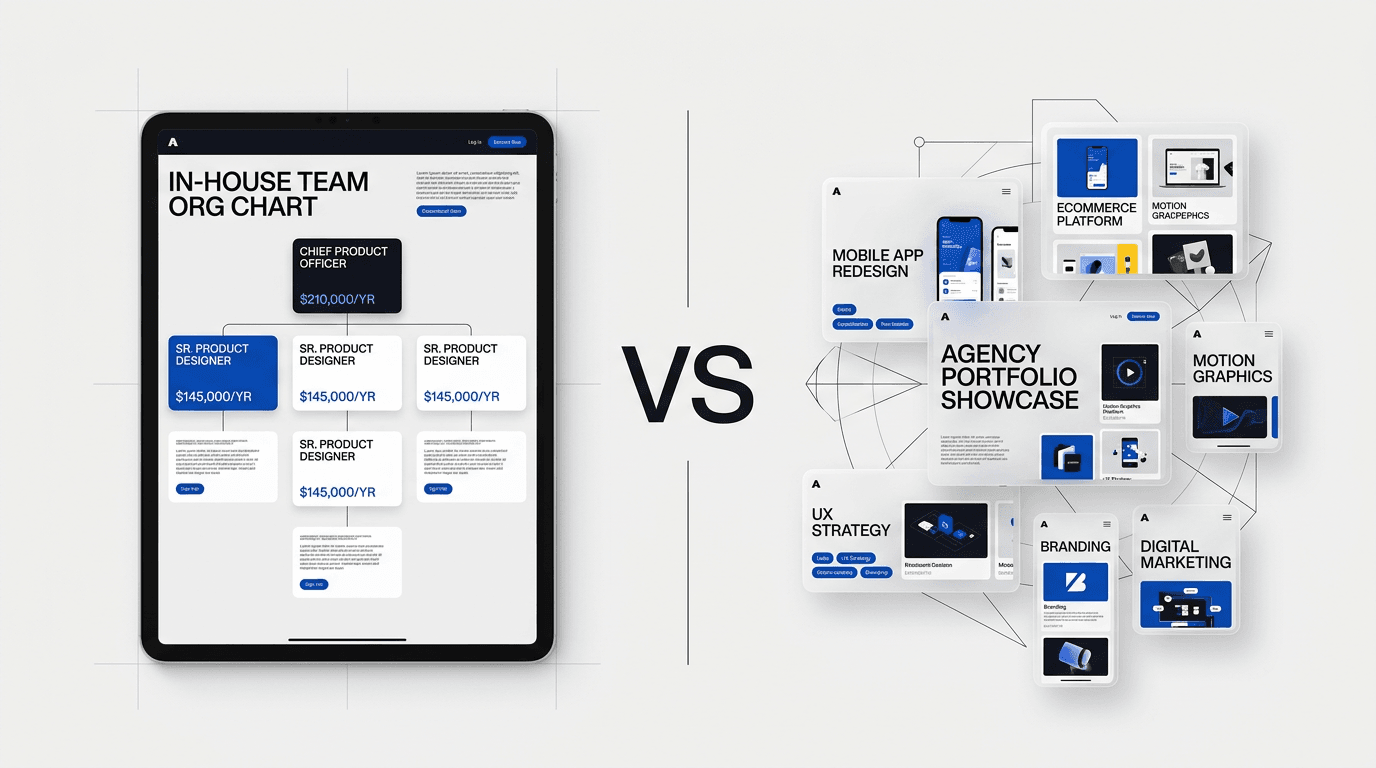
Deciding between an in-house design team and a design agency is not a simple choice. The decision depends on specific needs, true costs, and project scope.
The Illusion of Control: Design Agency vs. In-House Design Team
Many business leaders ask if they should build an in-house design team or hire a design agency. They often frame it as a simple “either/or” choice. From our perspective, after shipping hundreds of projects, that’s the wrong starting point. The real question is about understanding your specific needs, the true costs, and the capabilities required to meet your business goals. It’s not about control; it’s about impact.
The choice between a design agency vs in-house design team isn’t static. It evolves as companies grow, as projects change, and as markets shift. We’ve seen Fortune 500 companies try to do everything in-house and then come to us for specialized projects. We’ve also seen startups try to manage multiple agencies and realize they need a core internal team. There are clear advantages and disadvantages to each model, and understanding them helps you make a decision that actually delivers results.
The Real Cost of In-House Design
The sticker price of an agency project or retainer often makes leaders pause. They see a flat fee, say $15,000 for a sprint or $9,700 a month for fractional work, and compare it to a designer’s salary. This comparison is fundamentally flawed. It ignores the fully-loaded cost of an employee.
Consider a senior product designer. Their base salary in a competitive market might be $140,000. That’s just the start. Add employer-paid taxes, health insurance, retirement contributions, and other benefits, and you’re typically looking at another 25-40%. So, that $140,000 salary quickly becomes $175,000 to $196,000 before they even open a design tool.
But the costs don’t stop there. Think about:
- Recruitment fees: Headhunters can charge 15-25% of the first year’s salary. If you’re doing it yourself, factor in HR team time, interview cycles, and lost productivity during the search.
- Software licenses: Figma, Adobe Creative Suite, Sketch, prototyping tools, project management software. These add up, often hundreds or thousands of dollars per designer per year.
- Hardware: High-end workstations, monitors, tablets. Design work demands powerful machines.
- Training and development: Conferences, online courses, workshops. Good designers need to stay current.
- Office space and utilities: Even if remote, there are overhead costs associated with managing an employee.
- Management overhead: Someone needs to manage, mentor, and direct the design team. This is a significant time investment from a manager or director who also has a fully-loaded cost.
- Lost productivity during onboarding: It takes weeks, sometimes months, for a new hire to become fully productive and integrated into a company’s culture and processes.
When you add all these up, a $140,000 salary can easily translate to a fully-loaded cost of $250,000 to $300,000 per year. And that’s for one designer. A small in-house team of four or five designers, plus a design lead, can easily cost $1.5 million or more annually. This makes our agency’s project fees, which cover a team with varied specializations and no hidden costs, look like a different kind of investment.
Capability and Specialization: Breadth vs. Depth
The capabilities you gain from a design agency vs in-house design team are fundamentally different.
Agency: Breadth, Fresh Perspectives, and Specialized Expertise
Agencies like DesignX are generalists in a specific way. We have teams with deep expertise across many design disciplines: brand identity, UX/UI, industrial design, motion graphics, content strategy, print production. When Klein Tools needed a catalog redesign for over 40,000 SKUs, they didn’t have a team in-house equipped to handle that scale and complexity with print-ready precision. We brought a dedicated team with specific experience in information architecture, photography direction, and large-scale print production. That’s a niche specialization.
Similarly, for Oura Ring’s launch identity, we provided a fresh perspective on a new product in a burgeoning market. Our team wasn’t bogged down by existing corporate politics or preconceived notions. We could think freely and bring best practices from diverse industries.
Agencies offer:
- Diverse skill sets: Access to a wide range of design specialists without needing to hire each one individually.
- External perspective: Unbiased views, not influenced by internal history or assumptions.
- Exposure to best practices: Experience from working with many clients across different industries.
- Scalability: We can quickly assemble a team for a large project or scale down when the immediate need passes.
In-House: Depth, Consistency, and Institutional Knowledge
An in-house design team, on the other hand, builds deep institutional knowledge. They understand your product, your users, your internal processes, and your brand’s unique voice intimately. They live and breathe your company culture every day. This leads to:
- Deep product knowledge: A detailed understanding of the product roadmap, technical constraints, and user feedback over time.
- Brand consistency: They act as guardians of the brand identity, ensuring everything aligns with established guidelines.
- Cultural alignment: They are part of the company culture, which can lead to smoother collaboration with other internal teams.
- Long-term vision: They can work on iterative improvements and build design systems that grow with the product.
If you need someone to manage your established design system, update UI components, and maintain brand consistency across dozens of product features week after week, an in-house team is often the right answer. But if you need to redefine your brand or launch a complex new product category, like HP did with a specific line of printers where we led the UI/UX, an agency can bring the concentrated horsepower and specialized perspective.
Speed and Agility: Ramping Up vs. Sustained Momentum
The speed at which design work can be executed also differs significantly between a design agency vs in-house design team.
Agency: Quick Starts and Project Sprints
Agencies are designed for rapid deployment. When you engage us, we can often assemble a team and start work within days or a couple of weeks, depending on project complexity. There’s no lengthy hiring process, no onboarding. We’re already equipped with the tools, processes, and people. This makes agencies ideal for:
- Time-sensitive projects: A product launch, a rebrand with a tight deadline, or a critical user experience overhaul.
- Spikes in workload: When your existing team is at capacity, an agency can absorb the overflow without hiring permanent staff.
- Discovery phases: Running a design sprint to validate an idea or explore new product directions, as popularized by Google Ventures, is something agencies excel at. We can come in, focus intensely for a few weeks, and deliver actionable insights.
The drawback is that once the project ends, the agency team disbands. You lose that direct connection, though a good agency will ensure a thorough hand-off.
In-House: Consistent Iteration and Ongoing Support
An in-house team, once established, provides a consistent, ongoing presence. They are there for daily stand-ups, continuous iteration, and long-term product maintenance. This is essential for:
- Product development cycles: Integrating design directly into agile development processes.
- Maintaining design systems: Evolving and documenting component libraries and guidelines.
- Iterative UX improvements: Constantly refining user flows based on feedback and analytics.
- Building internal relationships: Fostering collaboration with engineering, product management, and marketing over time.
The trade-off here is the time it takes to build this team. Hiring a senior designer can take 3-6 months. Getting them fully productive takes longer. If you need something done yesterday, an in-house hire won’t be the answer.
The Hybrid Design Model: Getting the Best of Both Worlds
For many companies, the most effective approach is not an “either/or” but a “both/and.” This hybrid model combines the strengths of a design agency vs in-house design team. It’s often the strategy we recommend to our larger clients, like HP or Bodybuilding.com, who have established internal teams but need specialized support.
Here’s how a hybrid model often works:
- In-house team: Focuses on daily product iteration, maintaining the existing design system, and ensuring brand consistency across current offerings. They are the brand guardians and the day-to-day executors.
- Design agency: Brought in for specific, high-impact projects. This could include a new product launch, a major rebrand, a complex user research initiative, or exploring entirely new market segments. They act as an extension, bringing specialized skills that the internal team might not possess or that are not needed full-time.
For example, DesignX might partner with a company’s internal team to lead a design sprint for a new feature concept, then hand off validated designs for the in-house team to implement and maintain. Or, we might handle a complete brand identity refresh, providing the new guidelines and assets for the internal team to apply across all touchpoints.
This model allows companies to scale their design capabilities up or down as needed, without the fixed overhead of hiring for every possible design specialty. It provides fresh external perspectives while maintaining internal consistency and deep product knowledge.
When to Switch Your Design Approach
The ideal balance between a design agency vs in-house design team isn’t fixed. It shifts with your company’s stage and needs.
When to Lean on an Agency:
- Early-stage startup: You need a brand identity, a minimum viable product (MVP) design, or a website quickly and cost-effectively. You don’t have the funds or the sustained need for a full-time designer.
- Growth stage, specific projects: Your in-house team is busy, but you have a new initiative that requires a specialized skill set (e.g., motion graphics, complex industrial design, or a specific type of user research).
- Rebranding or major strategic shifts: You need an unbiased, external perspective and concentrated creative power to redefine your brand or product vision.
- Budget flexibility: You prefer project-based costs over fixed salaries and benefits.
When to Build or Grow an In-House Team:
- Consistent product development: You have a steady stream of ongoing design work, iterative improvements, and maintenance.
- Building a design system: You’re committed to creating and maintaining a scalable design system for long-term efficiency.
- Deep product immersion needed: Your product is complex, and an intimate understanding of its nuances and user base is critical for every design decision.
- Cultural integration: Design needs to be deeply embedded within your company’s daily operations and cross-functional teams.
The goal is to align your design resources with your business strategy. Regularly assess your design needs, your budget, and the current capabilities of your team. Don’t be afraid to adjust the balance. We’ve seen companies successfully transition from agency-heavy to a strong in-house team, and vice versa, depending on their evolving priorities. The key is to be intentional with your strategy.
Ready to build a design strategy that delivers real business impact? Contact DesignX to talk through your project.
Frequently Asked Questions
What should teams know about design agency vs. in-house design team?
Many business leaders ask if they should build an in-house design team or hire a design agency. They often frame it as a simple “either/or” choice. From our perspective, after shipping hundreds of projects, that’s the wrong starting point. The real question is about understanding your specific needs, the true costs, and the capabilities required to meet your business goals.
What should teams know about the real cost of in-house design?
The sticker price of an agency project or retainer often makes leaders pause. They see a flat fee, say $15,000 for a sprint or $9,700 a month for fractional work, and compare it to a designer’s salary. This comparison is fundamentally flawed. It ignores the fully-loaded cost of an employee.
What should teams know about breadth vs. depth?
The capabilities you gain from a design agency vs in-house design team are fundamentally different. Agency: Breadth, Fresh Perspectives, and Specialized Expertise Agencies like DesignX are generalists in a specific way. We have teams with deep expertise across many design disciplines: brand identity, UX/UI, industrial design, motion graphics, content strategy, print production. When Klein Tools needed a catalog redesign for over 40,000 SKUs, they didn’t have a team in-house equipped to handle that scale and complexity with print-ready precision.
What should teams know about ramping up vs. sustained momentum?
The speed at which design work can be executed also differs significantly between a design agency vs in-house design team. Agency: Quick Starts and Project Sprints Agencies are designed for rapid deployment. When you engage us, we can often assemble a team and start work within days or a couple of weeks, depending on project complexity. There’s no lengthy hiring process, no onboarding.
What should teams know about getting the best of both worlds?
For many companies, the most effective approach is not an “either/or” but a “both/and.” This hybrid model combines the strengths of a design agency vs in-house design team. It’s often the strategy we recommend to our larger clients, like HP or Bodybuilding.com, who have established internal teams but need specialized support. Here’s how a hybrid model often works: In-house team: Focuses on daily product iteration, maintaining the existing design system, and ensuring brand consistency across current offerings. They are the brand guardians and the day-to-day executors.